
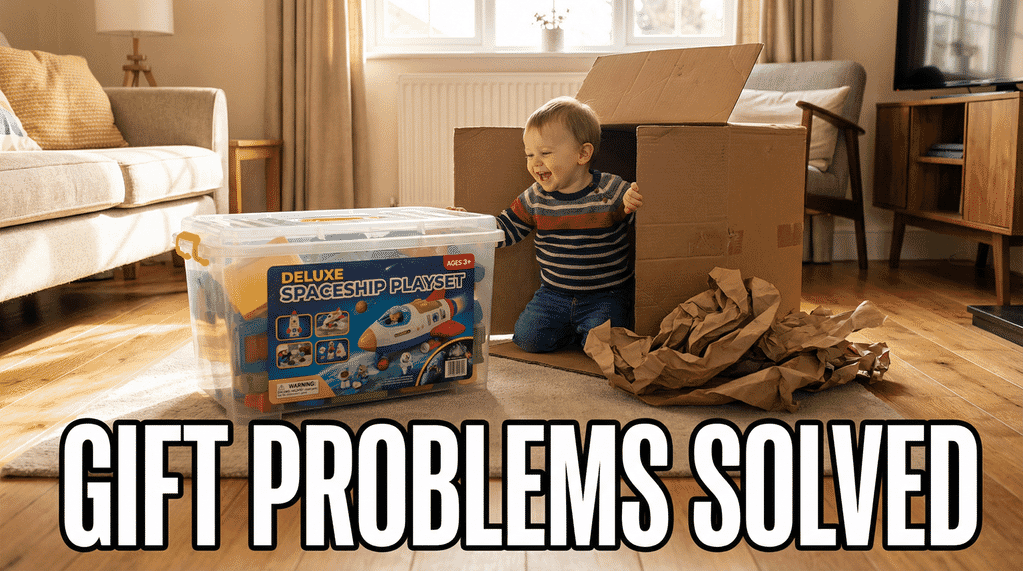
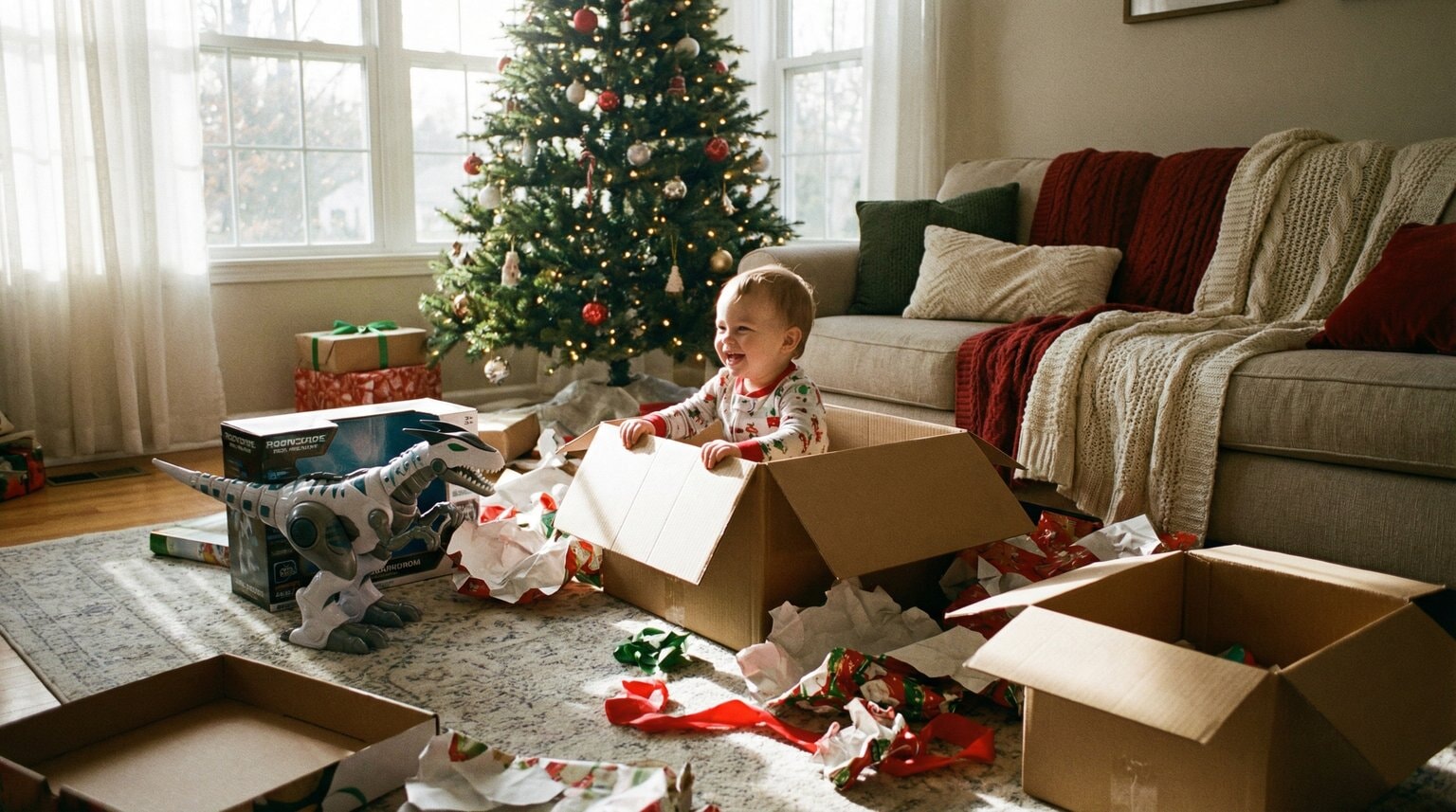
It’s 7:30 AM on Christmas morning. Your 4-year-old has ripped through eight presents in under five minutes and is now asking, “Is that all?” Meanwhile, your 8-year-old is crying because her sister got “more,” and your toddler has abandoned every gift to play with a cardboard box. The grandparents are watching, slightly hurt. You’re wondering where you went wrong.
You didn’t go wrong. This scene plays out in millions of homes every year—and here’s what the research actually shows about why it happens and what you can do about it.
Key Takeaways
- Children play with only 5% of their toys daily—fewer toys actually leads to longer, more creative play
- Use age-appropriate gift limits: 1-2 for toddlers, 4 gifts using the “want, need, wear, read” rule for preschoolers
- Redirect grandparents toward meaningful roles like “experience grandparent” rather than just setting limits
- Practice gratitude skills before gift occasions arrive—kids can’t use skills they haven’t rehearsed
- Experiences consistently bring greater lasting happiness than material gifts
Why Gift Overload Happens (The Problem Nobody Talks About)
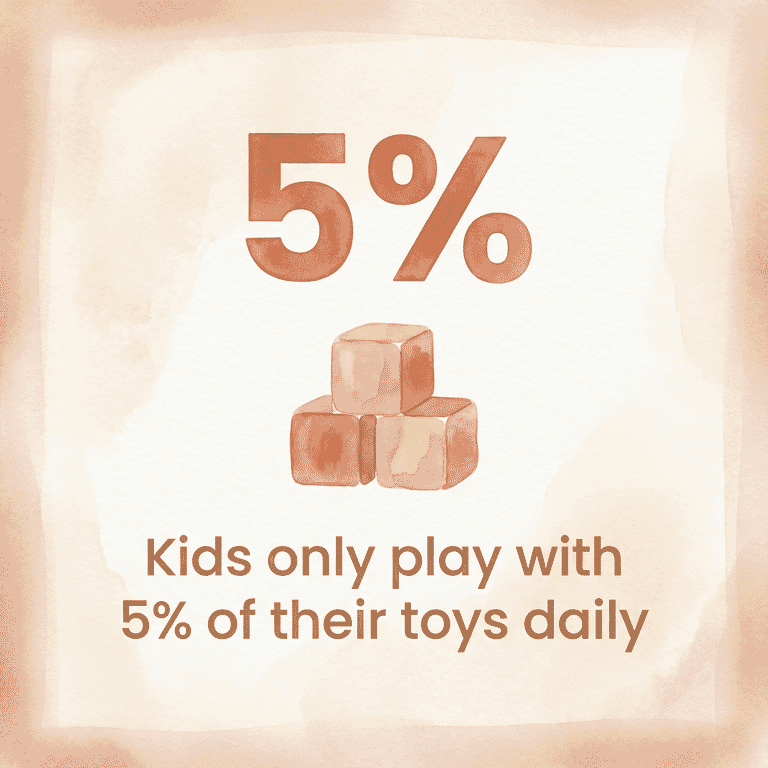
Let me start with a number that stopped me in my tracks: LSE researchers documented that the average child owns 236 toys. But here’s the part that really got my librarian brain spinning—parents report their children play with only 12 of those toys daily. That’s 5% utilization.
How did we get here?
Research from Carnegie Mellon and other universities reveals something called the “smile-seeking hypothesis.” Gift givers—grandparents, aunts, uncles, friends—focus on the moment of exchange. They want the biggest reaction, the widest eyes, the most enthusiastic shriek. Even if that pleasure is short-lived.
But receivers? They actually feel greater gratitude for gifts that bring longer-term enjoyment. This fundamental mismatch explains why toys pile up faster than interest fades.
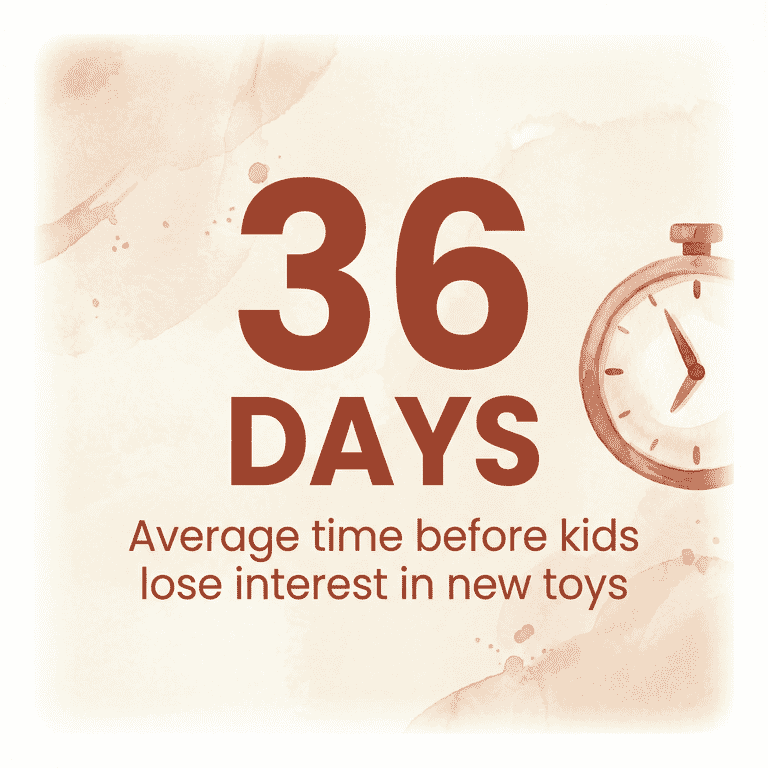
The same research found that children lose interest in new toys within just 36 days on average. Nobody in this scenario is the villain.
Grandparents aren’t trying to undermine your parenting. Your kids aren’t ungrateful. You haven’t failed. It’s a systemic mismatch between how givers think and what receivers actually need. Understanding the psychology behind gift-giving is the first step toward solving it.
The Real Costs of Too Many Gifts
What Happens to Development
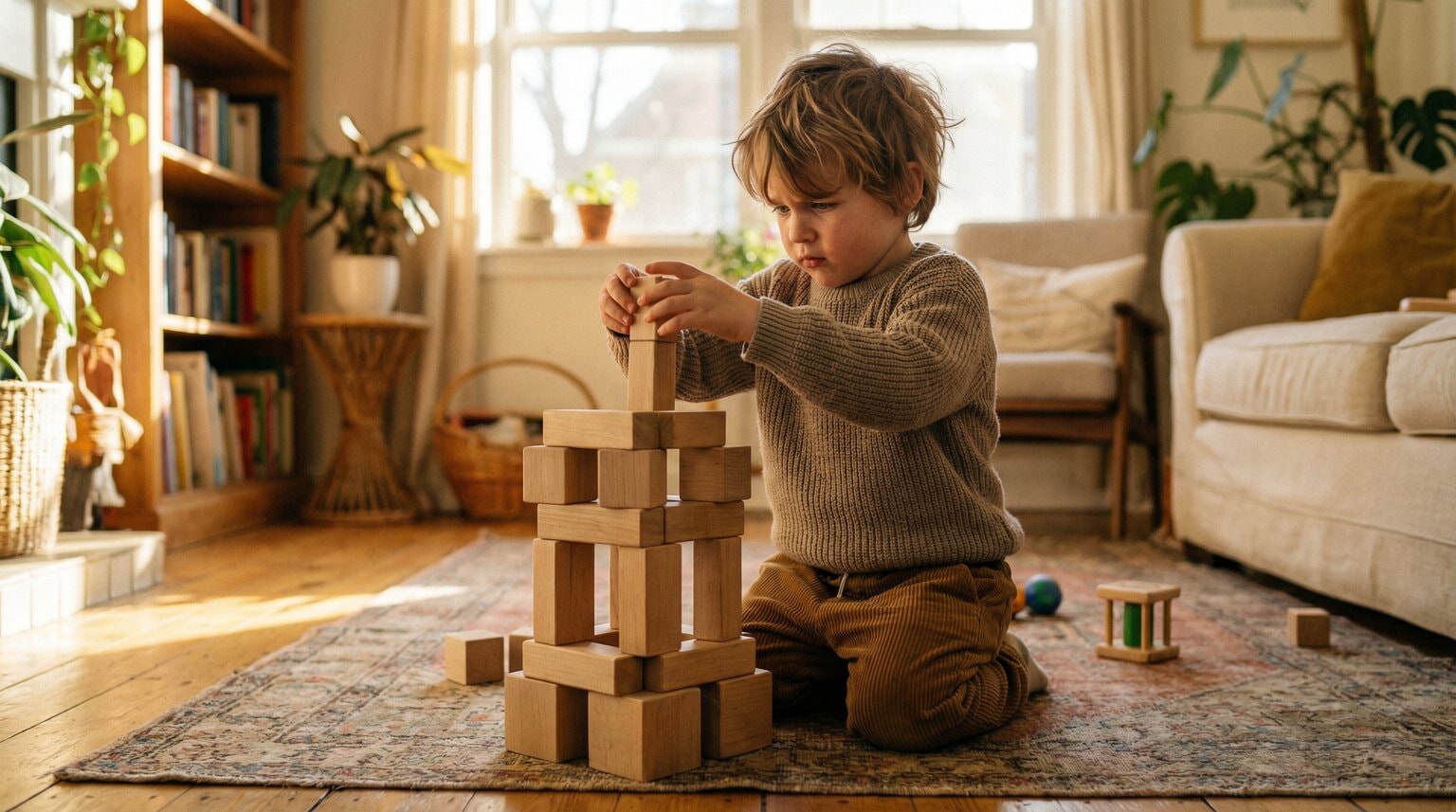
Research on child play behavior confirms what I’ve watched happen across all eight of my kids: when children have fewer toys, they play longer, in more varied ways, and with significantly more creativity. The opposite is also true—having more than 12 toys available to a toddler leads to shortened attention spans and less creative play.
This makes sense when you think about it. With too many options, children flit from thing to thing. With constraints, they dig deeper into what they have.
I’ve seen this in my own house. My 6-year-old will spend 45 minutes building elaborate worlds with a single set of wooden blocks. Hand her a mountain of toys, and she’s “bored” in ten minutes.
What Happens to Families
Gift overload creates invisible labor. UCLA Health calls it “mental load”—the behind-the-scenes cognitive and emotional work required to manage a household. Every toy that enters your home requires organizing, storing, rotating, and eventually disposing.
Then there are the relationship strains. Disagreements with your partner about gift philosophy. Tension with grandparents who show love through abundance. Sibling conflicts when one child perceives the other got “more.”
Research on giving dynamics shows that excessive gift quantities “can make others feel guilty or conflicted and can stimulate feelings of obligation.” When relatives give too much, parents often experience this guilt cycle—grateful for the love, stressed by the stuff.
What Happens to the Planet
Here’s one that genuinely surprised me: an estimated 80% of all toys end up in landfills, incinerators, or the ocean. Over a quarter of UK parents admit to discarding toys in perfect working condition. The LSE research estimates this could represent 162 million unused toys in the UK alone.
When my 15-year-old helped me clear out the playroom last spring, she pulled out toys she’d received at age 5—still in packaging, never opened. That moment changed how I think about gift-giving.
Age-by-Age Gift Guidelines
Here’s what you actually came for. These recommendations are based on developmental research, refined by what I’ve observed with children at every single one of these stages currently living in my house.
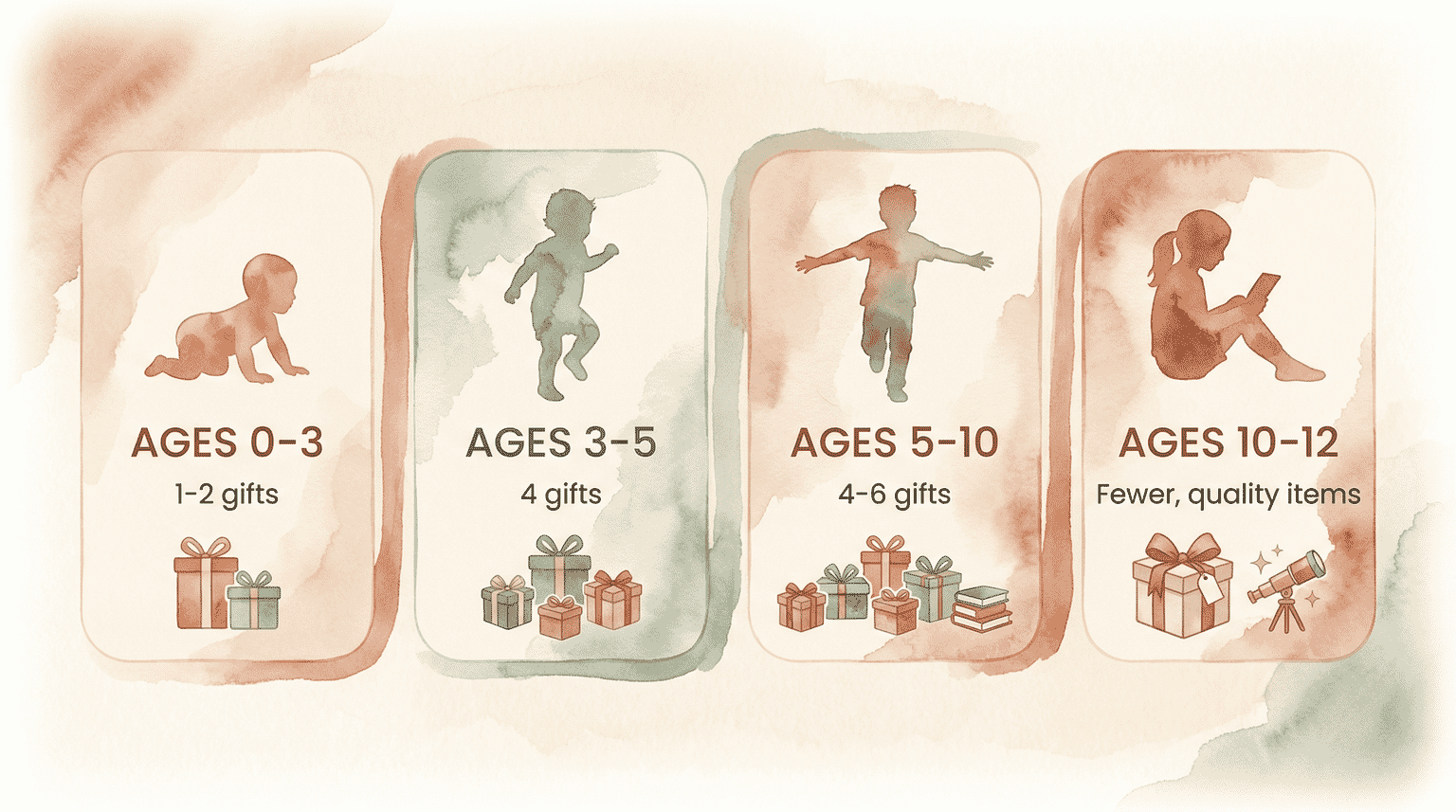
Developmental research suggests age-appropriate gift quantities:
- Infants and toddlers (0-3): 1-2 gifts maximum
- Preschoolers (3-5): 4 gifts using the “want, need, wear, read” rule
- Elementary age (5-10): 4-6 meaningful gifts across all givers
- Tweens (10-12): Focus on fewer, higher-quality items and experiences
Infants and Toddlers (Birth to Age 3)
Recommended gifts: 1-2 maximum
Young children don’t actually understand what presents are. They get excited by the excitement around them.
“What they care about is being with family, having the family’s attention, and of course the occasional yummy treat.”
— Dr. Corinne Masur, Clinical Psychologist
A mountain of gifts combined with demands to “open, open, open” can overwhelm rather than delight young children. Watch for signs: crankiness, appearing “wired,” meltdowns. These signal overstimulation.
My 2-year-old’s best Christmas gift last year? A $12 wooden puzzle she played with for six months. She also received plenty of other things from well-meaning relatives—most of which went directly into rotation storage because she was too overwhelmed to process them.
What actually works:
- Simple, sensory-rich items over complex toys
- Books for reading together
- Gifts that facilitate family interaction
Script for grandparents:
“At this age, [child’s name] gets overwhelmed by too much at once. She won’t remember the gifts, but she’ll remember being happy with you. Could we focus on one special thing you pick together?”
Preschoolers (Ages 3-5)
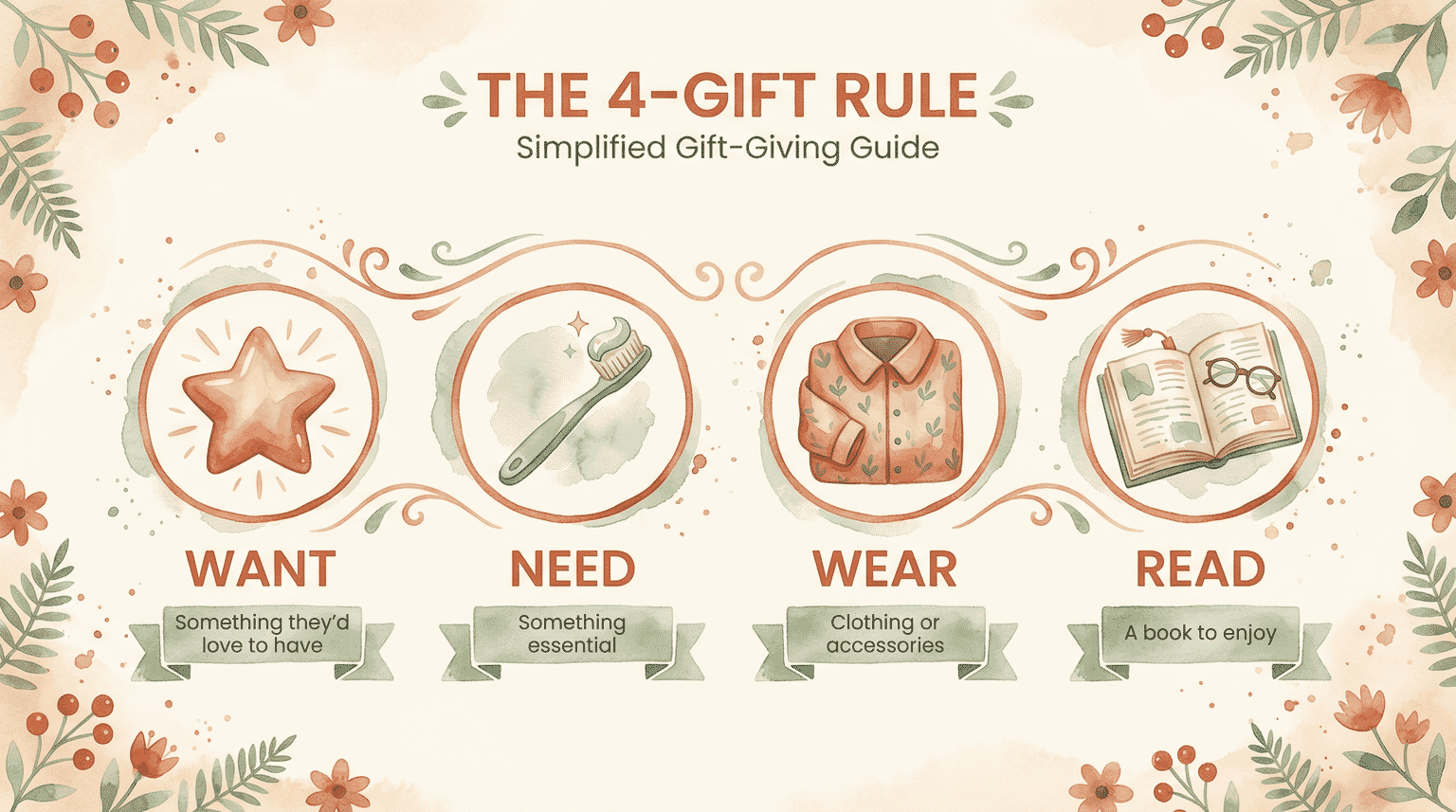
Recommended framework: The 4-gift rule—want, need, wear, read
Children this age are beginning to understand gift-giving concepts, but they’re still easily overwhelmed by quantity. They’re learning to express preferences but have limited capacity for genuine gratitude (more on that in a moment).
The 4-gift rule works beautifully here. One thing they want. One thing they need. One thing to wear. One thing to read. It’s enough to feel special without tipping into chaos. Pairing this with family gift traditions creates predictable rituals kids can count on.
What actually works:
- Experiences they’ll remember (zoo membership, class enrollment)
- Open-ended toys that grow with imagination
- Introducing the concept of choosing
Script for grandparents:
“We’re trying the 4-gift rule this year—one thing she wants, needs, wears, and reads. Would you like to pick one category? That way your gift is extra special because it’s THE want gift from Grandma.”
Teaching gratitude at this age:
Practice makes perfect—even with manners.
“We can’t expect ourselves to use a skill when we need it if we haven’t practiced that skill.”
— Dr. Becky Kennedy, Clinical Psychologist
Dr. Kennedy recommends what she calls “dry run” practice. Before gift occasions, give your child a silly practice gift—even a rock in a box—and rehearse polite responses together. Focus on “thank you” as habit, not forced emotion. And model it yourself—let them see you receiving gracefully.
Early Elementary (Ages 5-8)
Recommended quantity: 4-6 meaningful gifts across all givers
Now children understand gift-giving as social exchange. They can participate in wishlist creation. They’re beginning to grasp “enough” versus “more”—though peer comparison awareness is emerging too. And increasingly, digital influence shapes their wishlists in ways worth understanding.
This is the perfect age to introduce the “one in, one out” rule. When something new comes in, something must leave. Research suggests children are surprisingly receptive to this approach when given ownership of the decision.
What actually works:
- Involve children in creating wishlists with limits
- Experience gifts gain meaning (events, classes, trips)
- Charity giving as gift alternative (sponsor an animal, donate toys)
Script for your child:
“This year, we’re going to make a special list together. You can pick your five most-wanted things, and people who love you will choose from those. That way, you get things you really want!”
Script for grandparents:
“We’re involving [child] in the gift process now—she made a wishlist! Here’s the link. And she’s really excited about experiences too. Any interest in being the grandparent who does special outings with her?”
Late Elementary (Ages 8-10)
Recommended approach: Experience-to-material ratio of 2:1
My 10-year-old can tell you exactly what she received for her 6th birthday. She cannot recall a single toy. But she remembers every detail of the day her grandmother took her to a Broadway show.
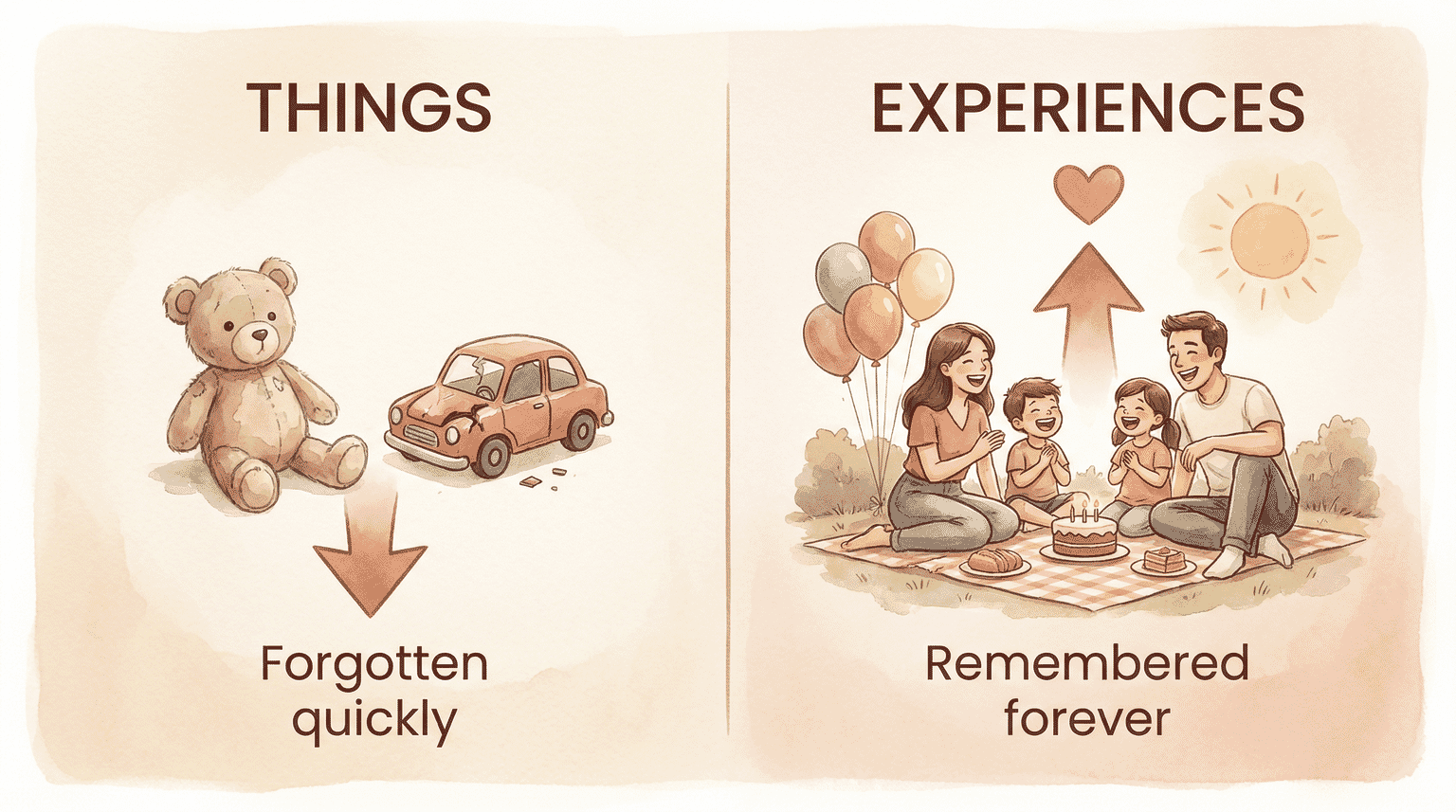
Research backs this up. Studies on happiness and gift-giving consistently find that experiences bring greater overall happiness than material gifts, with memories lingering long after material possessions lose their luster.
The things we do together become part of who we are. The things we own just become clutter.
What actually works:
- Experience gifts create lasting memories and social connection
- Quality over quantity conversations
- Involvement in gift-giving to others
- Savings contributions (529 plans, savings accounts)
Script for your child:
“What do you remember most from last year—the toys or the trip to [place]? Experiences usually make us happier longer. Let’s think about what experiences you’d love this year.”
Script for grandparents:
“[Child] is really into [interest] right now. Instead of another toy that ends up in the closet, would you consider taking her to [related experience]? She’d remember that forever—and remember it was from you.”
Tweens (Ages 10-12)
Recommended approach: Collaborative family gift planning
Tweens have sophisticated understanding of materialism. They have strong opinions. They’re capable of participating in family gift discussions and beginning to understand financial implications.
My 12-year-old now participates in our family gift planning meetings. She helps coordinate who’s buying what, tracks wishlists, and thinks about what she wants to give others. It’s shifted gift occasions from something that happens to her into something she’s part of creating.
What actually works:
- Family gift budget conversations
- Contribution to charity as part of gift process
- Technology and electronics with intention
- Experiential gifts shared with friends
Script for your child:
“You’re old enough to be part of planning now. Our family gift budget is [amount]. Let’s talk about what matters most to you—and how we can make gifts meaningful for everyone.”
Script for grandparents:
“[Child] is asking for bigger-ticket items now, so we’re coordinating to pool resources. Would you want to contribute toward [specific item] rather than separate gifts? That way your gift is something she’ll use every day.”
Grandparent Management: The Conversation Everyone Dreads

Let’s be honest. Grandparents are often the primary source of gift overload—and also the hardest conversation to have.
Understanding Their Perspective
Gift-giving is often a love language. For many grandparents, providing abundance represents success—the ability to give their grandchildren what they couldn’t give their own children. The “smile-seeking hypothesis” is especially strong here. They live for that moment of delight.
Sociologist Marcel Mauss described gift-giving as involving three obligations: the obligation to give, the obligation to receive, and the obligation to reciprocate. Receiving a gift means accepting the identity the giver is offering. When grandparents give abundantly, they’re expressing who they are as grandparents. Rejecting gifts can feel like rejecting them.
Pre-Occasion Communication
Initial conversation opener (values-based, not accusatory):
“We’ve been thinking about what we want [child’s name] to learn about gifts and gratitude. We’d love to talk about how we can all work together to make gift occasions feel special without overwhelming her.”
The “special role” approach:
Instead of limiting what grandparents give, redirect their giving:
“Would you want to be the experience grandparent? The one who takes her to special places? She’d remember those outings—and that they came from you—forever.”
Alternative suggestions:
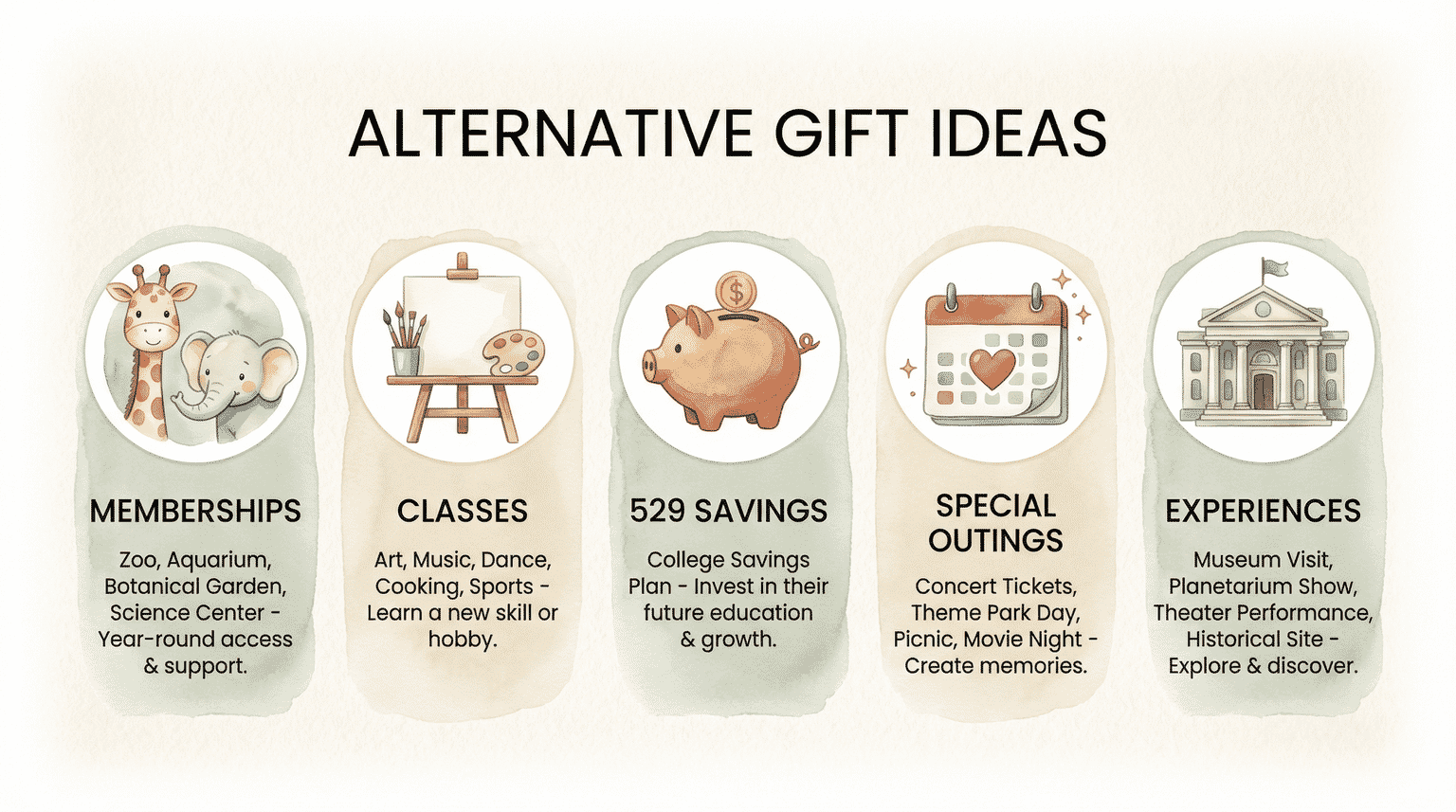
- Contributions to 529 education savings (new rules allow unused funds to roll into a Roth IRA)
- Membership gifts (zoo, museum, children’s museum)
- Class enrollments (art, music, sports)
- Shared wishlist links to channel enthusiasm
- “Day with Grandma” coupons
When Boundaries Aren’t Respected
Sometimes you’ll do everything right and the gifts still arrive in abundance. Here’s a perspective that genuinely helped me relax:
“Your parents giving your kid boatloads of gifts is not going to turn your kid into an entitled monster. Your child is parented by you 365 days of the year.”
— Dr. Becky Kennedy, Clinical Psychologist
Your consistent family gift philosophy matters more than one holiday. Choose your battles. Some things are worth the conversation; others are worth a graceful in-moment response and a quiet rotation into storage later.
Problem-Specific Solutions

Gift Overwhelm: Christmas Morning Survival
The problem: Too many gifts at once creates overstimulation, ungrateful-appearing responses, and chaos.
In-moment strategies:
- Space out gift opening. One gift per hour, not all at once
- Take breaks between gifts. Let children actually play with each thing
- Save some for later. “We’ll open more this afternoon/tomorrow”
- Photograph as you go. For thank-you notes and slowing the pace
Signs of overwhelm by age:
- Toddlers: Crankiness, meltdowns, appearing “wired”
- Preschoolers: Loss of interest, inability to focus on any single gift
- School-age: Rushing through without engagement, asking “what’s next?”
When I see these signs, I know we’ve exceeded capacity. The remaining gifts go into a closet for another day. No one is being punished—we’re simply respecting developmental limits.
Storage and Clutter Management
The problem: 236 toys don’t fit in any home—and 95% aren’t being played with anyway.
The “one in, one out” system:
Implement this before gift occasions. Let your child choose what leaves when something new arrives. In my experience, children are remarkably receptive when given ownership of these decisions. They often surprise you with what they’re willing to release.
Toy rotation strategy:
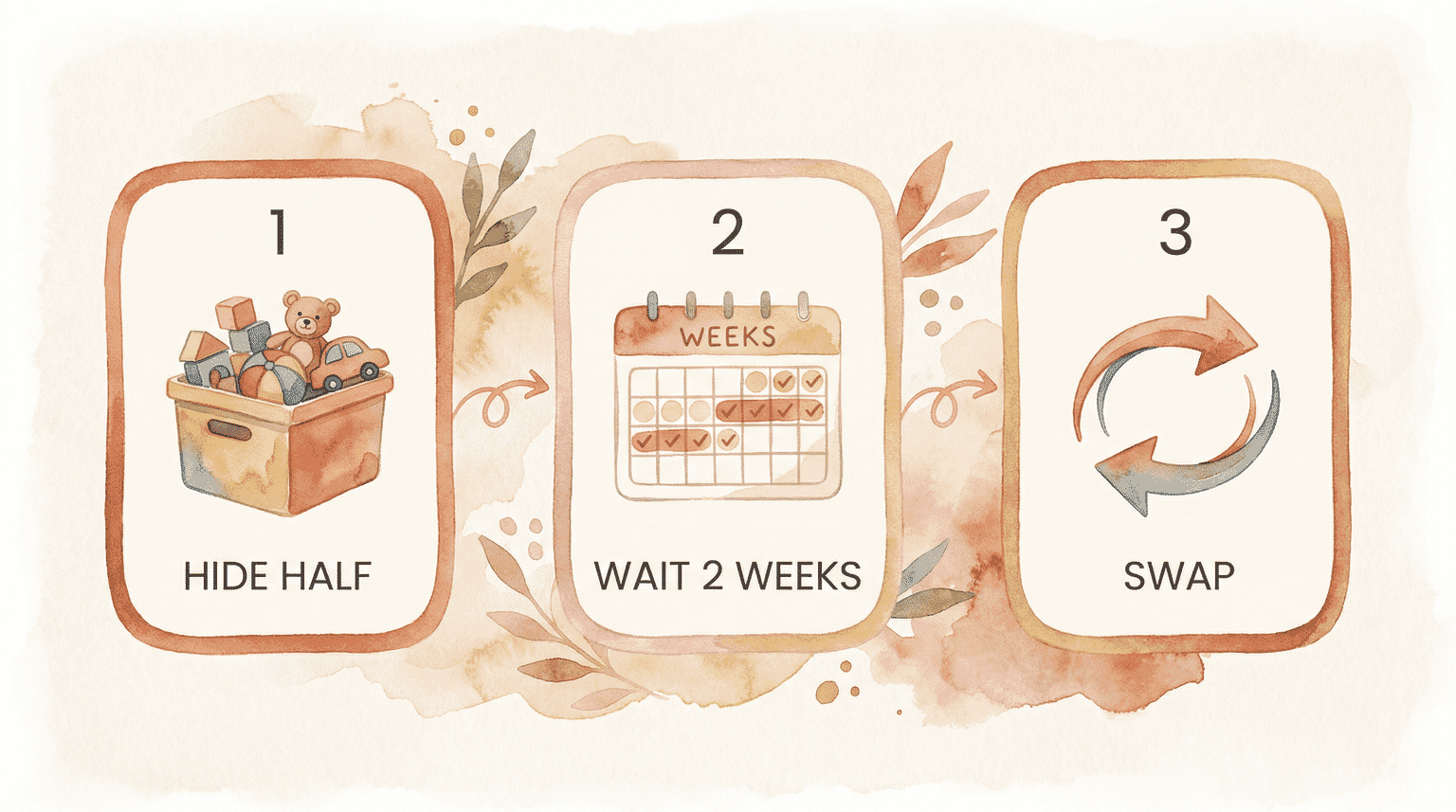
Keep 12-15 toys accessible at any time (the research-optimal number). Store the rest. Rotate monthly or seasonally. “New to them” feels like new gifts without the accumulation.
Pre-gift-occasion declutter:
A week before birthdays or holidays, clear out together. This creates space—both physical and psychological—for what’s coming. My kids now expect this ritual and sometimes initiate it themselves.
Sibling Jealousy and Gift Equity
The problem: Different gift quantities or types between siblings creates conflict.
Here’s what I’ve learned across 8 kids: count matters less than perception of fairness. And different children genuinely need different things.
Strategies:
- Explain rather than defend differences: “Your sister needed winter boots. You got the art supplies you asked for.”
- Focus on “birthday child’s day” rather than comparison
- Teach waiting for your turn without resentment
Script for children:
“Your sister got more packages because some things are smaller. You both got things that are special for you. Remember how you felt on YOUR birthday?”
Ungrateful Reactions (And Why They Happen)
The problem: Your child opens a gift and says “I didn’t want this” or shows visible disappointment. Grandma’s face falls.
Why this happens:
- Developmental honesty (especially under 5)
- Overwhelm and overstimulation
- Unmet expectations versus reality
- Lack of gratitude skill practice
Prevention:
Dr. Becky’s “dry run” technique, mentioned earlier, is genuinely effective. Practice receiving gracefully before the moment arrives. Model your own grateful receiving. Discuss ahead of time that some gifts won’t be exactly right—and that’s okay.
In-moment recovery:
Don’t shame. Redirect gently:
“We say thank you for the thought. You can tell me privately how you feel later.”
Move on quickly. Don’t make it a teaching moment in front of the giver. There will be time for that conversation later.
Kids Who Have Everything
The problem: What do you give a child who lacks nothing material?
Experience alternatives:
- Event tickets (concerts, shows, sporting events)
- Class enrollments (art, music, sports, cooking)
- Membership gifts (zoo, museum, aquarium)
- Adventure gifts (escape room, trampoline park, special outing)
- Travel fund contributions
Contribution gifts:
- 529 education savings
- Savings account deposits
- Charity donations in their name
- Animal sponsorships
Time gifts:
- “Day with Grandma” coupons
- Special outing promises
- One-on-one time commitments
Research on social versus solitary spending reveals that socially shared experiences—planning trips together, attending events as a family—are the single best predictor of happiness. The gift of time and shared experience often means more than any object.
Managing Expectations Year-Round
The problem: Gift occasions feel overwhelming because expectations build unchecked throughout the year.
Year-round strategies:
- Talk about family gift philosophy outside of gift occasions
- Model modest gift-giving to others
- Discuss commercials and marketing targeting children
- Celebrate non-material aspects of holidays
- Practice gratitude that doesn’t center on receiving
My 17-year-old recently told me that what she remembers most about holidays isn’t the gifts—it’s the traditions. The cinnamon rolls on Christmas morning. The movie we always watch together. The gifts are backdrop. The connection is what lasts.
The Systems That Make It Sustainable
Annual Gift Planning Framework
In my house, we now have a gift planning rhythm:
Six weeks before major gift occasions:
- Family meeting to discuss the upcoming occasion
- Children create wishlists (with limits appropriate to their age)
- We share wishlist links with family members
Two weeks before:
- Grandparent coordination (who’s covering which wishlist items)
- Pre-occasion declutter with kids
The day after:
- Processing conversation: What was your favorite gift? Why?
- Thank-you note writing begins
- Rotation decisions for storage
The Gift Philosophy Conversation
Having a family discussion about values sounds intimidating, but it doesn’t have to be formal. At dinner one night, try:
“What makes a gift feel special to you?”
“Can you think of a time you were excited about a gift for a long time—not just the first day?”
“What’s more fun: getting things or doing things?”
Create shared language. In our house, we talk about “gifts that last” versus “gifts that fade.” We revisit and adjust as children grow. What worked for my now-17-year-old at age 8 isn’t quite right for my current 8-year-old.
This isn’t about eliminating gifts or making kids feel guilty for wanting things. It’s about building intentionality into how we give and receive—and helping children understand that the quantity of presents has surprisingly little to do with happiness.
As the Guardian research noted, “the unwanted gifts of Christmas past can haunt us for many months or years after the event.” But intentional gifts—chosen thoughtfully, received gratefully, truly enjoyed—become part of a child’s story. That’s what we’re aiming for.
Frequently Asked Questions
How many gifts should a child receive?
Developmental research suggests 1-2 gifts for children under 3, when overstimulation is the primary concern. Preschoolers do well with the 4-gift rule (want, need, wear, read). School-age children benefit from 4-6 meaningful gifts total across all givers. Watch for overwhelm signs like crankiness or inability to focus.
Is it bad to give kids too many presents?
Children with fewer toys play longer, more creatively, and in more varied ways. Excess gifts can shorten attention spans and reduce appreciation. However, Dr. Becky Kennedy notes that one gift occasion won’t create entitlement—children are “parented 365 days a year,” and consistent values matter more than holiday gift quantities.
How do I tell grandparents to stop buying so many gifts?
Focus on giving grandparents a meaningful role rather than just limits. Try: “Would you like to be the special-outing grandparent? She’d remember those experiences forever—and remember they came from you.” Share wishlists to channel their enthusiasm, or suggest contribution gifts like 529 deposits.
What is the 4 gift rule?
The 4-gift rule limits presents to one from each category: something they want, something they need, something to wear, and something to read. This framework prevents accumulation while ensuring each gift feels meaningful. It works best for children ages 3-10, before preferences become more complex.
How do I teach my child gratitude for gifts?
Practice before gift occasions arrive. Dr. Becky Kennedy recommends “dry run” exercises—give children a practice gift (even a rock in a box) and rehearse polite responses together beforehand. Focus on “thank you” as a habit, not forced emotion, and model graceful receiving yourself.
Over to You
What gift problem has been hardest to solve in your family? After eight kids, I thought I’d seen everything—but readers’ questions still surprise me. Your challenge might spark a solution for someone else.
I read every single response and often find solutions I hadn’t considered.
References
- London School of Economics Research Paper – Research on toy consumption patterns, play quality, and environmental impact
- Psychology Today: Try Doing Less Not More – Dr. Corinne Masur on age-appropriate gift quantities and overstimulation
- Good Morning America: Dr. Becky Kennedy Interview – Practical strategies for teaching gratitude and managing holiday expectations
- The Guardian: Art and Science of Gift-Giving – Research on gift-giver psychology and the smile-seeking hypothesis
- The Third Self: Psychology of Giving – Neurological and social effects of gift-giving behavior
Latest in Gift Problems
-
Too Many Gifts? Fix Kids’ Gift Overload Now
by
· Updated
Continue reading →: Too Many Gifts? Fix Kids’ Gift Overload NowIt’s Christmas morning. Your child rips through eight presents in five minutes and asks ‘Is that all?’ You didn’t fail. Here’s why this happens and what actually works to fix it.
-

Grandparents Won’t Stop Buying Toys? Try This
by
· Updated
Continue reading →: Grandparents Won’t Stop Buying Toys? Try ThisYour mother-in-law just left after her third gift drop this month, and your four-year-old didn’t even look up to say thank you. Here’s how to redirect that generosity without damaging the relationship your child actually needs.
-
Regifting Ethics for Kids: A Parent’s Guide
by
· Updated
Continue reading →: Regifting Ethics for Kids: A Parent’s GuideThat duplicate LEGO set in your closet could be the perfect gift for Saturday’s party. Research shows your guilt is probably overblown and recipients care far less about a gift’s origins than you think.
-
Holiday Gift Giving Anxiety: 6 Ways to Stop the Stress
by
· Updated
Continue reading →: Holiday Gift Giving Anxiety: 6 Ways to Stop the StressStanding in the toy aisle at 9 PM, frozen between two nearly identical building sets, I realized my brain had simply stopped working. Here are six research-backed strategies to break the paralysis and actually enjoy giving this year.
-
Duplicate Gifts: How to Prevent and Handle Them
by
· Updated
Continue reading →: Duplicate Gifts: How to Prevent and Handle ThemFour identical unicorn plushies later, you realize the problem isn’t thoughtless givers. It’s that everyone independently thought they nailed it. Here’s how to coordinate without becoming the gift police.
-

Child Disappointed With Gift? What to Say and Do
by
· Updated
Continue reading →: Child Disappointed With Gift? What to Say and DoThat forced smile before the polite thanks tells you everything. Here’s why 41% of kids feel let down even with wish list items, and exactly what to say in the five scenarios where it matters most.

Share Your Thoughts