

The moment my mother-in-law handed my then-four-year-old a red envelope at Chinese New Year, he ripped it open before she’d even let go. The look on her face—I still remember it. What he didn’t know (and honestly, what I hadn’t prepared him for) was that opening a red envelope in front of the giver is considered disrespectful in her culture. She recovered gracefully. I learned something important: we weren’t just blending families. We were blending entirely different gift languages.
If you’ve ever felt that stomach-drop moment when your family’s gift expectations collide with your in-laws’, your partner’s, or even your own kids’ friends’ families—you’re navigating one of modern parenting’s trickiest territories. And here’s the good news: there’s a way through that doesn’t require memorizing an encyclopedia of cultural rules or abandoning your own values.

Key Takeaways
- As much variation exists within cultures as between them—focus on the specific families in your life, not cultural stereotypes
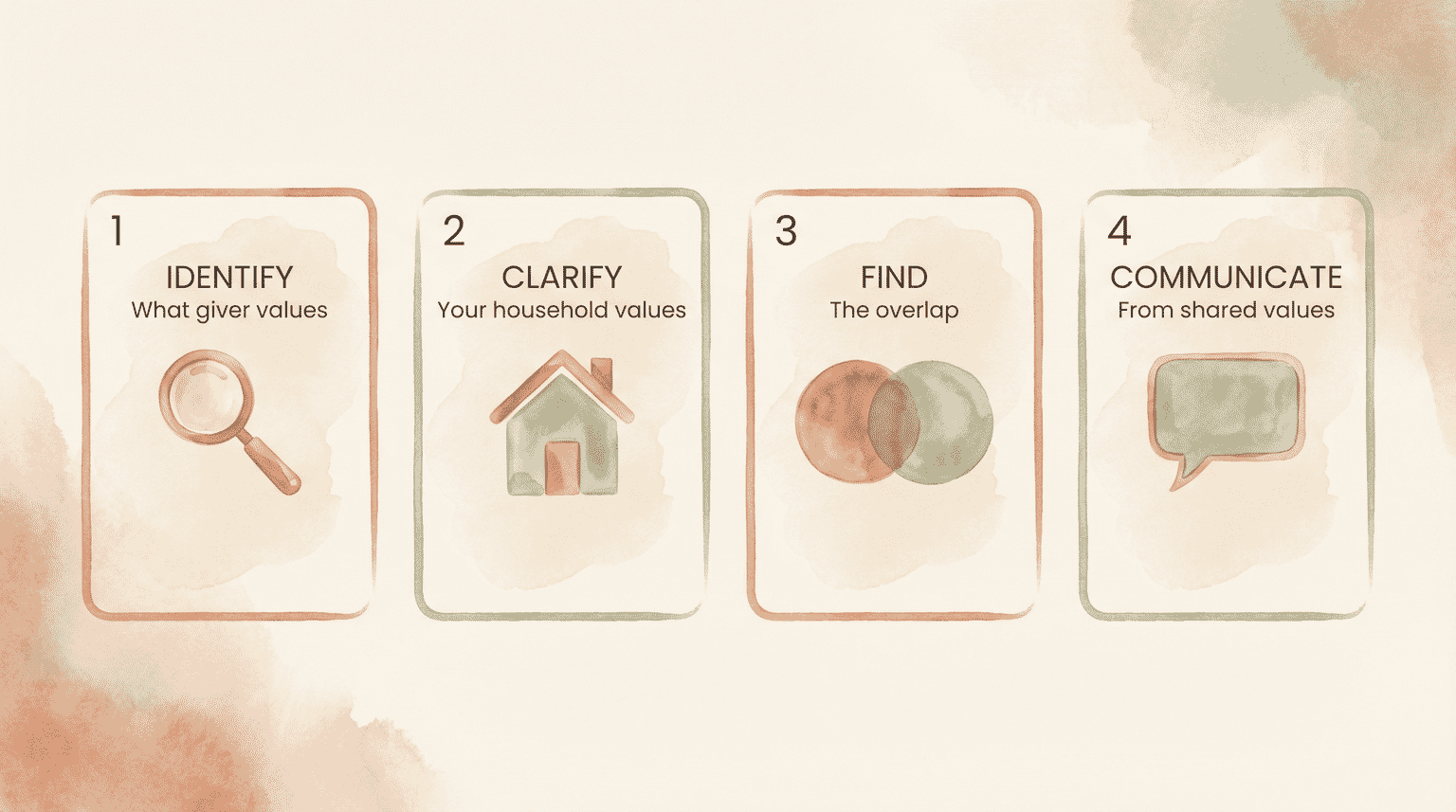
- Use the Values-First Framework to find common ground: identify what the giver values, clarify your household values, find the overlap, and communicate from shared values
- Children around age four can understand that different families do things differently—prepare them before situations arise
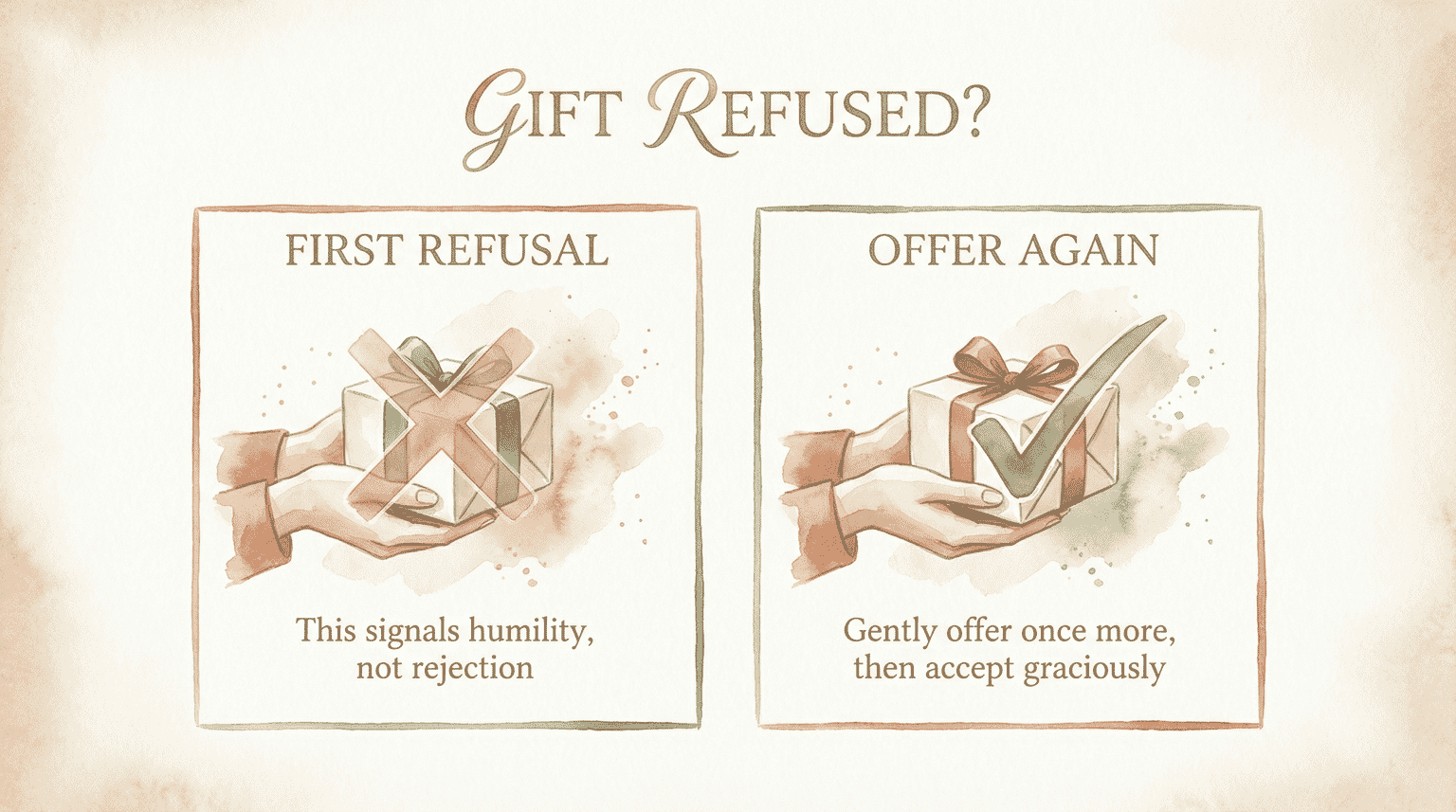
- When gifts are refused, it often signals humility, not rejection—offer again gently before accepting graciously
- Build “both/and” blended traditions rather than choosing between cultural practices
Why This Is Genuinely Hard
Here’s what the research actually shows: as much variation exists within cultures as between them. A 2021 NIH-funded parenting study put it bluntly: “Cultures are not homogeneous entities without individual variation.” Your Chinese American neighbors may have completely different gift expectations from your partner’s Chinese American parents—and both are “right” within their own family contexts.
This is why googling “Asian gift-giving rules” or “Latino gift etiquette” will only get you so far. You’re not dealing with cultures in the abstract. You’re dealing with Grandma Chen, who grew up in Shanghai, and Tía Rosa, who brings tamales to every gathering whether you asked or not.
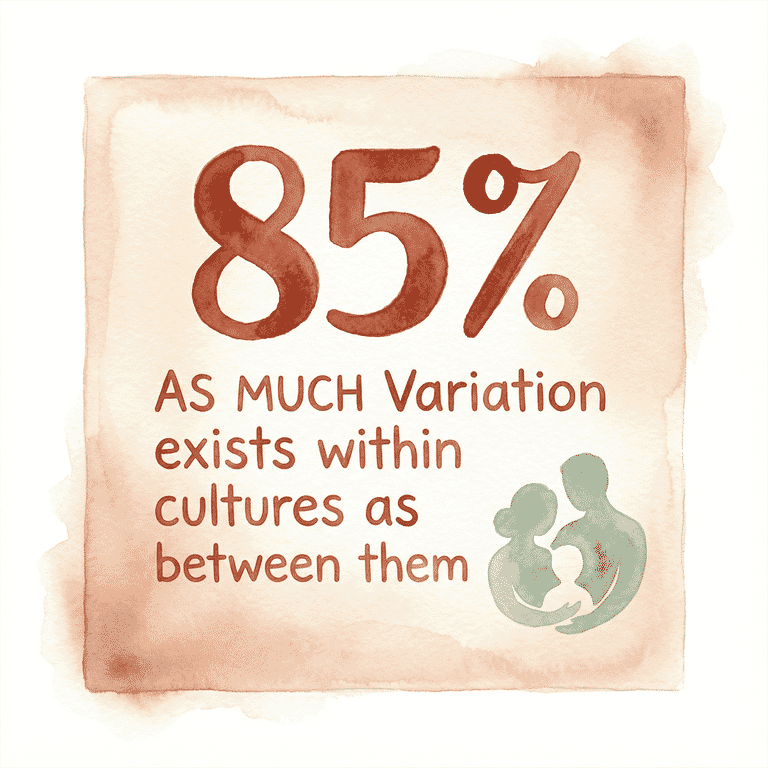
The tension isn’t about conflicting rules. It’s about conflicting values—and those run deeper. Each family has its own interpretation of cultural traditions, shaped by immigration history, generational differences, and personal experiences.
According to research on gift meaning, a gift’s overall value has four components: economic value, functionality, social value, and expressive value. The weight each family places on these components varies enormously.
Your handmade gift might carry profound expressive value to you—and register as “cheap” to a family that reads economic value as respect. Understanding this has made all the difference in my own household.

When you understand that different families simply weight these components differently—not wrongly—it becomes easier to navigate the gaps without judgment.
The Values-First Framework
Rather than memorizing rules you’ll forget under pressure, here’s a decision-making system you can apply to any gift situation—whether it’s your mother-in-law’s birthday or your kid’s first multicultural playdate.
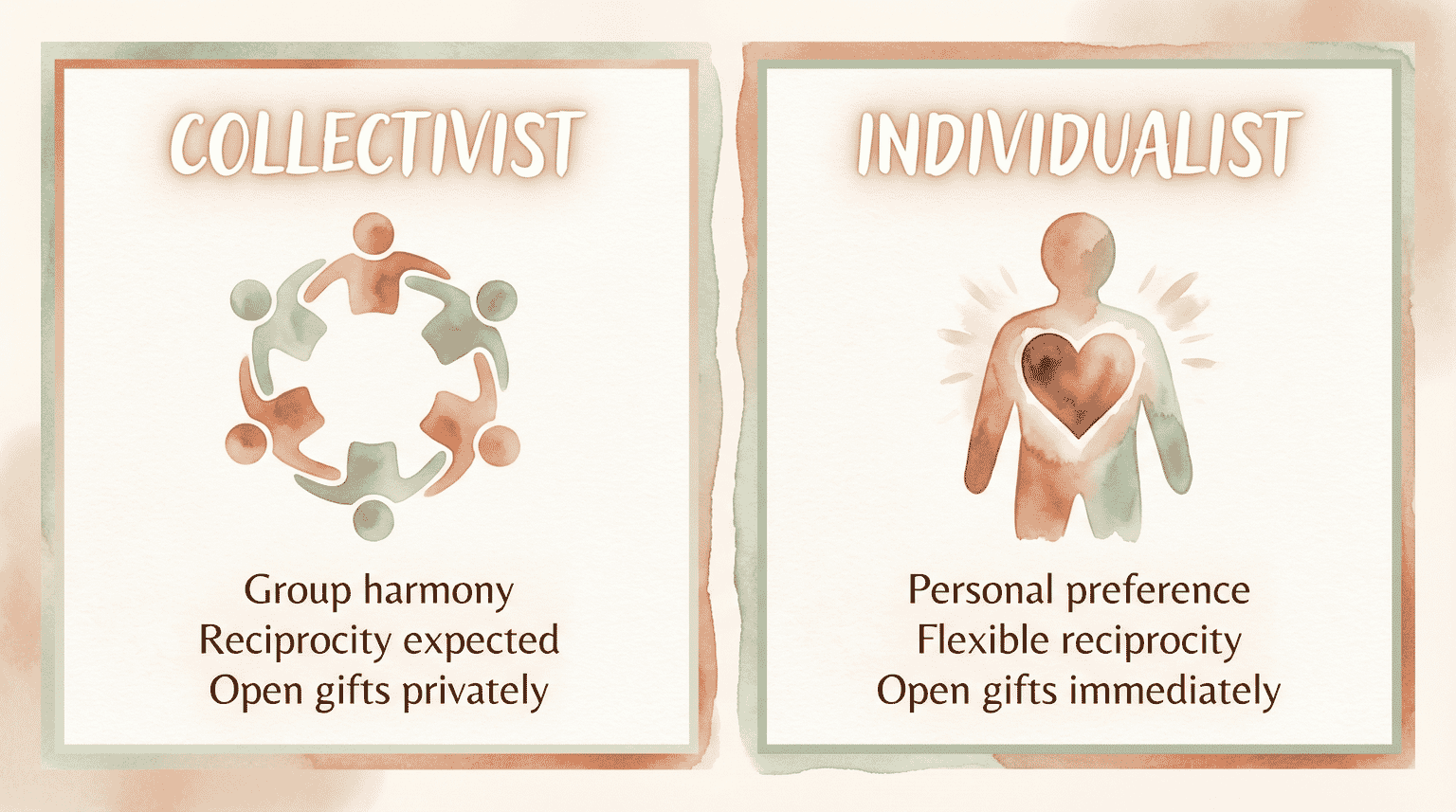
Step 1: Identify what the gift giver values. Is this person expressing love? Fulfilling social obligation? Demonstrating respect? Seeking validation? In many collectivist cultures, formal gift-giving is motivated by social integrity and respect. In individualist contexts, it’s often about personal connection and preference.
Step 2: Clarify your household’s core gift values. My husband and I had to have this conversation explicitly. What matters to us? Thoughtfulness over expense? Experiences over stuff? Reciprocity or freedom from obligation? If you haven’t aligned with your partner on this, cultural collisions will expose that gap fast. For more on navigating multiple family traditions, that alignment becomes your foundation.
Step 3: Find the overlap. There almost always is one. Even when my family’s “rip it open immediately!” enthusiasm clashed with my in-laws’ “wait and open privately” tradition, we both valued gratitude. We both valued the giver feeling appreciated. We built from there.
Step 4: Communicate from shared values, not competing rules. “In our family, we do it this way” creates opposition. “We want Grandma to feel appreciated—let’s talk about how her family shows that” opens conversation.
Research in Social Analysis journal distinguishes between gift obligations (which carry social sanctions if violated) and gift expectations (which can simply be disappointed). Understanding which category you’re dealing with helps you respond proportionally.
Understanding What’s Behind Different Expectations
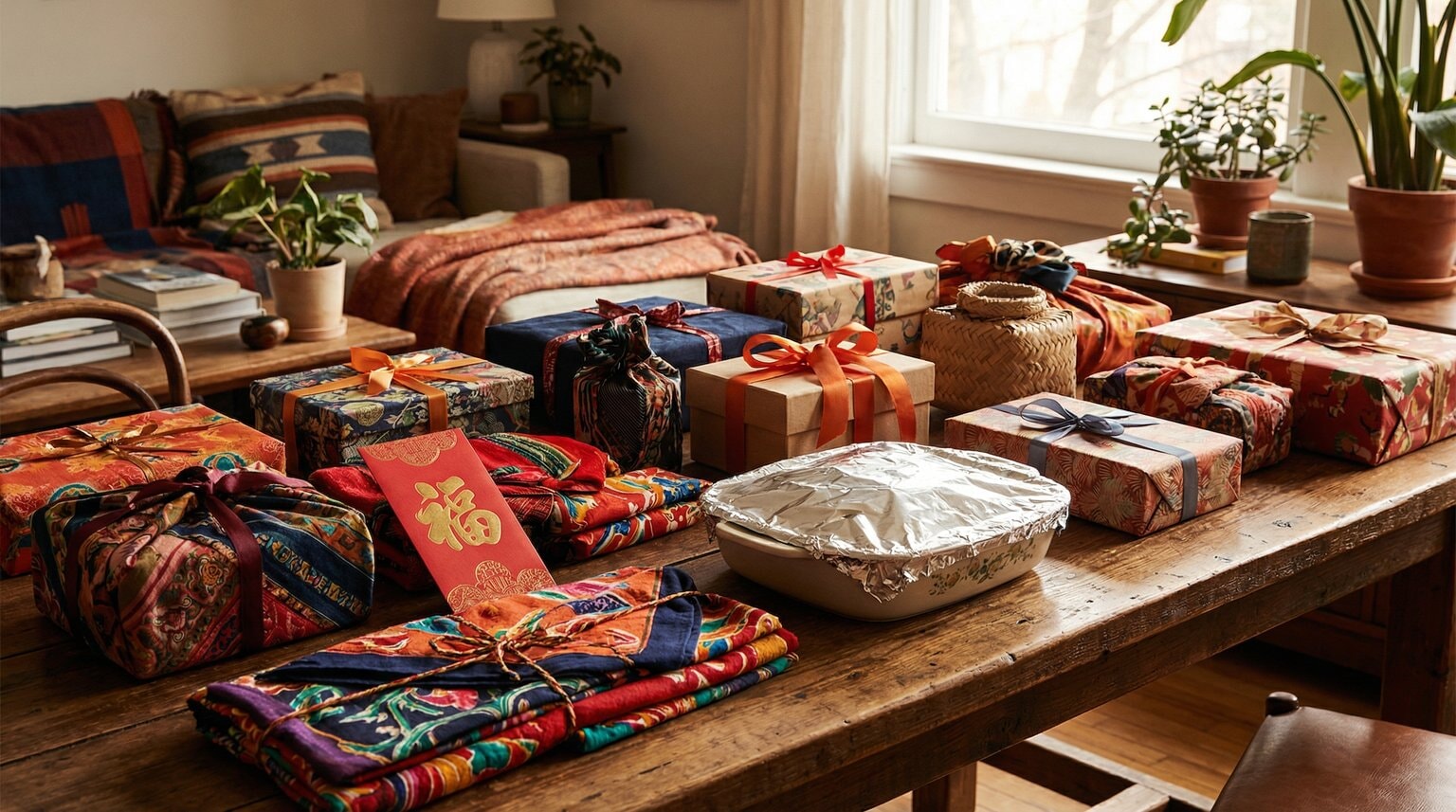
I’m not going to give you exhaustive country-by-country rules—those exist elsewhere and honestly aren’t that helpful for actual families. Instead, here are the values driving the expectations you’re likely to encounter.
Collectivist Traditions
In many East Asian, South Asian, and African cultural contexts, gifts operate within a web of relationships. Reciprocity isn’t optional—it’s how you demonstrate mutual respect. Group harmony matters more than individual preference, which is why gift-giving can feel more prescribed than spontaneous.
Specific practices vary, but themes include:
- Saving face: Gifts should never embarrass the giver or receiver
- Timing protocols: Many traditions call for opening gifts privately, not immediately
- Reciprocity expectations: A 2024 study on gift value noted that in most Asian cultures, recipients are expected to reciprocate to show mutual respect
- Gift presentation: How you wrap and present can matter as much as what’s inside
Familismo Traditions
In Latino cultures, “familismo” shapes everything—including gifts. Research on cultural responsiveness describes this as “commitment to provide emotional and tangible social support to nuclear and extended family members via solidarity, loyalty, and reciprocity.”
What this looks like practically:
- Food as love language: “Latinos may express their hospitality and generosity through food,” the researchers note—and declining food gifts can feel like rejecting the relationship
- Relationships over efficiency: “Interpersonal relations hold great significance for Latinos, in that they are valued more than time and individual achievements.” If Abuela brings gifts at inconvenient times, that’s not oblivious—it’s prioritizing connection
- Extended family inclusion: Gift occasions naturally expand to include aunts, uncles, cousins
Individualist Traditions
Western and particularly American gift culture tends toward:
- Personal preference as priority (the “right” gift matches individual taste)
- Immediate opening expected (and watched with anticipation)
- Less rigid reciprocity (thank-you notes yes, matching gift value less so)
- Individual credit (one giver, one recipient)
Religious Traditions
Christmas, Eid, Hanukkah, Diwali—each carries specific gift expectations that layer onto cultural ones. The key isn’t learning every rule; it’s asking the families in your life what matters most to them about their traditions.
For deeper exploration of international gift-giving traditions, that resource covers specific practices by region.
Five Conversations Every Family Needs

Knowing the framework is one thing. Having the actual conversations is another. Here are scripts for the situations I’ve navigated—and heard about—most often.
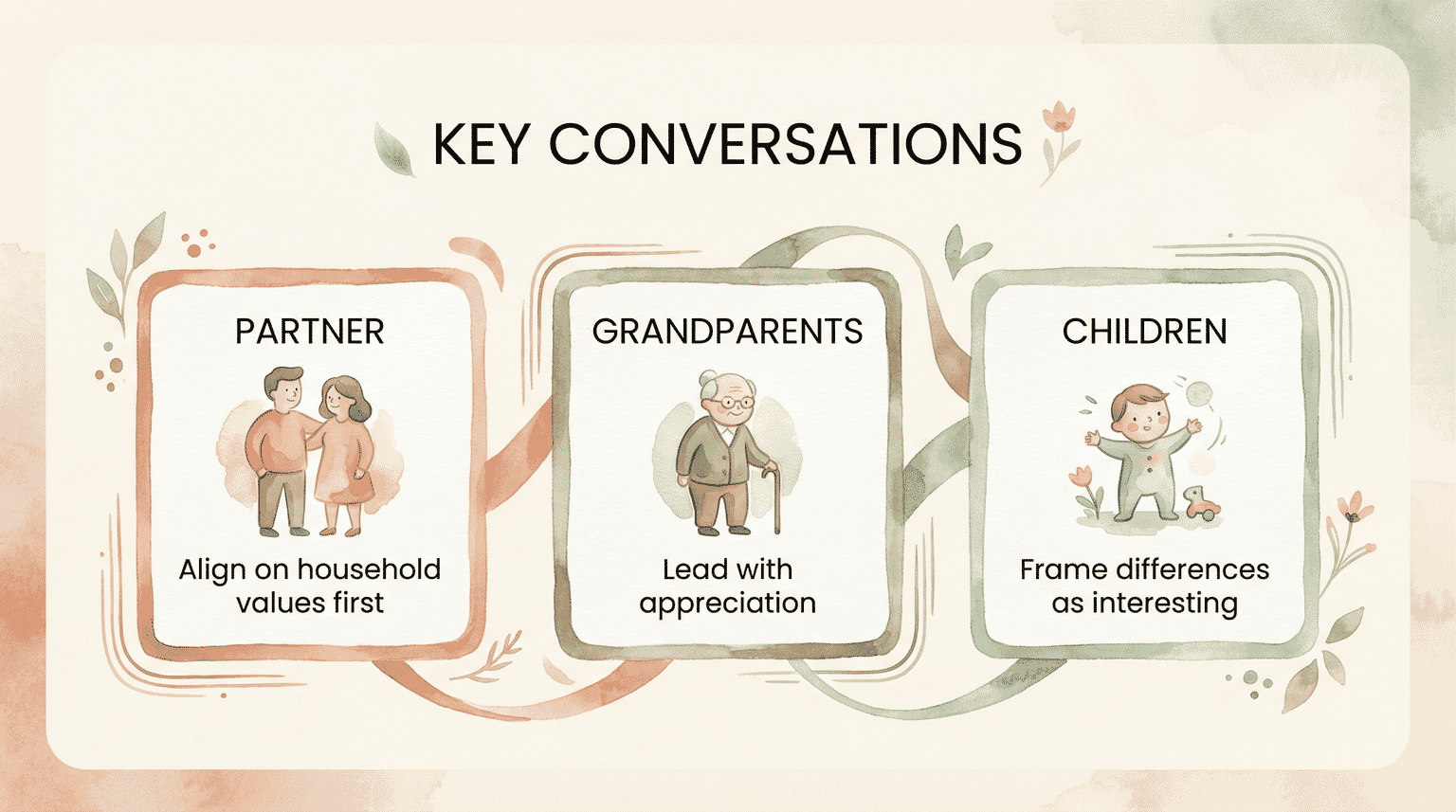
Conversation 1: With Your Partner
Before you can navigate anyone else’s expectations, you need alignment at home.
“I’ve been thinking about how our families do gift-giving differently. Can we talk about what we want that to look like in our house? Not what our families expect—what we actually value.”
— Suggested conversation starter
Start with curiosity about their family’s traditions, not criticism. Then share yours. Find the overlap and build your household philosophy from there.
Conversation 2: With Grandparents
This is often the hardest—especially when grandparents are generous in ways that overwhelm you.
“We love how much you want to give to the kids. We want them to really appreciate your gifts, not be overwhelmed. Could we talk about what would help them treasure what you give even more?”
— Suggested conversation starter
Lead with appreciation for their intention. Make it about the kids’ experience, not your preferences.
Conversation 3: With Your Child
Children around age four can understand that “different families do things differently.” By age seven or eight, they can grasp cultural reasons behind traditions.
“At Grandma Chen’s house, we wait to open gifts later—it’s how her family shows respect. I know that’s different from how we do it at home. Both ways are right in their own families.”
— Before a multicultural situation
Frame differences as interesting, not right/wrong. Prepare them for specific situations they’ll actually encounter.
Conversation 4: With Extended Family
When your preferences aren’t being respected despite clear communication:
“I know gift-giving is how you show love to the kids, and they feel that. We’re working on helping them appreciate what they have. Could we try [specific alternative] for the next birthday?”
— Suggested conversation starter
Offer a concrete alternative: experience gifts, contributions to a savings account, one special item rather than several.
Conversation 5: Preparing Children for Multicultural Situations
Before birthday parties or holidays with families from different backgrounds:
“Different families celebrate differently. At Amir’s party, they might do things we haven’t seen before. If you’re not sure what to do, just watch what Amir does first, or ask me quietly.”
— Before multicultural events
Give them permission to observe before acting, and a way to get guidance without embarrassment.
The good news? Children are remarkably adaptable when it comes to cultural differences. They don’t carry the same assumptions adults do about the “right” way to do things.
When we frame cultural differences as fascinating rather than confusing, kids absorb that attitude. They become the bridge-builders in multicultural situations.

When Expectations Collide

Even with frameworks and scripts, collisions happen. Here’s how to navigate the most common ones.
When Someone Refuses Your Gift
In many Asian cultures, declining a gift initially signals humility—accepting too readily can appear greedy. Some people refuse gifts they cannot adequately reciprocate; in cultures with strong reciprocity norms, accepting creates obligation.
Reframe: This is respect, not rejection. Offer again gently. If refused twice, accept graciously.
When a Gift Feels Obligating
The Social Analysis research on expectations versus obligations helps here. Ask yourself: Is this actually an obligation (with social consequences if I don’t reciprocate) or an expectation (which can be disappointed without major fallout)?
Strategy: Gestures of generosity serve as “safety mechanisms that retain the value of the gift even when no return occurs.” A heartfelt thank-you, a follow-up note, or a modest reciprocal gesture often satisfies the underlying value even when precise matching isn’t possible.
When Extended Family Ignores Your Preferences
You’ve asked for fewer toys. More toys arrive.
Strategy: Control what you can. Thank graciously, rotate what enters your home, involve kids in donating extras. Save the bigger conversation for when emotions aren’t running high.
When Money Gifts Conflict With Your Values
Some families give cash; others find it impersonal. Some use specific amounts with cultural meaning; others see that as cold.
Strategy: Separate the method from the meaning. A red envelope isn’t “just money”—it’s a wish for luck and prosperity. Teach your child the significance, not just the amount.
Building Your Blended Family Tradition

After eight kids and countless cultural collisions, here’s what I’ve learned: you don’t have to choose between traditions. The goal is “both/and,” not “either/or.”
In my house, we’ve created hybrid traditions that honor multiple heritages. Red envelopes at Chinese New Year and immediate-opening on Christmas morning. Tamales that arrive unannounced and the freedom to politely redirect birthday gift excess.
The key is teaching children cultural pride without cultural rigidity. They can know that their grandparents’ tradition matters and that other families do things differently—both can be true.
For families creating traditions in blended families where stepparents and multiple extended families are involved, this “both/and” philosophy becomes even more important.
And if you’re still in the early stages of establishing your family’s gift-giving traditions, know that this is ongoing work. We’re still figuring it out—and with eight kids spanning seventeen years, I expect we always will be.
Frequently Asked Questions
How do gift-giving traditions differ between cultures?
Traditions vary primarily in timing (immediate vs. private opening), reciprocity expectations (whether you must return a gift of similar value), what gifts signify (relationship status, respect, or personal preference), and appropriate gift types (cash, food, or individually selected items). These differences stem from deeper values—collectivist cultures often prioritize group harmony while individualist cultures emphasize personal expression.

Why do some cultures refuse gifts?
In many Asian cultures, declining a gift initially signals humility and avoids appearing greedy. Additionally, people may refuse gifts they cannot adequately reciprocate—in cultures with strong reciprocity norms, accepting creates obligation. Rather than interpreting refusal as rejection, understand it often demonstrates respect.
How do I explain cultural differences to my child?
Children around age four understand “different families do things differently.” By seven or eight, they can grasp cultural reasons behind traditions. Use concrete examples before situations arise, frame differences as interesting rather than right/wrong, and give them permission to observe before acting.
What if my family’s gift expectations conflict with my values?
Start by identifying what the gift giver actually values—often it’s relationship connection, not the specific practice. Find common ground values you share (gratitude, thoughtfulness) and communicate from that overlap. You can honor their intention while maintaining your household’s approach.
Share Your Story
Have you navigated clashing cultural gift expectations? I’d love to hear how you’ve bridged the gap—especially the conversations that actually helped relatives understand each other’s traditions.
Your cultural bridge-building stories help other families navigate these tender moments.
References
- Cultural Roots of Parenting – NIH-funded study on parenting values across cultures
- Cultural Meaning of Client Gifts – Tennessee Counseling Association research on gift value components
- Expectations of the Gift – Social Analysis journal framework on expectations vs. obligations
- Contextual Behavioral Framework – PMC research on Latino cultural values including familismo

Share Your Thoughts