
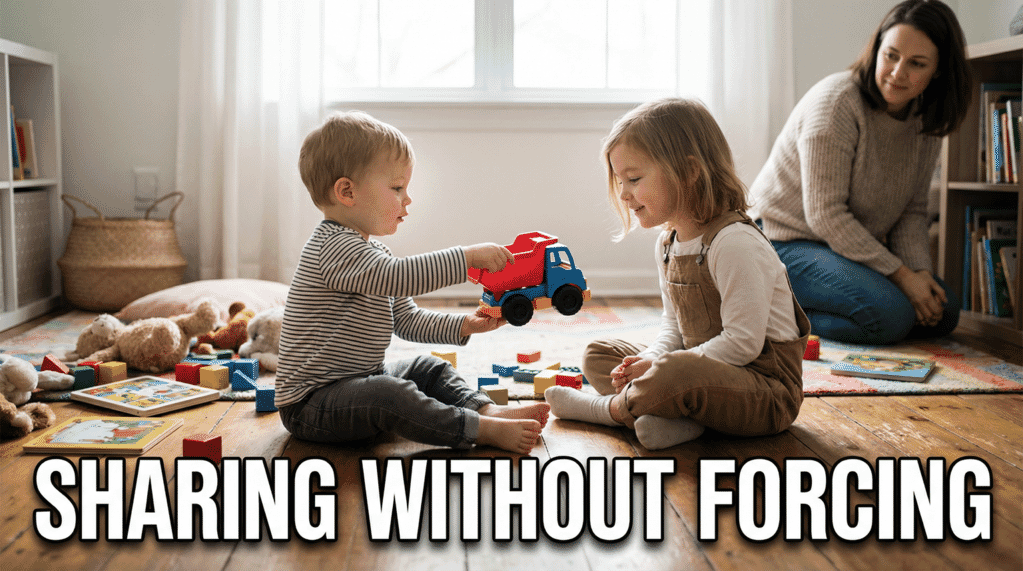
My 6-year-old handed her little brother one of her Halloween treats last week—from her personal stash, unprompted. I nearly dropped my coffee. After eight kids, I’ve learned that moments like these don’t happen by accident. They’re the result of something more deliberate than I once assumed.
Here’s what I’ve discovered after years of watching generosity develop (or not) across my household: the science behind raising generous children is surprisingly clear, and it often contradicts our instincts. The strategies that actually work aren’t complicated—but they do require rethinking some common approaches.
The 7 strategies that research supports:
- Adopt a growth mindset — See struggles with sharing as developmental, not character flaws
- Stop forcing, start inviting — Create voluntary giving opportunities instead of mandating
- Praise the act, skip the prizes — Use verbal encouragement, avoid material rewards
- Let them witness the impact — Ensure children see recipients’ reactions
- Read stories about giving — Use narrative to prime generous behavior
- Ask “what if” questions — Prime empathy through emotional hypotheticals
- Make gift-giving a teaching moment — Use birthdays and holidays as generosity practice
Key Takeaways
- Children only experience the “warm glow” of giving when it’s voluntary, not forced
- Material rewards for kindness actually reduce long-term generosity—verbal praise works better
- Kids need to witness the recipient’s reaction to understand what their generosity accomplished
- Asking hypothetical “what if” questions before sharing situations primes empathy
- Parents must narrate their own generosity out loud for children to learn from it
Let me break down each one—and why the research says they work.
The Mindset Shift Every Parent Needs First
Before any strategy works, you need to change how you think about your child’s generosity struggles.
My librarian brain couldn’t let this go: I kept wondering why some of my kids seemed naturally generous while others clutched toys like their lives depended on it. Turns out, I was thinking about it all wrong.
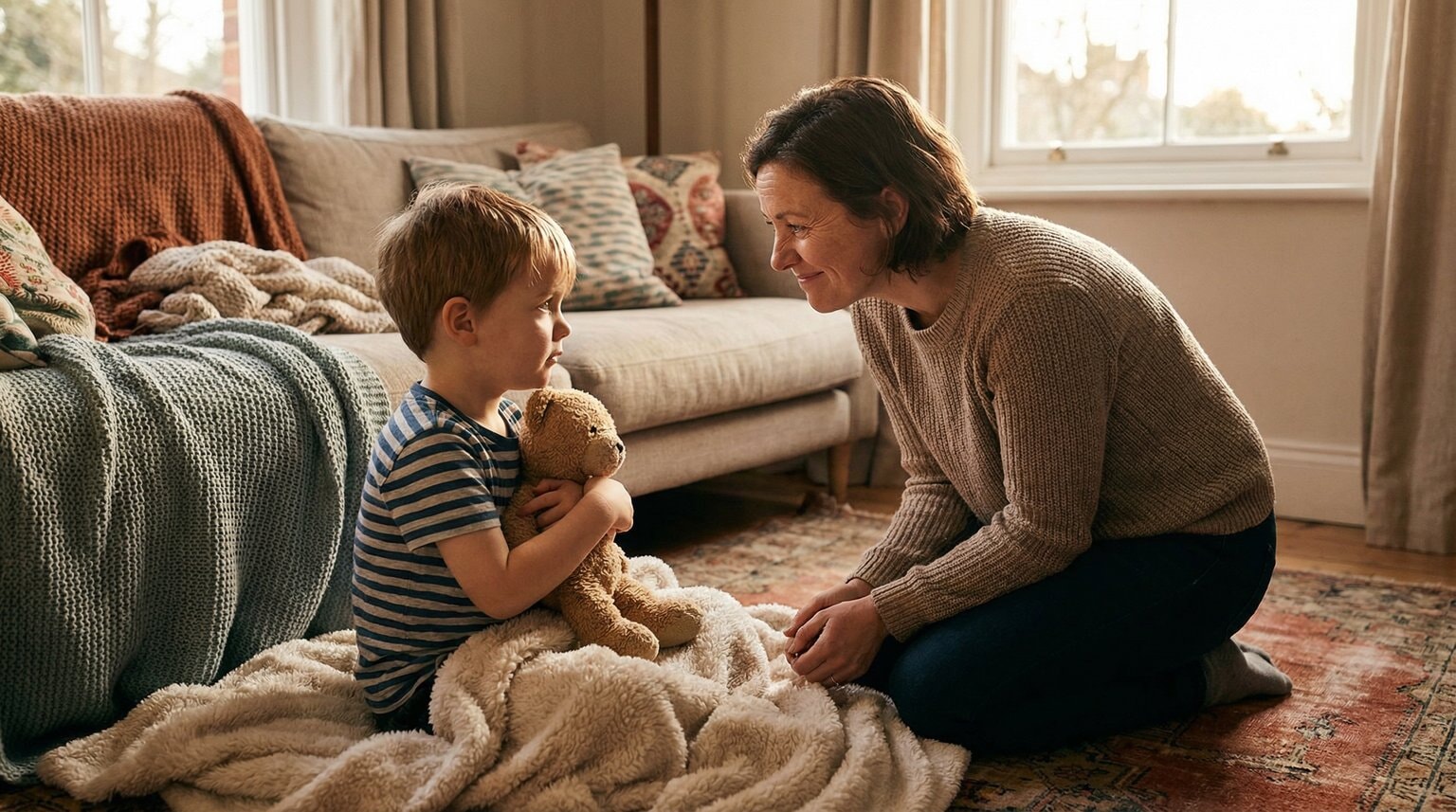
Harvard’s Making Caring Common initiative reframed everything for me. Richard Weissbourd and Kiran Bhai put it this way:
“A child may struggle to share, but that doesn’t mean they’re selfish. It means they’re not able to share yet and they need support and guidance in developing this ability.”
— Richard Weissbourd and Kiran Bhai, Harvard Making Caring Common
This is Carol Dweck’s growth mindset applied to moral development. When your 4-year-old won’t share the red crayon, they’re not being bratty—they’re simply not developmentally ready to share yet. Your job is to build that capacity, not punish its absence.
The self-talk shift: Instead of “Why is my child so selfish?” try “What support does my child need to develop this skill?”
Strategy #1: Stop Forcing, Start Inviting
Here’s where the research genuinely surprised me. I’d always thought making kids share was teaching them generosity. It’s actually doing the opposite.
A fascinating synthesis of studies on Parenting Science examined what researchers call the “warm glow” of giving—that happiness boost we get from being generous. The key finding? Children experience this warm glow only when giving is voluntary.
In a study of toddlers aged 20-22 months, researchers found children displayed the highest levels of happiness when they gave away treats from their own personal stash—not when they shared surplus items or were told to share. The children enjoyed giving more than receiving, but only when the choice was theirs.
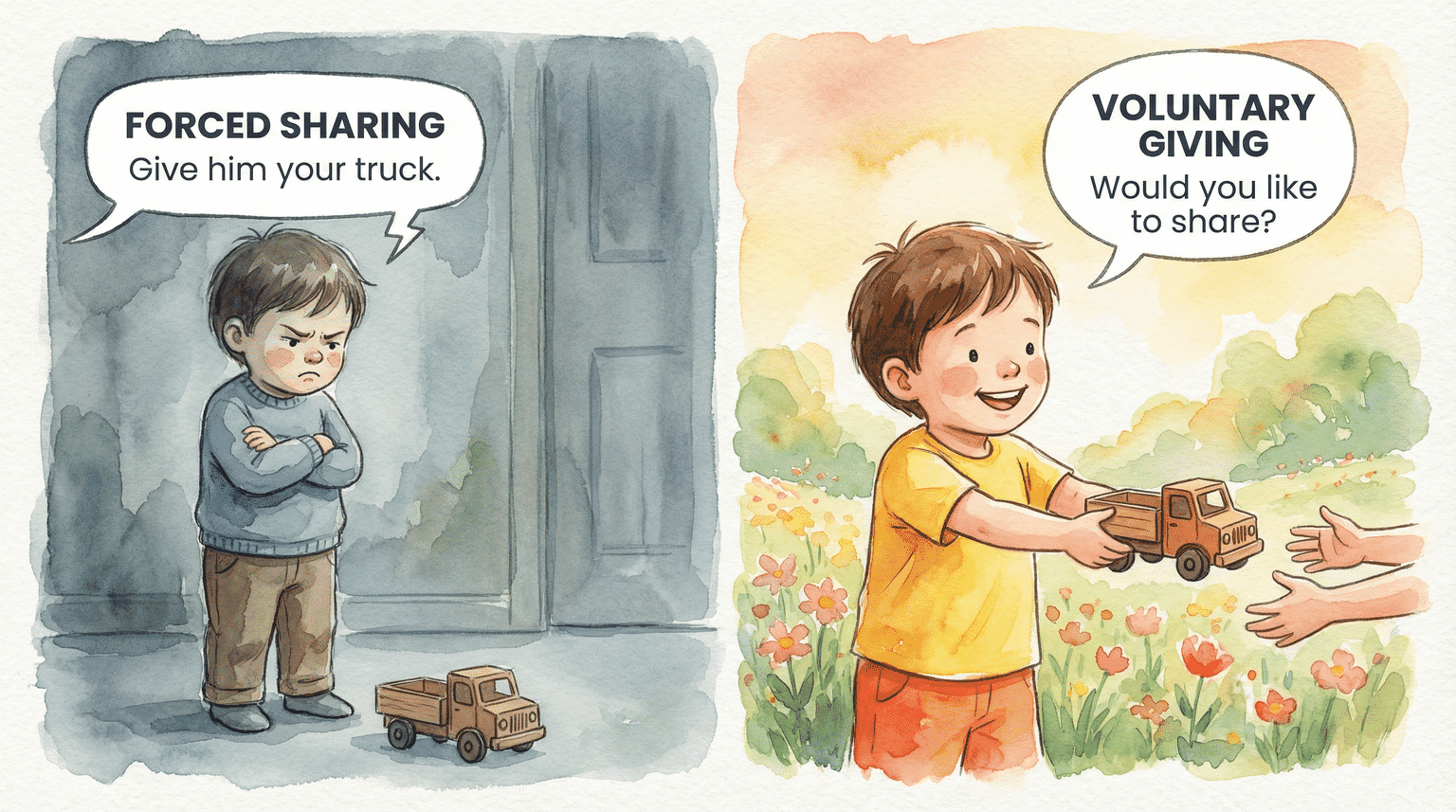
This has been replicated across cultures—Canada, the Netherlands, China, and even a rural village in the South Pacific. When giving is forced, the warm glow disappears.
In my house, this looks like: Instead of “Share your truck with your brother,” I say “Would you like to let your brother have a turn?” The difference seems small, but one builds generosity and one just builds resentment.
Strategy #2: Praise the Act, Skip the Prizes
If you’re using a reward chart for kind behavior, the research suggests you might want to reconsider.
A 3-year longitudinal study from UC Berkeley’s Greater Good Science Center followed over 400 Spanish teens and found something striking: material rewards for kindness—points systems, allowance bonuses, extra privileges—led to less moral reasoning and reduced helping behavior when no reward was expected.
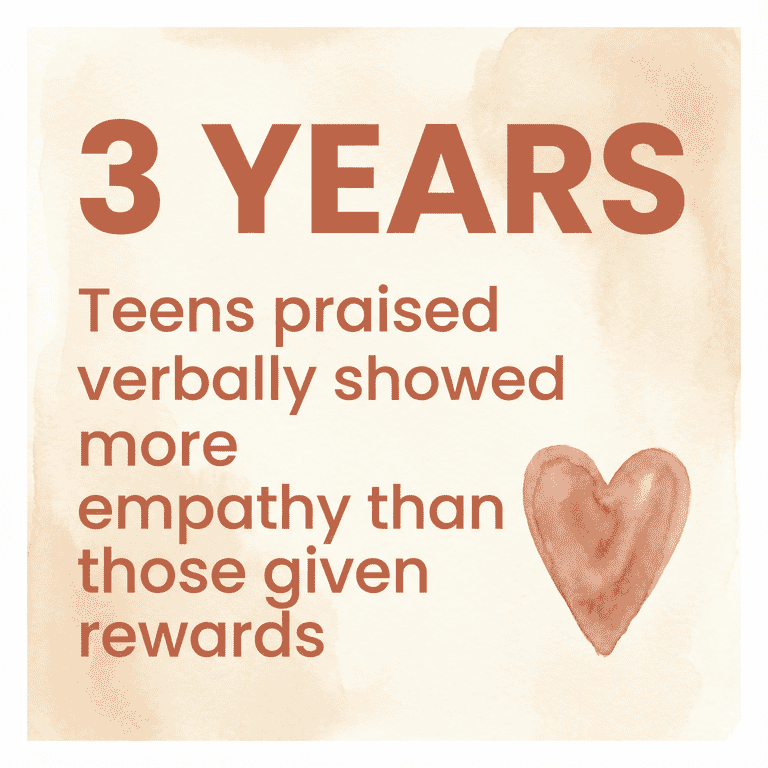
But social encouragement? Showing warmth and affection when teens did something good? That increased both empathy and helpfulness.
Psychology Today’s research review confirms this extends to younger children too—verbal praise rather than tangible rewards better encourages continued generous behavior.
The reason makes sense once you think about it: material rewards teach kids to expect something in return. Verbal praise reinforces the intrinsic satisfaction of being generous.
Specific praise phrases that work:
- “I noticed you gave your sister the bigger piece. That was really thoughtful.”
- “Did you see how happy Grandma looked when you shared your drawing? You made her day.”
- “That was kind of you to include the new kid at lunch.”
Notice these are specific and connect the action to its impact—not generic “good job!” statements.
Strategy #3: Let Them Witness the Impact
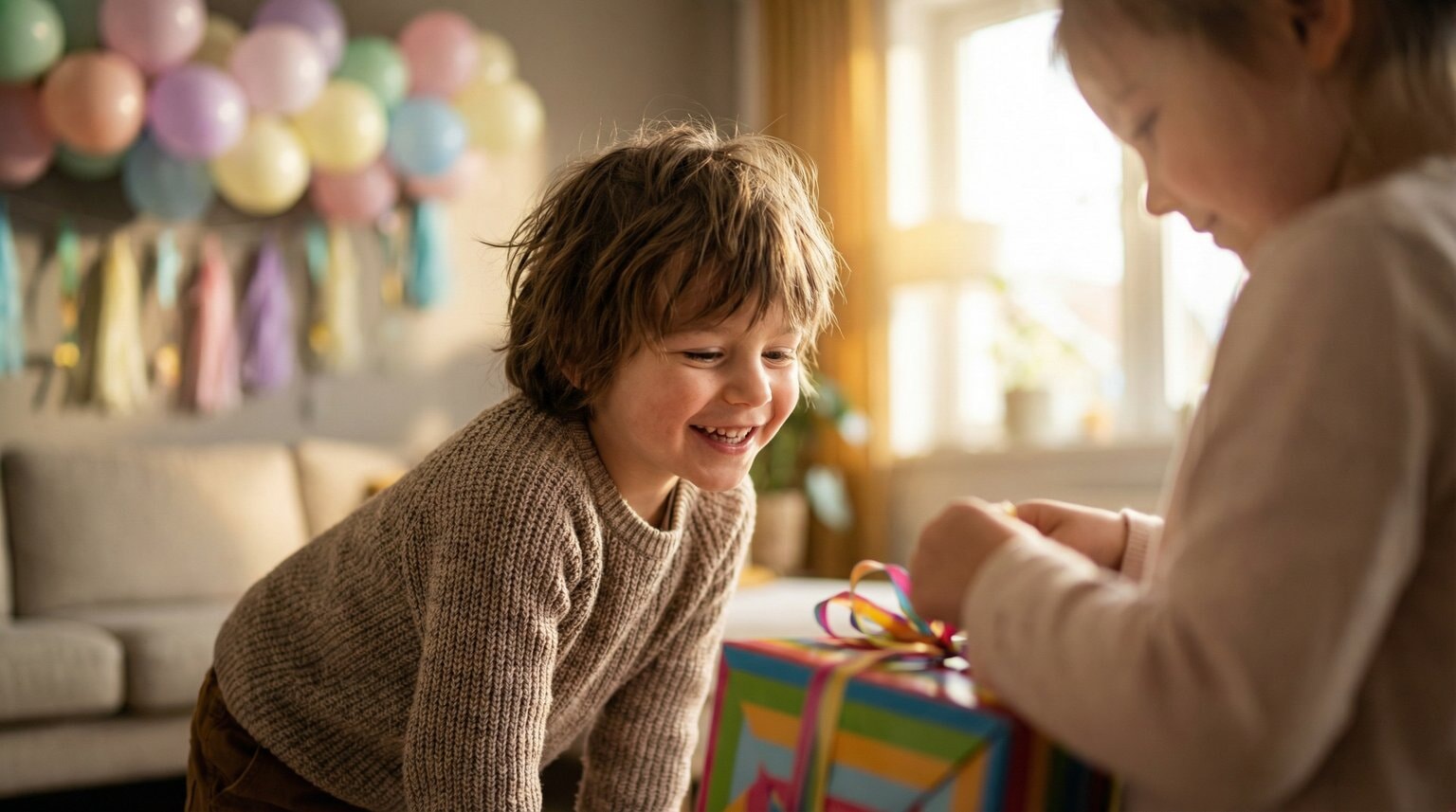
This strategy transformed how we handle gift-giving occasions in our family.
According to the American Psychological Association, direct, face-to-face giving offers more emotional rewards than indirect giving. The research reveals why seeing the impact matters so much.
“When people give in ways that are more socially connected or relational, that seems to better unlock these emotional rewards.”
— Dr. Lara Aknin, Simon Fraser University
Research shows 5-year-olds acted happier when they got to witness the positive emotional impact of their giving on recipients. The key isn’t just giving—it’s seeing what your generosity does.
What this means practically:
- Have your child hand-deliver birthday gifts instead of dropping them in a pile
- Let them watch the recipient open their gift when possible
- For charitable giving, choose opportunities where they see the impact directly
- After giving, talk about what you both noticed: “Did you see her smile when she opened it?”
I’ve noticed my kids are far more enthusiastic about giving when they get to witness the reaction. The abstract concept of “someone will appreciate this” doesn’t stick. Seeing a cousin’s face light up does.
Strategy #4: Read Stories About Giving
This one surprised me with how immediately effective it is.
Research by Russell and Cain found that children became more generous immediately after adults read them stories about characters who gave to others—but specifically human characters. Stories about animals sharing or unrelated books didn’t have the same effect.
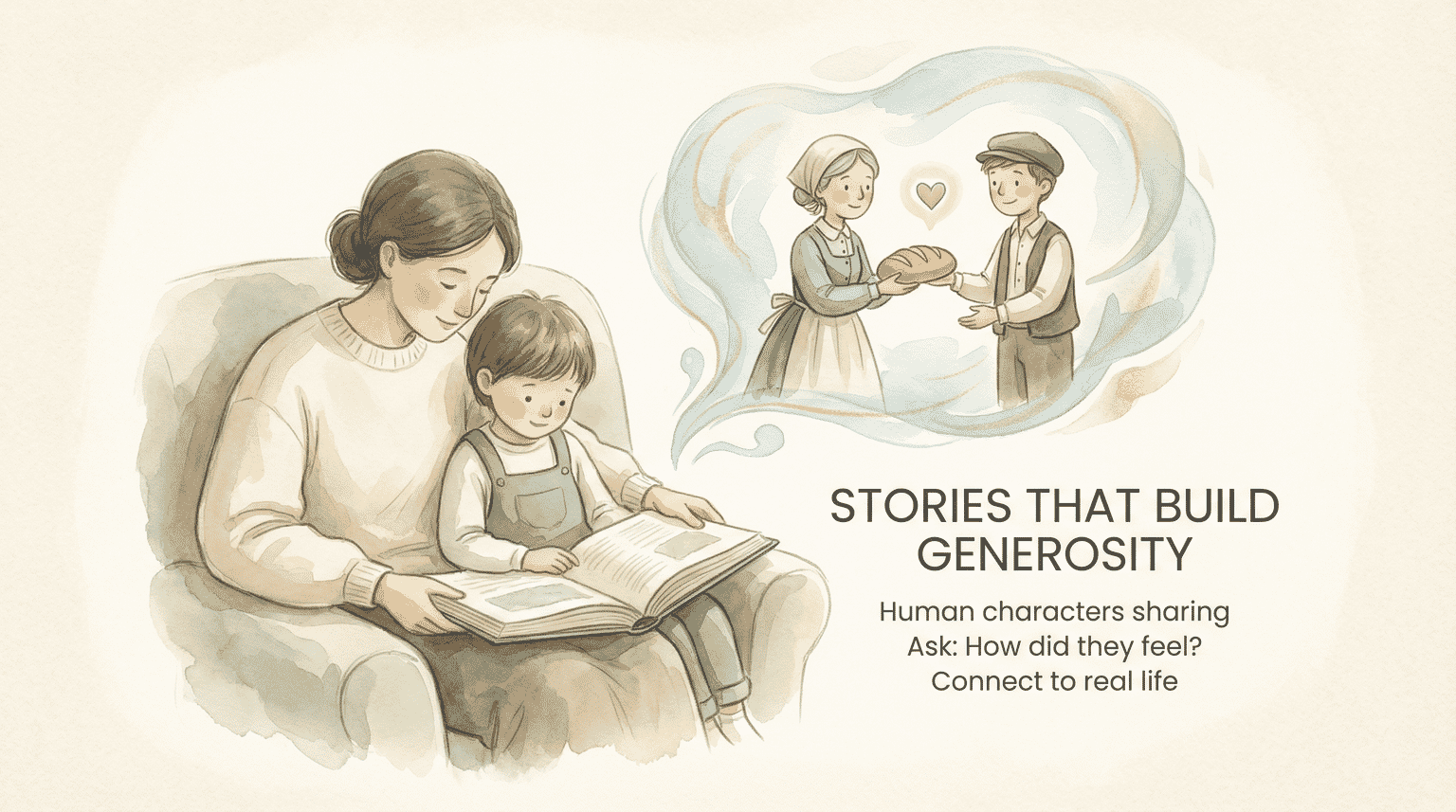
The Growing Gratitude and Generosity (G3) program at UC Berkeley reported that 93% of participating families increased their conversations about gratitude and generosity through story-based approaches. Corky Klimczak, the program’s co-director, notes:
“When I ask parents what they want for their children, the answer I hear the most is that parents want their children to grow up to be happy and kind.”
— Corky Klimczak, Co-director, UC Berkeley G3 Program
Post-story questions that deepen the lesson:
- “How do you think [character] felt when they shared?”
- “What would have happened if they hadn’t helped?”
- “Have you ever felt like that character?”
I’ve started being more intentional about this during bedtime reading. It’s not about finding “generosity books”—it’s about pausing during any story where a character gives or helps and asking what the kids notice.
Strategy #5: Use “What If” Questions
Here’s a technique I wish I’d known years ago.
Research on preschoolers ages 4-6 found that simply asking hypothetical emotional questions—”If Olivia didn’t share with you, how would you feel?”—led to higher rates of sharing when real opportunities arose later.
This is essentially priming empathy. By getting children to imagine emotional consequences before they face a sharing moment, you’re helping them access perspective-taking skills they might not naturally engage.
The timing matters here—these conversations work best before situations where generosity will be relevant, not as a lecture after someone didn’t share.
Sample questions by age:
For 3-5 year olds:
- “If nobody shared the playground toys with you, how would that feel?”
- “What if you went to a party and nobody gave you cake?”
For 6-8 year olds:
- “How would you feel if you were the new kid and nobody sat with you at lunch?”
- “What if you really wanted to play a game and everyone said no?”
For older kids:
- “Imagine you worked really hard on something and nobody noticed.”
- “What if you needed help and everyone was too busy?”
Strategy #6: Make Gift-Giving a Teaching Moment
This is where GiftExperts’ focus on the science behind meaningful gifts really connects to raising generous kids. Birthdays, holidays, and celebrations aren’t just gift-receiving occasions—they’re natural practice opportunities for giving.
Harvard’s research found that people who habitually express gratitude are more likely to be helpful, generous, compassionate, and forgiving—and also happier and healthier. The gratitude-generosity connection runs both directions.
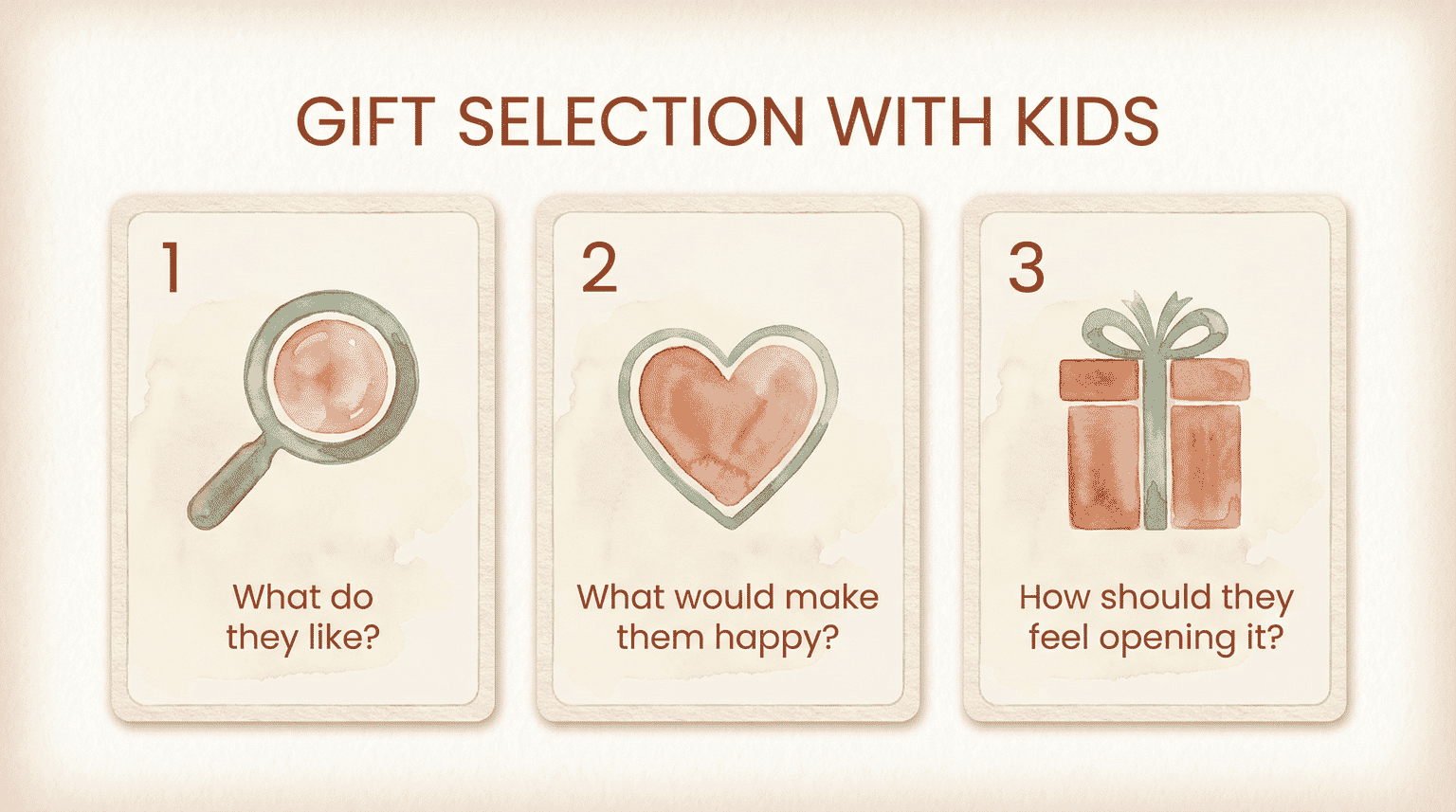
Birthday gift selection process:
Instead of buying something for your child to give, involve them in choosing. Ask:
- “What does [friend] really like?”
- “What would make them happy to open?”
- “What do you want them to feel when they see it?”
Holiday giving traditions:
- Let each child choose one item to donate before new gifts arrive
- Have them pick a gift for a sibling (with guidance appropriate to their age—see our guide to age-appropriate giving opportunities for specifics)
- Create a family giving project where everyone contributes
Thank-you rituals:
After receiving gifts, don’t just prompt “Say thank you.” Help them connect the gift to the giver’s thoughtfulness: “Grandma remembered you love dinosaurs. How do you think that made her feel to find this for you?”
Strategy #7: Model It Loudly
Here’s the thing about kids: they’re always watching. But if you’re generous quietly, they might miss it entirely.
A UC Davis study tracked preschoolers and their mothers, finding that children with mothers who expressed strong compassionate love were more likely to donate. Professor Paul Hastings explained that “compassionate mothers likely develop emotionally close relationships with their children while also providing an early example of prosocial orientation toward the needs of others.”
But here’s the part that gets overlooked: you have to narrate your generosity for kids to understand it.
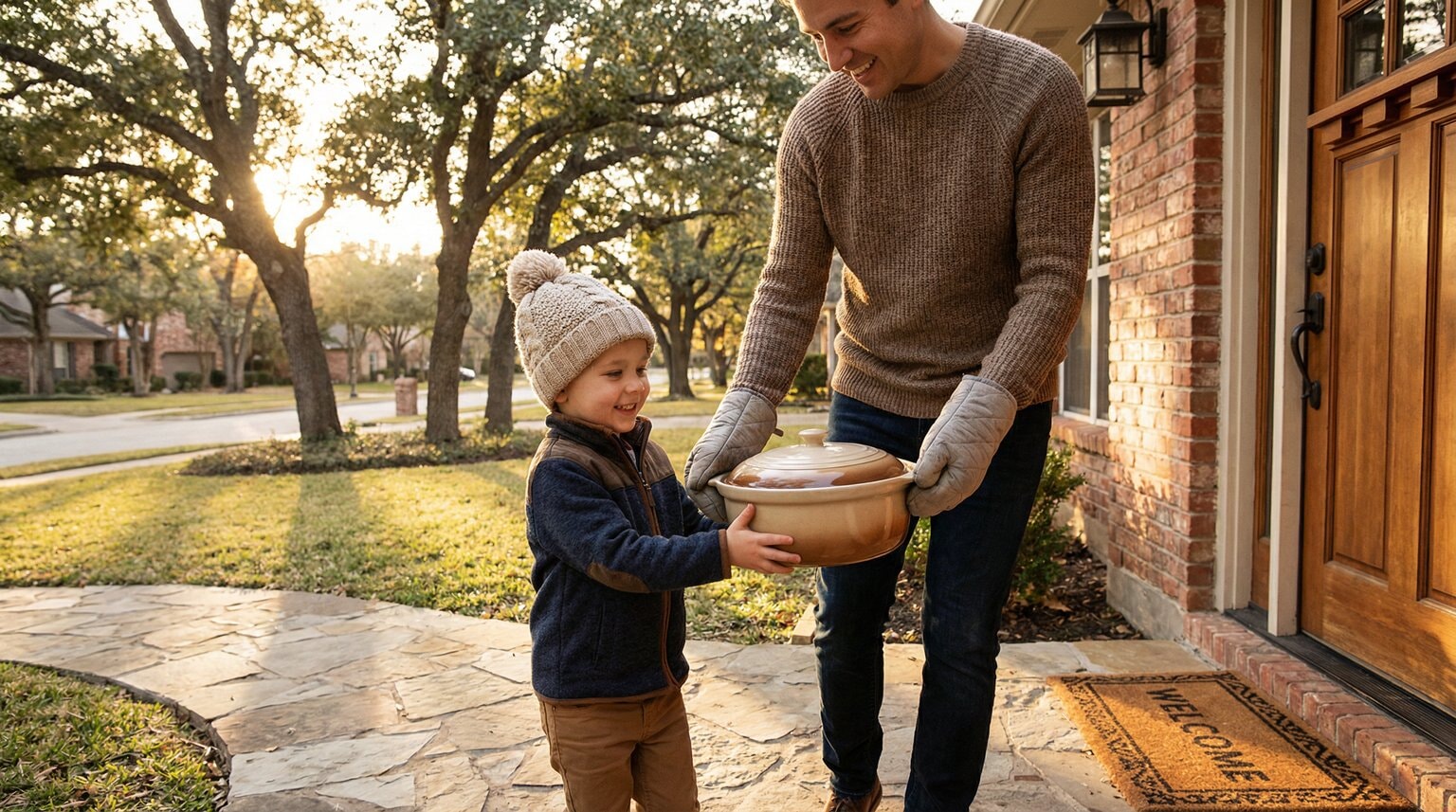
Talk-aloud scripts:
“I’m going to bring Mrs. Johnson some soup since she’s been sick. It feels good to help a neighbor.” Or: “I’m donating these clothes because another family might really need them.”
“I noticed the new mom at school looked overwhelmed, so I offered to help. Remember how we talked about noticing when someone needs kindness?”
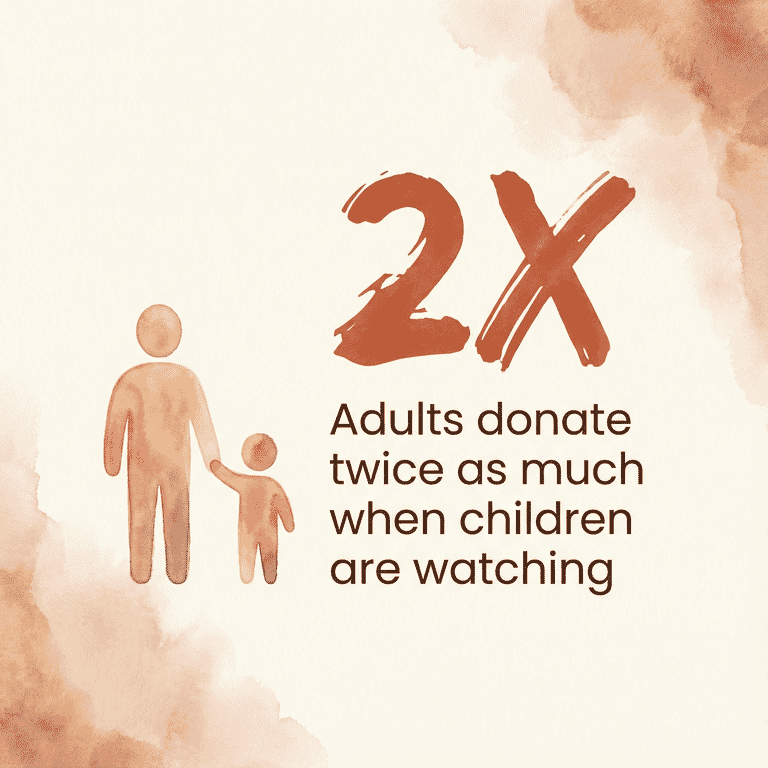
Research from The Conversation found that adults are actually more generous when children are present—donations doubled when kids were nearby. So involving your children in family giving decisions isn’t just teaching them; it might make you more generous too.
Quick Reference: What’s Realistic at Each Age
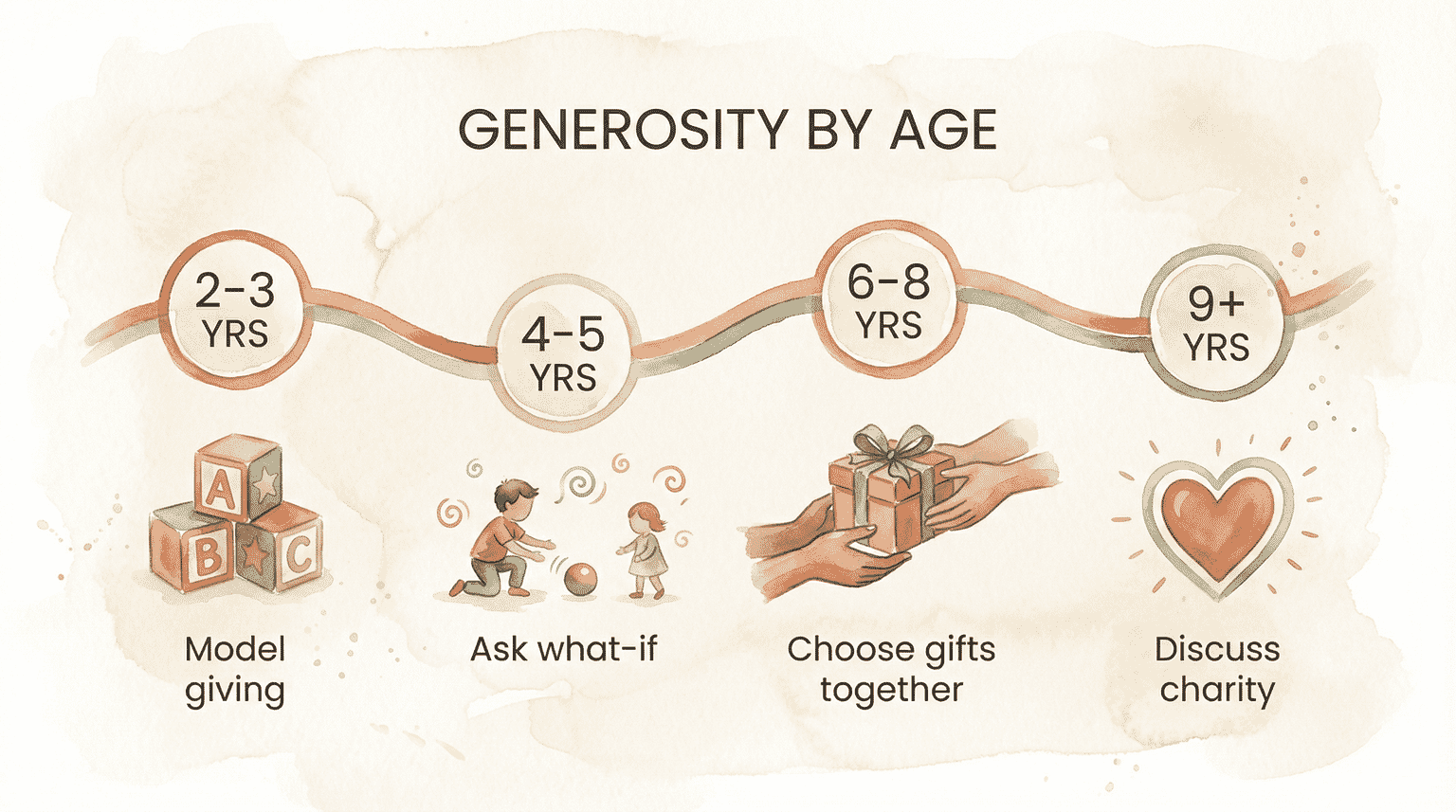
Understanding what’s developmentally appropriate prevents frustration for everyone. For a deep dive, see our article on when toddlers learn to share, but here’s the quick version:
| Age | What to Expect | How to Support |
|---|---|---|
| 15-24 months | Emerging sharing; warm glow possible | Offer opportunities, never force |
| 2-3 years | Parallel play; “mine” is normal | Model giving; read stories |
| 4-5 years | Perspective-taking developing | Use “what if” questions |
| 6-8 years | Can understand others’ feelings | Involve in gift selection |
| 9-12 years | Abstract generosity possible | Discuss charitable giving |
| Teens | Strategic, relationship-focused giving | Avoid material rewards; social encouragement only |
Each stage builds on the last. A toddler who experiences the warm glow of voluntary giving becomes a teen who helps without expecting anything in return.
What to Avoid: Three Common Backfires
1. Material rewards for generosity
The longitudinal research is clear: points systems, allowances for kind behavior, and prizes for sharing undermine the development of genuine compassion. Kids learn to expect something in return.
2. Forced sharing
When you require sharing, children lose the opportunity to experience the warm glow of voluntary giving. They also learn that their possessions can be taken at any time, which often increases possessiveness.
3. Abstract giving without visible impact
Dropping coins in a collection jar doesn’t build generosity the way face-to-face giving does. Young children especially need to see the recipient’s reaction to understand what their generosity accomplished.
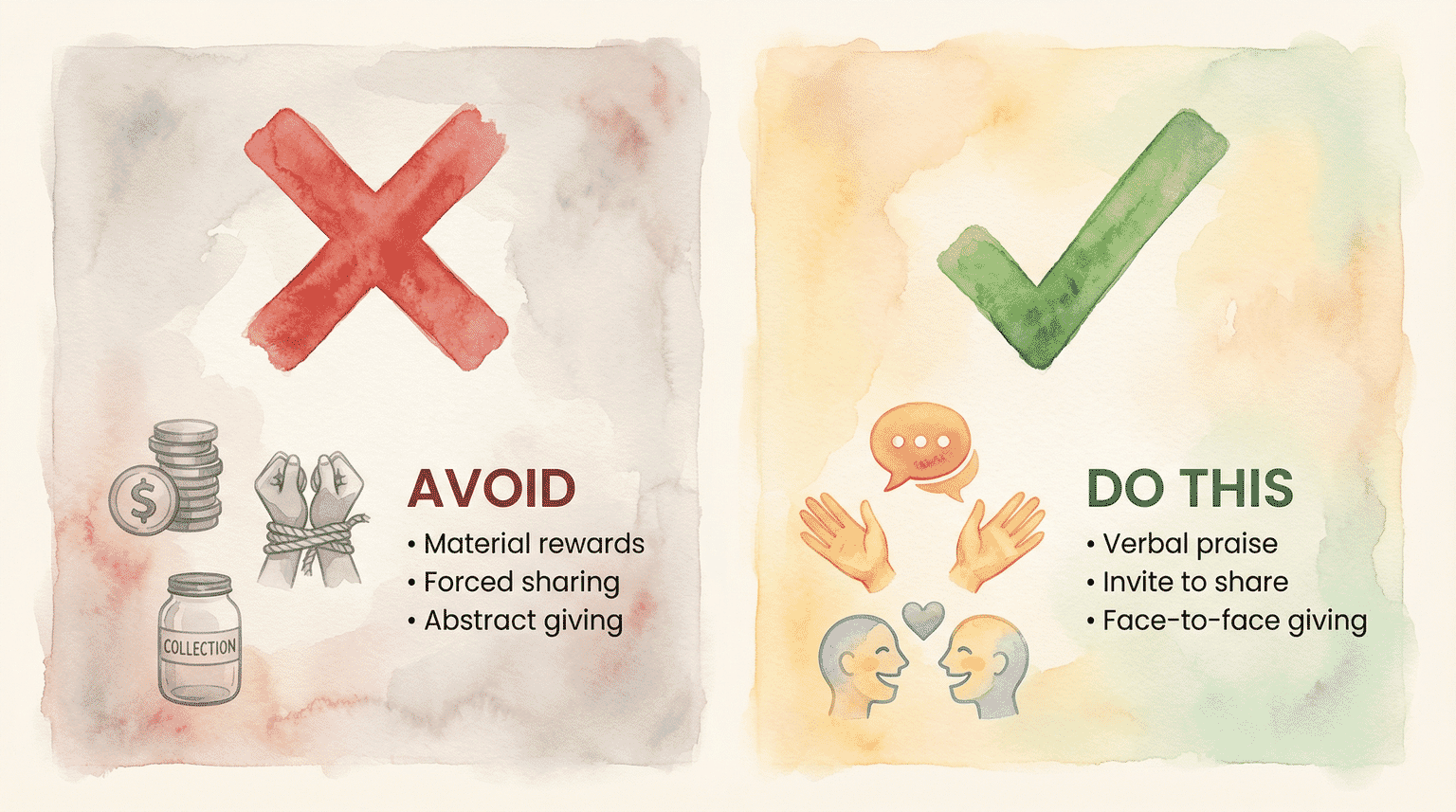
The good news? Once you understand what undermines generosity, avoiding these pitfalls becomes second nature.
Frequently Asked Questions
At what age can children understand generosity?
Children show early signs of generosity as young as 15-18 months. Research shows toddlers aged 20-22 months experience happiness from sharing—but only when giving is voluntary and from their own possessions. Perspective-taking abilities that deepen generous behavior develop more fully between ages 3-6.
Should I reward my child for being generous?
Verbal praise yes, material rewards no. A 3-year longitudinal study found that teens whose parents used material rewards for kindness showed less moral reasoning and were less likely to help without expecting something in return. Social encouragement—warmth, acknowledgment, connection—builds lasting generosity.
How do I teach my toddler to share?
Create opportunities for voluntary giving rather than forcing sharing. Research shows children experience the warm glow of giving only when the choice is theirs. Offer invitations like “Would you like to share?” and let your toddler witness the recipient’s positive reaction.
Why won’t my child share their toys?
Difficulty sharing is developmentally normal, not a character flaw. As Harvard researchers explain, a child who struggles to share “isn’t selfish—they’re not able to share yet and need support developing this ability.” This capacity develops gradually through childhood with consistent support.
How do I stop my child from being selfish?
Focus on creating positive giving experiences rather than punishing selfishness. Let children choose what to give, praise generous acts with specific verbal feedback, and ensure they witness recipients’ reactions. UC Davis research found that children who donate voluntarily feel calmer afterward—building intrinsic rewards creates lasting habits.
Share Your Story
When did you first see genuine generosity from your child—the kind that wasn’t prompted or rewarded? Those moments catch me off guard every time. I’d also love to hear what didn’t work—the strategies that backfired or made sharing feel like a battle.
Your generosity stories help other parents know they’re not alone in this.
References
- Harvard Gazette – How Children Learn to Be Good – Making Caring Common initiative on moral development growth mindset
- Parenting Science – The Warm Glow of Giving – Comprehensive research synthesis on children’s happiness from voluntary giving
- Greater Good Science Center – Should You Reward Teens for Being Kind? – Longitudinal study on social vs. material encouragement
- Psychology Today – How to Foster the Value of Generosity – Verbal praise and biological foundations of generosity
- American Psychological Association – The Case for Kindness – Research on face-to-face giving and emotional rewards
- Greater Good Science Center – How Children Can Become Caring Community Members – G3 program research and storytelling effects
- UC Davis – Is It Better to Give Than Receive? – Maternal compassion and children’s physiological responses to giving
- Harvard Graduate School of Education – Raising Caring, Respectful, Ethical Children – Gratitude-generosity connection research
- The Conversation – Adults Are More Generous in the Presence of Children – Research on children’s influence on adult prosocial behavior

Share Your Thoughts