
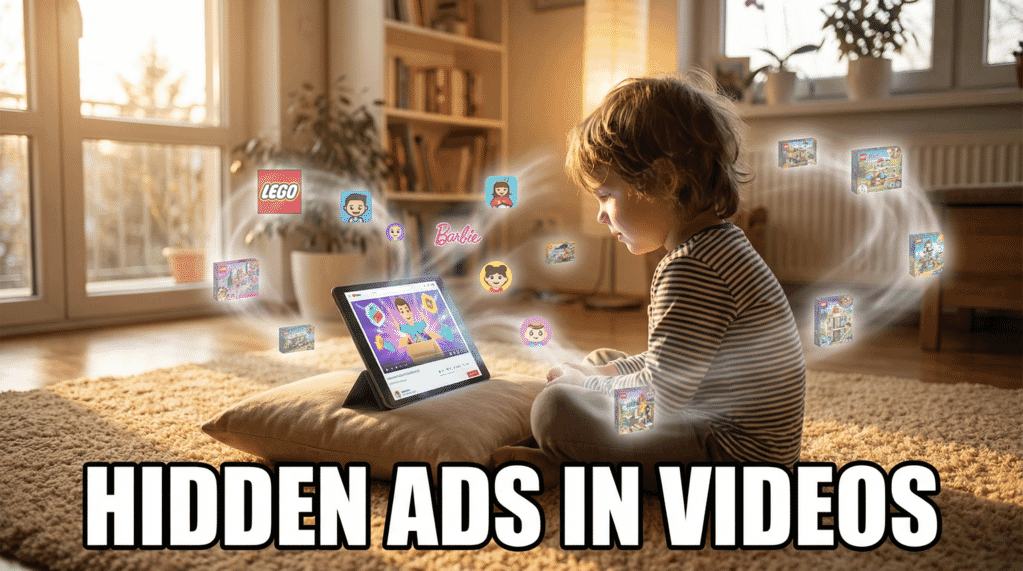
My 6-year-old asked for a specific brand of slime kit last week. Not just any slime—this exact brand, in this exact color, with these exact add-ins. When I asked where she’d heard about it, she shrugged: “From my videos.”
She couldn’t tell me which video. She didn’t remember seeing an ad. As far as she knew, a kid she watches just happened to be playing with it.
My librarian brain couldn’t let this go. What I found when I dug into the research genuinely alarmed me—and I’ve been parenting through YouTube’s rise with eight kids spanning toddlerhood to teens.

Key Takeaways
- 61% of kids’ marketing exposure comes from content embedded within videos, not labeled ads—making it nearly invisible to parents. (Use these 3 labels to help kids spot it.)
- Children under age 8 cannot reliably distinguish advertising from entertainment, and full comprehension doesn’t develop until around age 12
- YouTube earned $959 million from users 12 and under in 2022—creating massive financial incentive to keep children watching
- Research found only ONE video out of 400+ disclosed food sponsorship, despite FTC requirements
- Specific visual cues can help parents identify hidden advertising in their children’s content
What “Hidden Advertising” Actually Means
Let’s be clear about what we’re talking about. Hidden advertising in kids’ YouTube content isn’t the skippable ad before a video starts. It’s brand promotion woven directly into entertainment—appearing as part of the fun rather than as labeled commercials.
Hidden advertising in kids’ YouTube content refers to brand promotion embedded within video entertainment rather than clearly labeled ads. Unlike traditional pre-roll ads marked “Ad” or “Sponsored,” hidden advertising blends into content through:
- Unboxing videos featuring branded toys without sponsorship disclosure
- Product integration where branded items appear as props or story elements
- Influencer endorsements presented as personal preferences
- Gameplay content centered on specific branded products
- Lifestyle demonstrations showing products in “natural” use
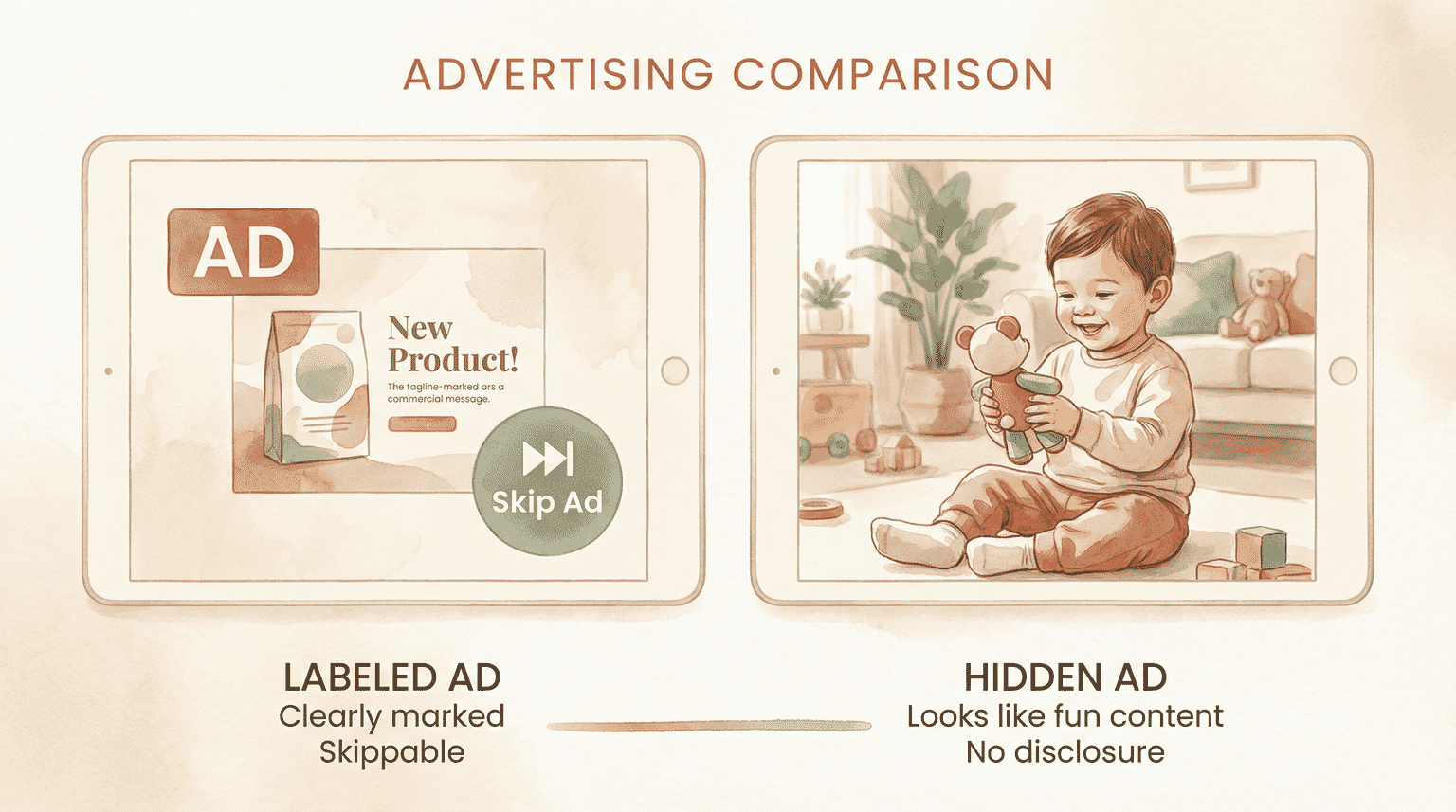
Research shows that 61% of children’s marketing exposure comes from content embedded within videos, not from labeled advertisements. That’s the key distinction: when my daughter watches a “regular” video and sees a kid her age excitedly playing with a toy, she’s experiencing advertising—she just doesn’t know it.
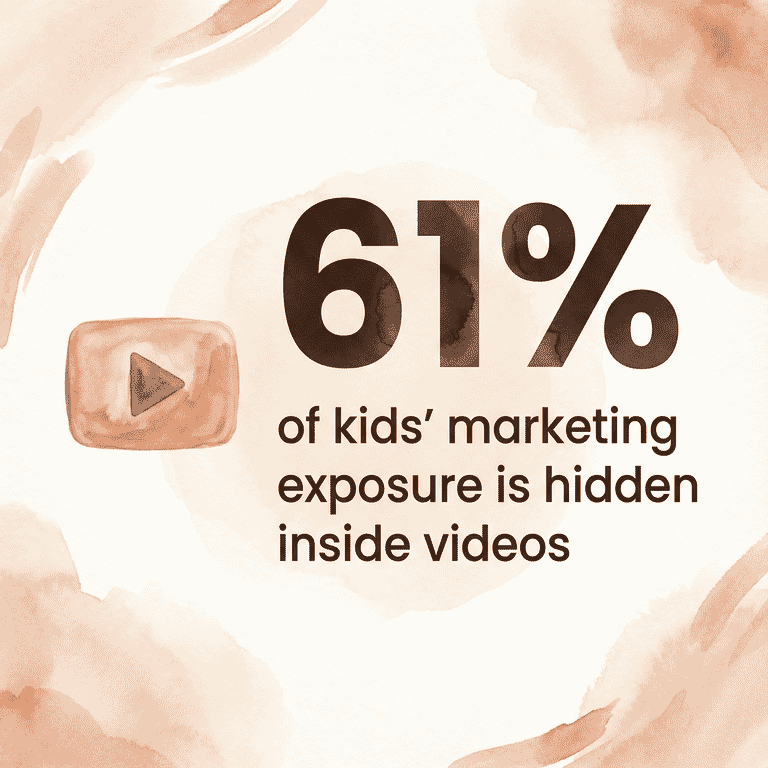
This statistic stopped me cold. Nearly two-thirds of the marketing reaching our children doesn’t look like marketing at all. It looks like entertainment, like play, like a kid just having fun with a cool toy.
If you’re curious about why children find unboxing content so compelling, the psychology runs deep. But first, let’s follow the money.
The Financial Reality Driving This
Here’s what helped me understand why this problem is so pervasive: platforms have enormous financial incentive to keep children watching.
A 2024 Harvard study tracking platform revenue found that YouTube earned $959.1 million from users 12 and under in 2022—plus another $1.2 billion from ages 13-17. A striking 27% of YouTube’s total advertising revenue that year came from users under 18.
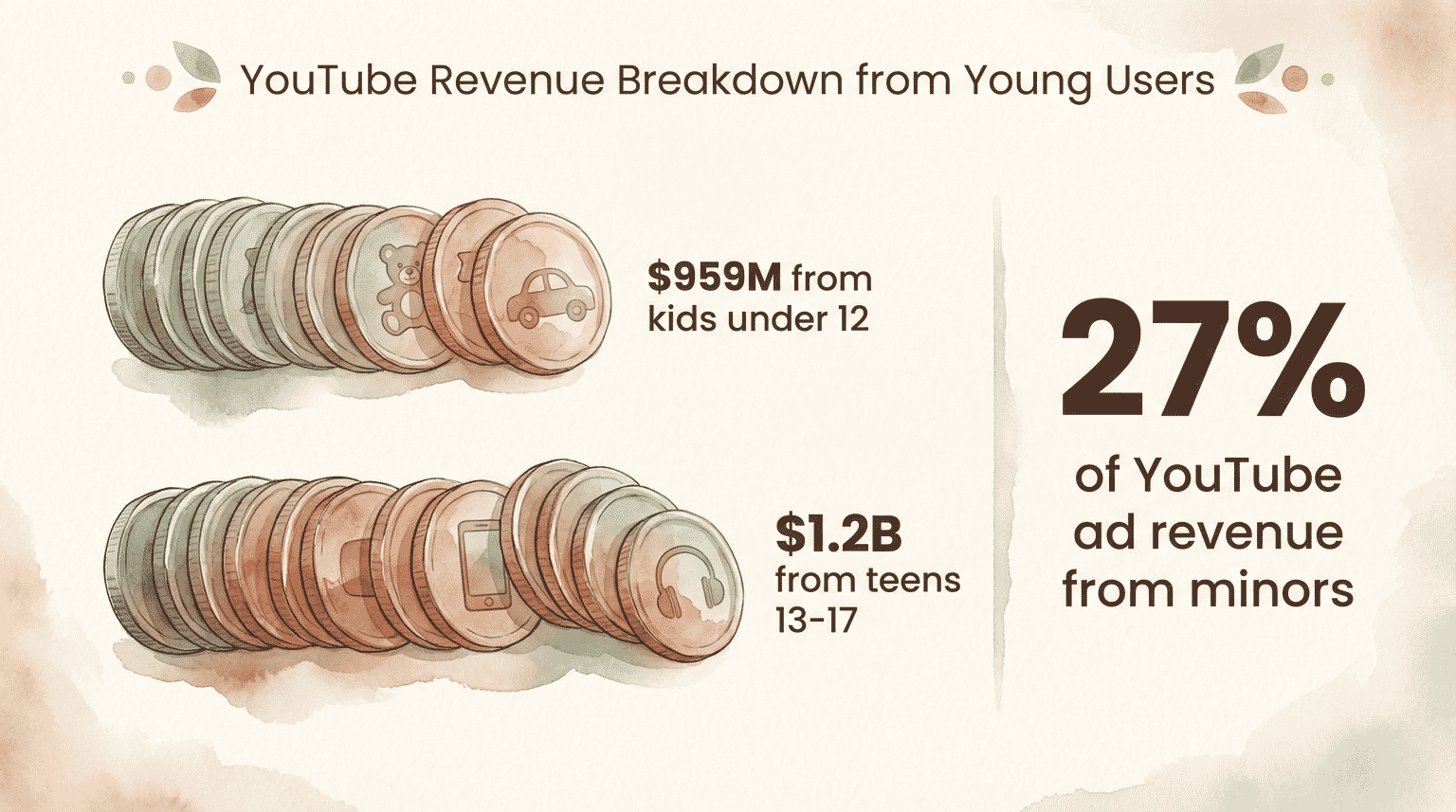
Professor Bryn Austin from Harvard’s T.H. Chan School of Public Health doesn’t mince words:
“Although social media platforms may claim that they can self-regulate their practices to reduce the harms to young people, they have yet to do so… they have overwhelming financial incentives to continue to delay taking meaningful steps to protect children.”
— Bryn Austin, Professor, Harvard T.H. Chan School of Public Health
Meanwhile, a 2021 JAMA Network Open study examining the top child-directed YouTube channels found children encounter an average of 5.72 advertisements per video. On one popular channel (Like Nastya), unskipped ads were actually longer than the videos themselves—1.6 minutes of ads for every minute of content.
But those are the labeled ads. The embedded marketing operates on top of that.
How Hidden Advertising Actually Reaches Children
Researchers at France’s École Polytechnique discovered something concerning about how targeting works. While YouTube’s policies supposedly restrict personalized advertising to children, their study found that 25% of ads appearing on children-focused videos showed evidence of profiling-based targeting—using interests, location, or behavioral data.
Even more troubling: when the researchers checked the ad explanations YouTube provides, they found the platform gave misleading information on children’s content. The same ad campaign would show accurate targeting explanations on adult videos but claim “personalization is disabled” when appearing on videos sourced from YouTube Kids.
The research team concluded bluntly: “We believe that the current legal and technical solutions are not enough to protect children from harm due to online advertising.”
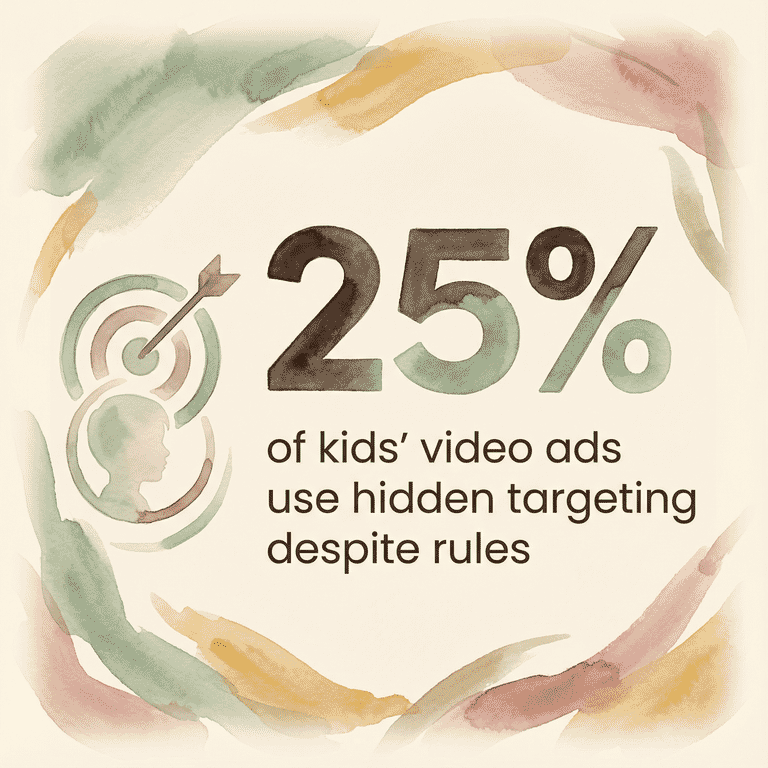
This creates a protection gap where parents can’t easily see what’s happening. As one 2024 study noted, “Parents cannot easily see what children are viewing now that screen time has shifted from shared televisions to personal devices.”
What Children Actually See

Let me break down what the research reveals about content itself.
A 2023 study in PMC analyzing food advertising found that 93.8% of food advertisements in children’s YouTube content were for ultra-processed products. Videos featuring kid YouTubers—child influencers—showed 2.79 times more frequent food advertising placements than other children’s content.
Why kid influencers specifically? The study explains: “The content of kid YouTubers’ videos contains subtle integrations between brand advertising and entertainment, which makes them more difficult to be recognized as advertising content.”
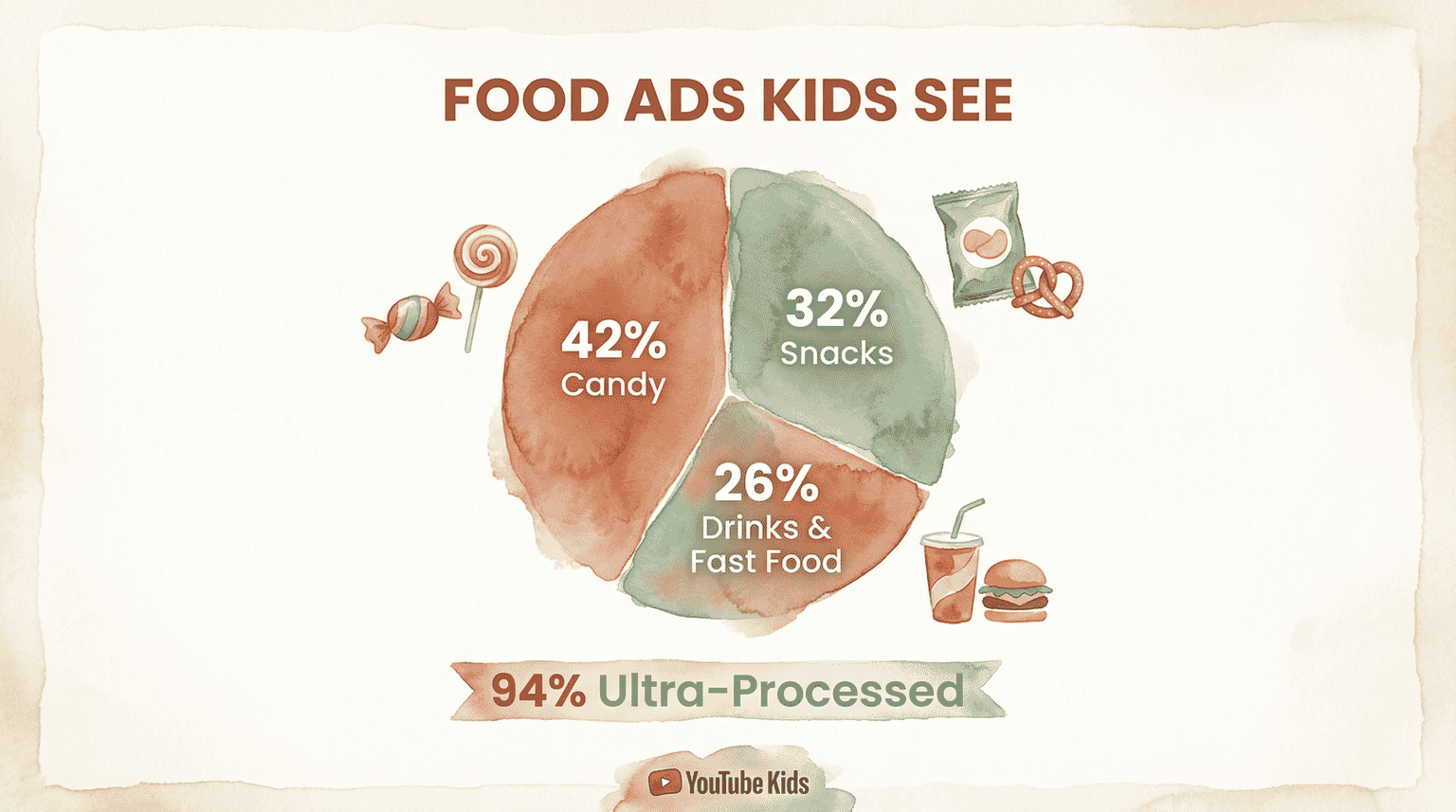
An international study from 2021 examining kid YouTuber channels in the US, UK, and Spain found 71% of food products appearing were unhealthy—rising to 88% on US channels specifically. Products high in sugar dominated across all countries.
Candy alone accounts for 42% of branded food appearances in children’s content. Sweet and salty snacks add another 32%, followed by sugary drinks and fast food.
And here’s what struck me: research tracking actual child viewing found that only 17% of brand exposure came from traditional advertisements. The majority—61%—came from brands embedded within videos. Another 23% came from thumbnails. Most of the marketing children encounter doesn’t look like marketing at all.
Why Children Can’t Recognize It

This is where my mom-of-eight experience meets the developmental research—and it’s uncomfortable.
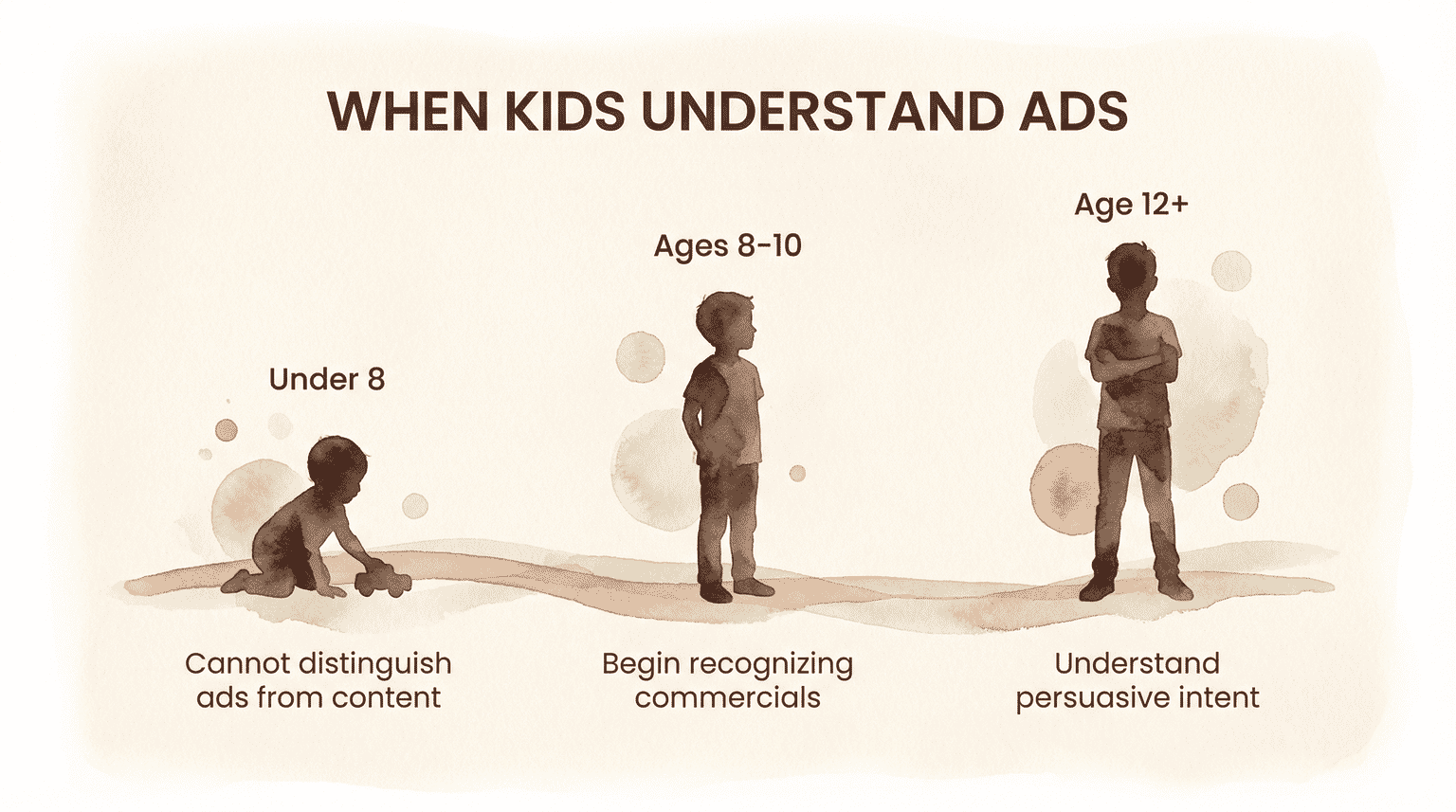
Children under age 8 cannot reliably distinguish advertising from entertainment content. Full comprehension of advertising’s persuasive intent doesn’t develop until around age 12. That means my 6-year-old, my 4-year-old, and my 2-year-old have essentially zero defense against embedded marketing.
A 2023 study from the Journal of Media Literacy Education found that children ages 6-7 had the most difficulty identifying video purposes and sponsorships. Even by ages 10-11, many children perceived YouTubers’ commercial messages favorably as just part of entertainment.
But here’s what really got my attention: children who felt emotionally attached to kidfluencers showed more susceptibility to persuasive messages. The researchers noted that “emotional distancing favored more critical analysis—here are 3 questions that help,” while children who liked and followed certain creators were less able to critically evaluate commercial content.
This connects directly to why kids feel like YouTube stars are their friends—a phenomenon researchers call “parasocial relationships.” YouTubers portray themselves as authentic and intimate, displaying their bedrooms and revealing personal details. Children form genuine emotional bonds with these personalities.
And when you trust someone like a friend, you don’t question their recommendations.
As one research team put it: “Advertising is introduced as part of the narrative, making it difficult to distinguish between content and publicity.” Children become influencers by imitation, finding social models on YouTube alongside school and family.
The Disclosure Failure
Here’s where I went from concerned to genuinely frustrated.
FTC guidelines require disclosure of paid sponsorships and product placements. But research examining hundreds of children’s videos tells a different story.
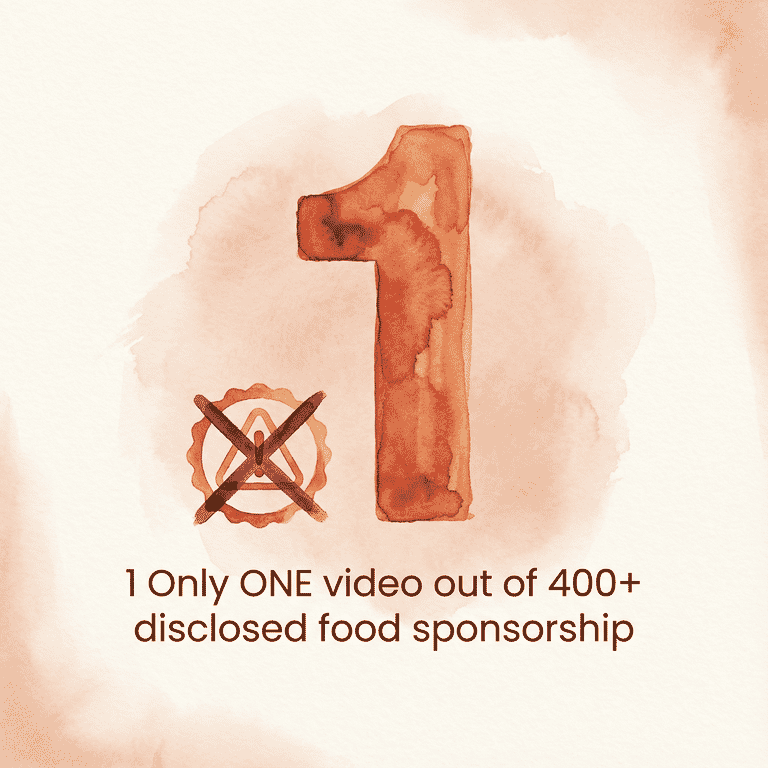
A 2023 study examining 400+ children’s influencer videos found that only one video disclosed a food-brand sponsorship. A 2024 study found zero disclosures of food company sponsorship in the videos analyzed.
Even when disclosures exist, they’re often inadequate. One study found that among videos with any disclosure, 44.9% disclosed only in the description (which children never read) rather than within the video itself. No videos maintained disclosure throughout their duration.
The transparency we expect simply isn’t happening.
“These things are simple and might only be brief in the video, but they can tip your awareness and indicate that what you’re watching is a paid promotion, not an organic video.”
— Dr. Jason Freeman, Professor, Brigham Young University
The problem is that children aren’t watching for those cues—and parents often aren’t watching at all.
What Parents Can Actually Do
Here’s where I shift from librarian-researcher mode to practical-mom-of-eight mode. The research points to specific strategies that actually help.
Detection First
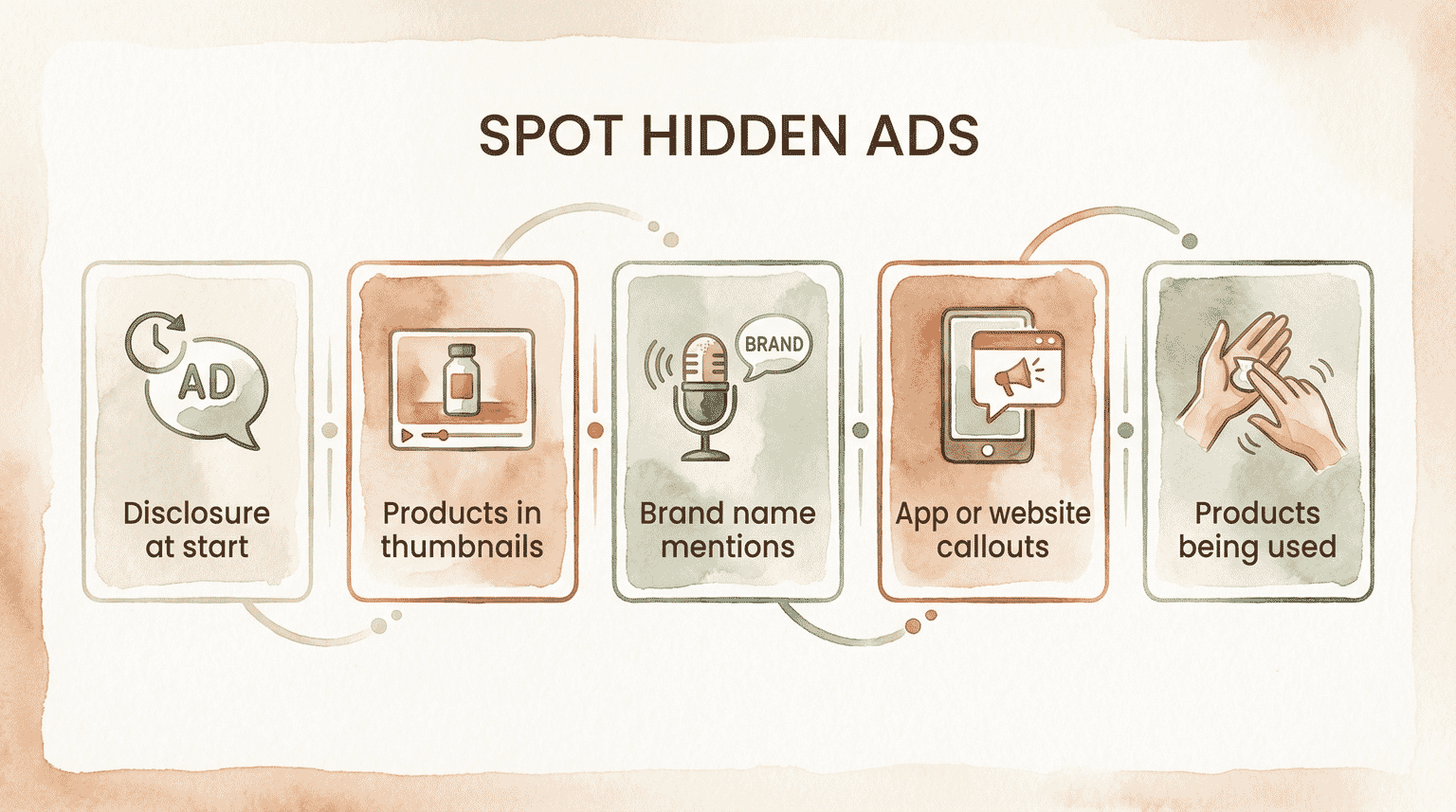
Dr. Freeman’s research identified concrete visual and behavioral cues parents can watch for:
- Disclosure language at video start (even if brief and easy to miss)
- Branded products featured prominently in thumbnails or titles
- Verbal brand mentions during content
- Calls to related apps, websites, or content (often on other platforms)
- Products shown being used or consumed rather than simply appearing
When I started watching my kids’ videos with these cues in mind, I was stunned by how much I’d missed.
Co-Viewing Matters More Than Restrictions
A finding that surprised me: the 2024 mobile device study found that children of parents with graduate degrees had 74% lower odds of seeing two or more ads per day. But crucially, this difference appeared driven by content type rather than total screen time.
It’s not just how long children watch—it’s what they watch and whether parents are engaged.
For younger children, this might mean sitting together and asking questions: “Why do you think they’re showing that toy?” For older kids, it might mean periodic check-ins about what they’re watching and conversations about how advertising works.
Platform Choices
Research confirms real differences between platforms:
- YouTube Kids blocks traditional pre-roll ads (though branded content within videos still appears)
- Regular YouTube has no advertising restrictions for children’s content
- Subscription services like Netflix and Disney+ don’t expose children to advertising
Understanding these differences helps inform choices—even if no platform is perfect.
Connecting the Dots
As children get older, they can start understanding how digital media shapes what they want. This awareness helps when navigating common gift challenges like managing requests and expectations.
In my house, I’ve started explicitly naming it: “Companies pay to have their toys in videos because they know you’ll want them. It’s designed to work that way.”
My 10-year-old rolled her eyes. My 12-year-old said, “I know, Mom.” But I’ve noticed both of them becoming more skeptical about what they “need.”
The Bigger Picture

The research team from École Polytechnique concluded something that’s stayed with me: current legal and technical solutions are simply not enough to protect children from online advertising harm.
That’s starting to change. In January 2025, the FTC finalized major updates to COPPA limiting how companies can monetize children’s data. In September 2025, the FTC settled with Disney over child-directed YouTube content violations. Regulation is arriving—slowly.
“Our finding that social media platforms generate substantial advertising revenue from youth highlights the need for greater data transparency as well as public health interventions and government regulations.”
— Dr. Amanda Raffoul, Harvard Medical School
Until that transparency and regulation arrives, parents are left filling the protection gap ourselves. That’s exhausting—I know. With eight kids across every age, I can’t co-view everything. I can’t catch every embedded ad.
But I can teach my children, gradually and age-appropriately, that the videos designed to feel like entertainment are often something else entirely. And I can pay attention to the specific products they start asking for, tracing requests back to their source.
My 6-year-old still watches her videos. But now, at least sometimes, I’m watching too—and asking questions.
Frequently Asked Questions
At what age can children understand YouTube advertising?
Children begin distinguishing commercials from content around ages 8-10, but full comprehension of advertising’s persuasive intent—including embedded marketing—doesn’t develop until approximately age 12. Even then, emotional attachment to creators can override critical thinking.

Is YouTube Kids safer than regular YouTube for advertising?
YouTube Kids blocks traditional pre-roll ads, but branded products still appear extensively within video content on the platform. Research shows 61% of children’s marketing exposure comes from embedded content, not labeled ads—and that embedded content appears on both platforms.
What should I look for to identify hidden advertising?
Watch for: branded products featured prominently in thumbnails or titles, verbal brand mentions during content, creators demonstrating or consuming specific products, calls to related apps or websites, and brief disclosure text at video start. Products shown being actively used (rather than just appearing) often indicate paid placement.
How can I talk to my child about advertising in videos?
While watching together, point out when products appear prominently and ask questions like “Why do you think they’re showing that toy?” or “Do you think someone paid for that to be in the video?” This builds recognition skills gradually without lecturing. Keep conversations age-appropriate—younger children need simpler explanations while older kids can understand financial incentives.
Join the Conversation
Have you spotted hidden ads in your kid’s videos? I’d love to hear what tipped you off—and whether your child believed you when you pointed it out. These stories help other parents know what to watch for.
I read every single story and reply when I can.
References
- Marketing to Children Through Online Targeted Advertising – École Polytechnique research on targeting loopholes and misleading ad explanations
- Food Advertising on YouTube Channels Aimed at Children – PMC study on ultra-processed food advertising prevalence
- Frequency and Duration of Advertising on Popular Child-Directed Channels – JAMA Network Open analysis of ad frequency across top channels
- Estimating Young Children’s Exposure to Food and Beverage Marketing – PMC study on actual mobile device marketing exposure
- Health-Related Food Advertising on Kid YouTuber Channels – Cross-national study of unhealthy food prevalence
- Social Media Platforms Make $11B from U.S. Youth – Harvard T.H. Chan School of Public Health revenue analysis
- Children Negotiating Meanings in Kidfluencers’ Channels – Journal of Media Literacy Education study on age-specific recognition challenges

Share Your Thoughts