

Another package arrived yesterday. The third this week. My mother-in-law had discovered Amazon’s one-click ordering, and my 4-year-old was developing an expectation that every visit to grandma’s house came with a new toy.
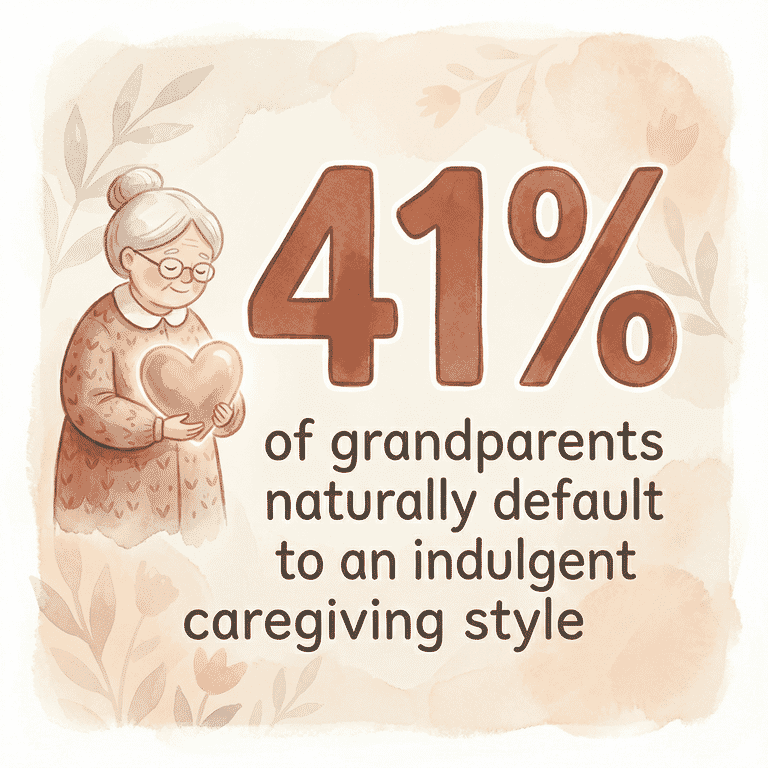
Here’s the thing: I wasn’t actually mad. A 2023 study on grandparent feeding practices found that 41% of grandparents naturally use an “indulgent” caregiving style—meaning nearly half of all grandparents default to spoiling. It’s not rebellion against your parenting. It’s practically in the grandparent job description.
But “normal” doesn’t mean “unlimited.” So how do you know when loving indulgence crosses into problematic territory? And more importantly, how do you have that conversation without creating a family rift?
I’ve navigated this eight times now—with my own parents, my in-laws, and various honorary grandparent figures. Here’s what actually works.
Key Takeaways
- 41% of grandparents default to indulgent caregiving—it’s normal, not a rebellion against your parenting
- The warning sign isn’t what grandparents do—it’s whether their choices consistently undermine health, authority, or healthy expectations
- Lead conversations with shared goals, not criticism—and always offer alternatives
- Experience-based spoiling (time, activities, skills) creates stronger bonds than material gifts
- Help kids understand that different houses have different rules—it’s actually a valuable life skill

The Spoiling Spectrum: What’s Normal vs. What’s Not
My librarian brain needed to understand the difference between harmless grandparent indulgence and patterns that might actually cause problems. Turns out, researchers have studied this extensively.
Healthy indulgence looks like:
- Occasional treats during visits (the research calls this “structured treat provision”)
- Special activities that break normal routines
- Extra patience and attention
- Relaxed rules on non-safety issues
- Gift-giving that respects general family values
Problematic patterns look like:
- Treats used as the primary relationship currency
- Openly contradicting parents in front of children
- Undermining established health routines consistently
- Secret-keeping that teaches kids to hide things from parents
- Gift frequency that creates expectation rather than surprise
Research from the UK identified that whether grandparents’ caregiving style was “responsible” or “fun,” both approaches were framed within a wider context of practicing love.
The grandmother who enforces bedtime and the grandmother who lets kids stay up late? Both motivated by love. That understanding changes everything about how you approach the conversation.
The warning sign isn’t what grandparents do—it’s whether their choices consistently undermine your child’s health, your authority, or your child’s developing expectations about how the world works.

Once you can name what’s healthy versus what’s concerning, the conversation becomes much easier to frame.
Why Grandparents Spoil: Understanding Before Acting

Before you script the conversation, it helps to understand what’s driving the behavior. One grandmother in a UK caregiving study explained it perfectly:
“It’s not that you love your grandkids any more than you love your children, but it just… it feels like a different kind of love.”
— Grandmother participant, UK caregiving study
That hits differently when you really sit with it.
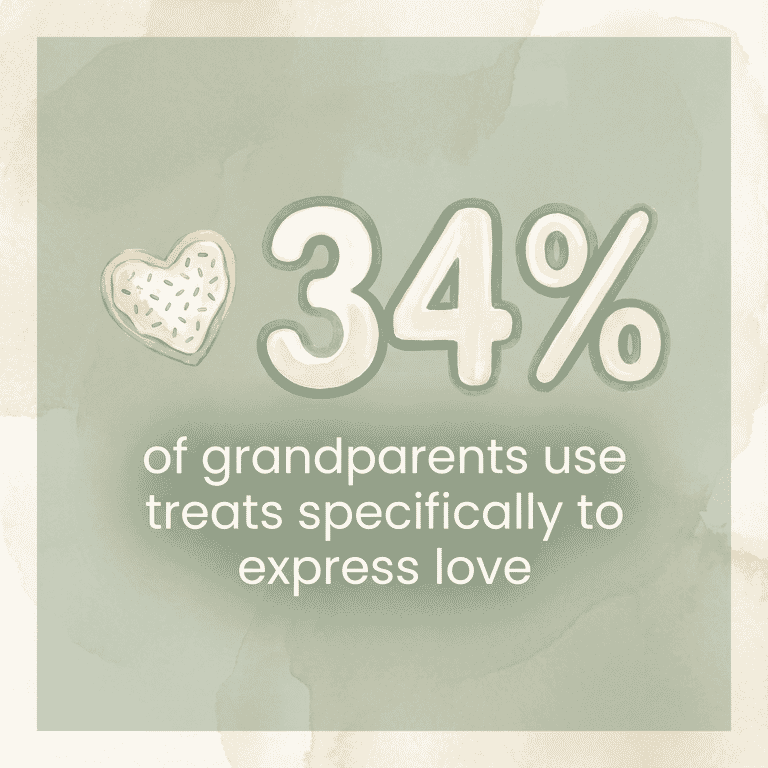
Grandparents operate without the daily weight of discipline, routine enforcement, and long-term outcome anxiety. They get to be the fun ones. Research shows that 34% of grandparents use treats specifically to express love—compared to just 22% of parents. They’re not undermining you; they’re speaking their love language.
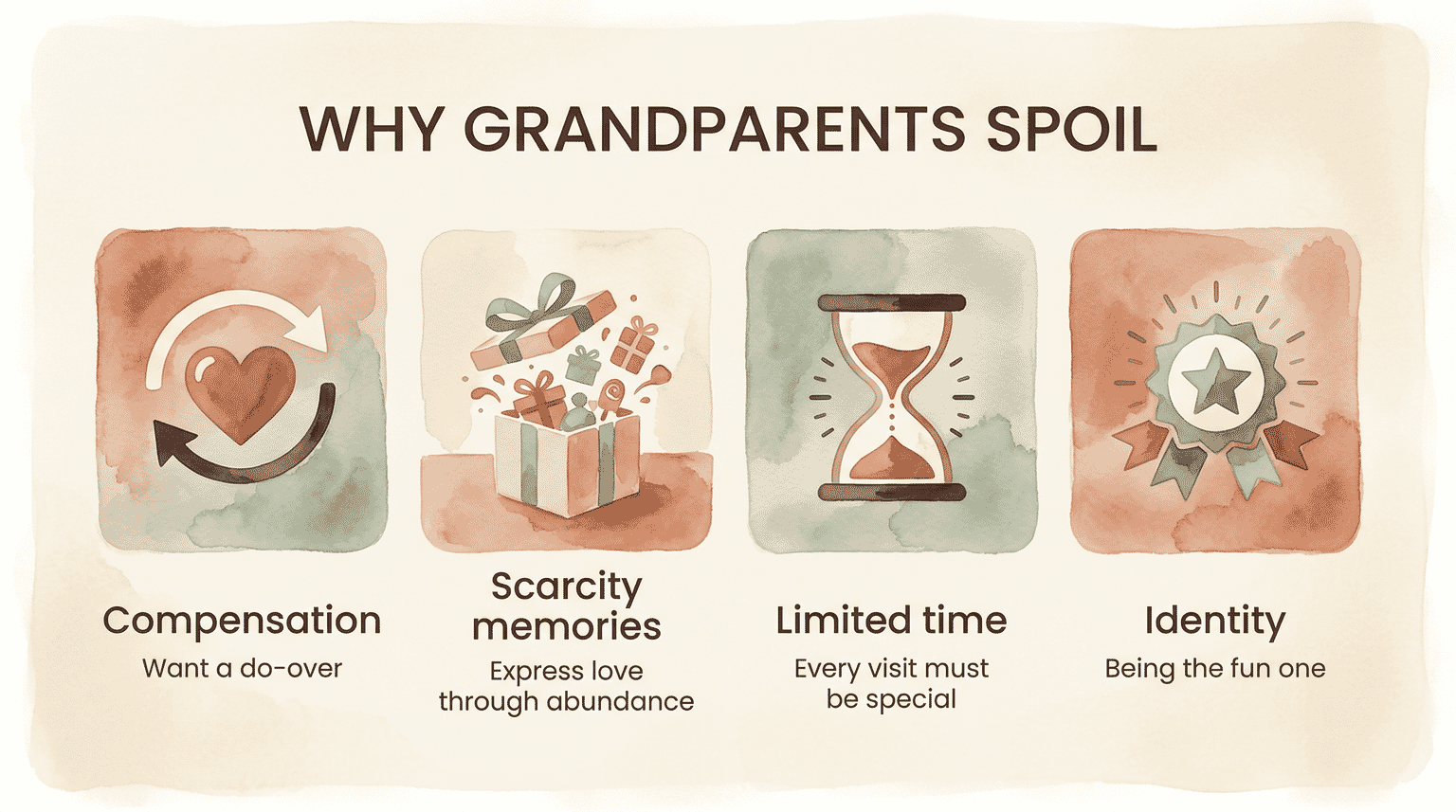
Other motivations I’ve observed in my own family run deep. Compensation drives grandparents who were strict with their own kids and now want a do-over.
Scarcity memories mean those who experienced hardship may express love through abundance. And limited time makes every visit feel like it should be special when you only see grandkids occasionally.
Understanding the why doesn’t mean accepting everything. But it does mean you can approach conversations with empathy instead of accusation—which research shows gets dramatically better results.
The Conversation Framework: Five Steps That Actually Work

Here’s the approach I’ve refined over years and multiple grandparent relationships. It’s based partly on what Chilean researchers documented about successful family communication around food practices, and partly on my own trial and error.
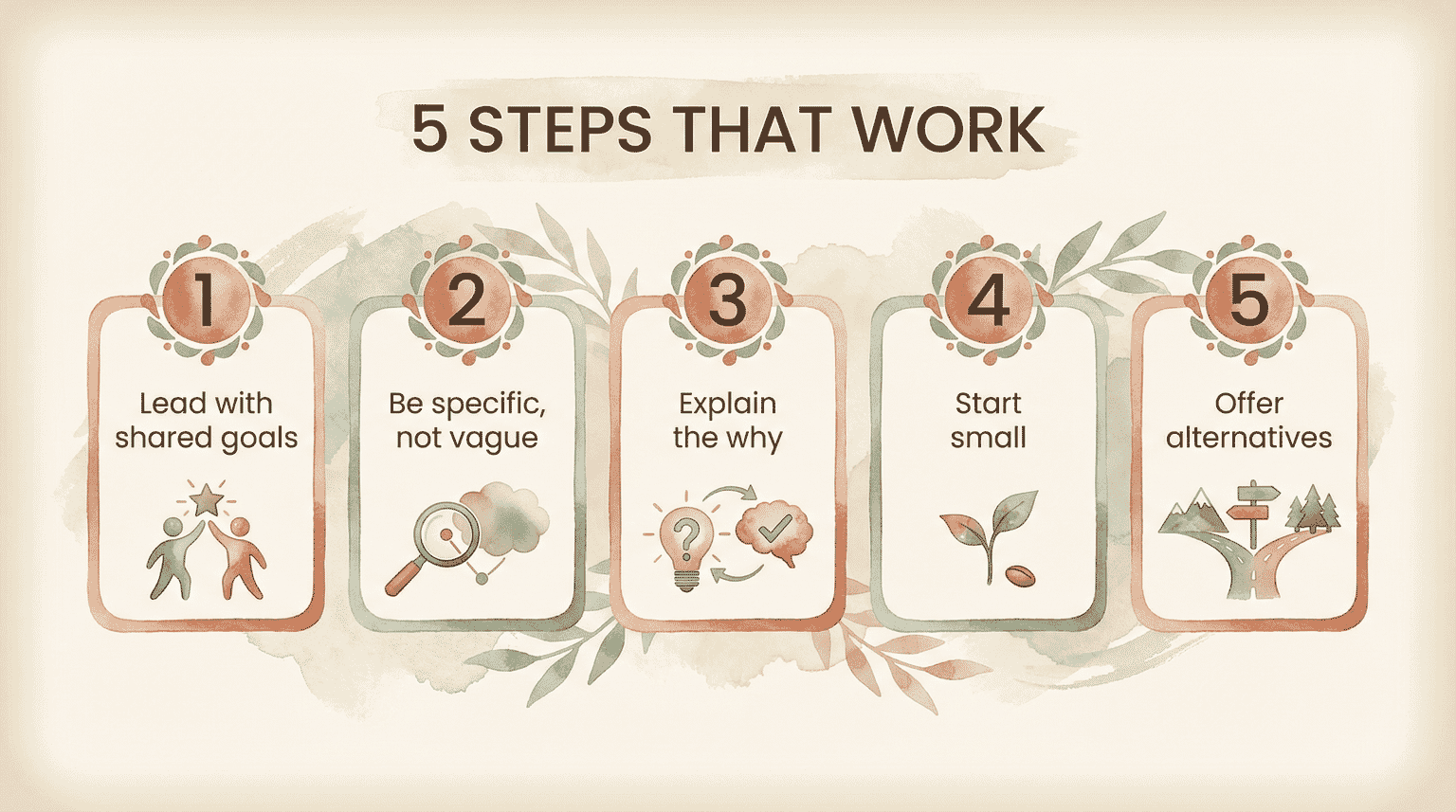
Step 1: Lead with Shared Goals
Never open with criticism. Start by establishing that you both want the same thing.
Try: “I know how much you love spending time with Emma, and she adores you. I want to make sure she can keep having that special relationship for years to come—which means we need to talk about some health stuff.”
This positions you as teammates, not adversaries.
Step 2: Be Specific, Not Vague
“Less sugar” means something different to everyone. “One dessert per visit” is clear.
One parent in the Chilean study described the confusion problem perfectly: “I prohibited something to the child, and she gives it to him, so the child is confused.” The solution? Concrete agreements.
Instead of: “Can you not give her so many toys?”
Try: “Could we agree on one small gift per visit? That way it stays special instead of expected.”
Step 3: Explain the Developmental “Why”
Grandparents respond better when they understand the reasoning—not just receive instructions. This is where your research actually helps.
Try: “I’ve been reading about how kids this age are developing expectations and impulse control. When treats or gifts happen every single time, they stop being special and start being demands. I don’t want her treating you like a vending machine instead of her grandmother.”
Step 4: Start Small and Build
Don’t try to overhaul everything at once. Pick one issue—the most important one—and address that first. Success builds trust for future conversations.
In my house, we started with “no screens at grandma’s house” because my mother was handing over her iPad the moment anyone whined. Once that boundary held, other conversations became easier.
Step 5: Offer Alternatives
This is crucial. Don’t just take away grandparents’ tools for connection—give them better ones.
Try: “Instead of a toy every visit, what if you two had a special activity? She talks about your garden all the time. What if ‘helping grandma with flowers’ became your thing?”
For more ideas on meaningful alternatives to material gifts, I’ve written about experience-based giving that actually strengthens relationships.
Redirecting the Love: Alternative Ways to Spoil

The goal isn’t to stop grandparent indulgence—it’s to channel it productively. Research on grandparent influence suggests the best outcomes come from families that “amplify positive influence while mitigating potential negatives.”
Here’s what that looks like in practice:
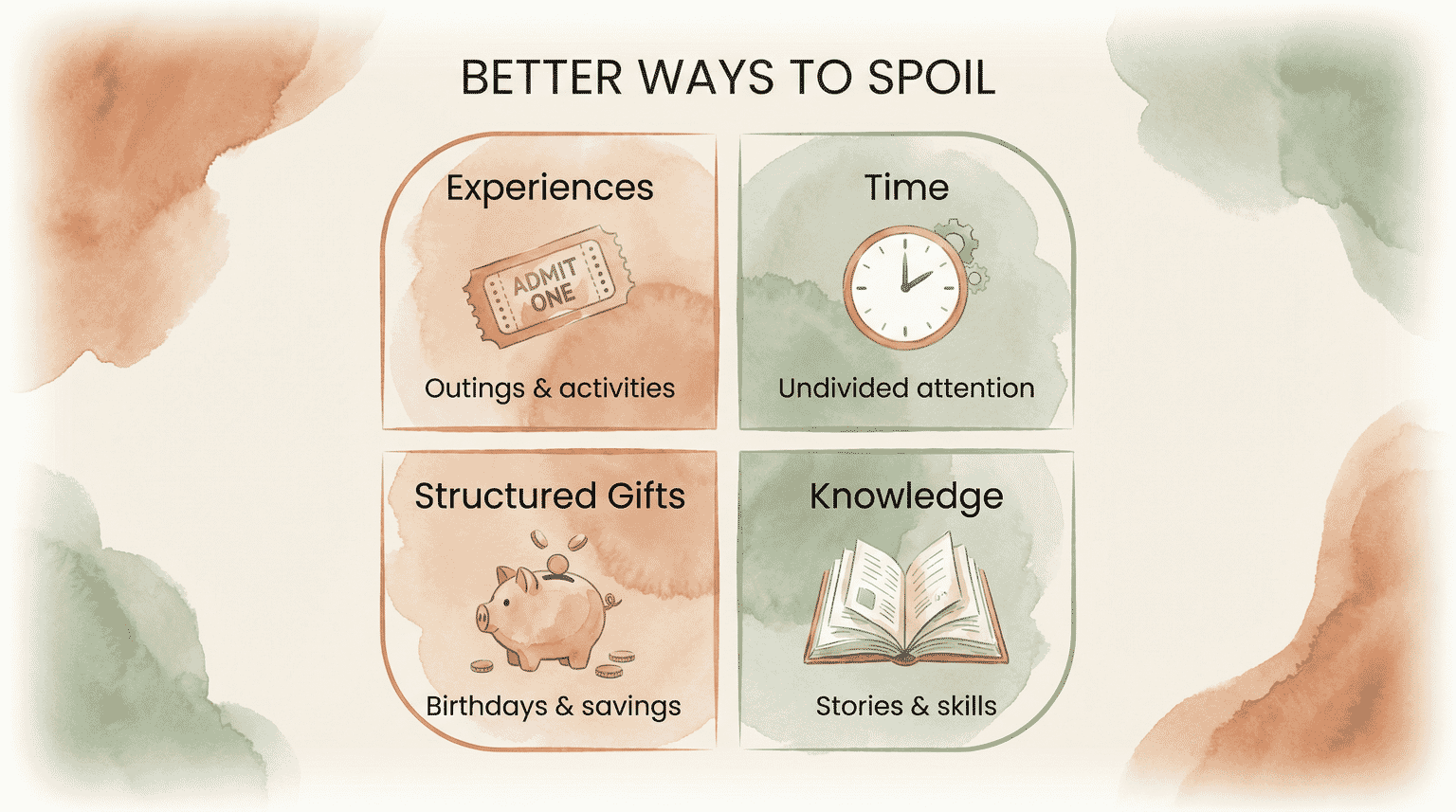
Experience spoiling:
- Special outings (zoo, museum, park)
- Teaching a skill (cooking, gardening, woodworking)
- One-on-one time doing “their thing”
- Sleepovers with special routines
Time spoiling:
- Undivided attention (no phone, no TV)
- Extended play sessions
- Patience that exhausted parents can’t always muster
- Listening to long, rambling stories about Minecraft
Structured gift spoiling:
- Contributing to college savings instead of toys
- “Experience jar” where grandparents fund activities
- Birthday and holiday gifts only (no random arrivals)
- One “special thing” per year that’s meaningful, not frequent
Knowledge spoiling:
- Family history and stories
- Cultural traditions and recipes
- Skills passed between generations
- Books read together
My kids remember the day my dad taught them to make his mother’s pierogi recipe far more vividly than any toy he’s ever given them.
When Grandparents Won’t Change

Sometimes you have the conversation—multiple times—and nothing shifts. This is harder.
Research on grandparent education levels found that more educated grandparents tend to be more responsive to developmental information. But education aside, some grandparents simply won’t adjust. Maybe they feel criticized. Maybe they believe they know better. Maybe boundary-setting wasn’t part of their generation’s toolkit.
Your options at this point:
Reduce unsupervised time while preserving the relationship. Grandparents who undermine you when alone may behave differently with you present. This isn’t punishment—it’s appropriate boundary enforcement.
Get explicit about deal-breakers. Safety issues (car seats, allergies, sleep position for infants) are non-negotiable. Make clear that ignoring these affects access, not just your feelings.
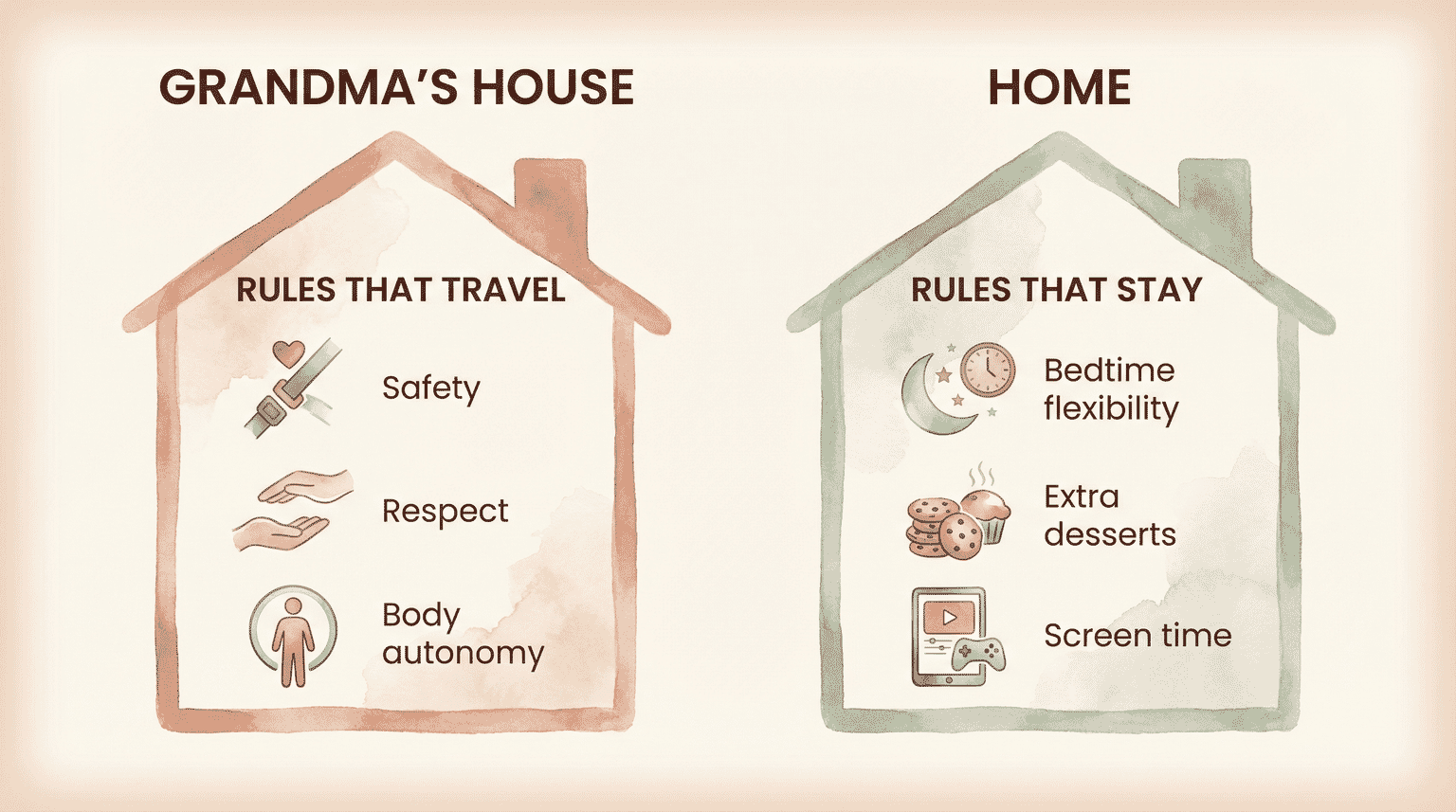
Help your child navigate the inconsistency. This is actually a life skill. Different houses have different rules—schools, friends’ homes, and grandparents’ houses all operate differently. What matters is which rules “travel” everywhere.
When your child says: “But grandma lets me!”
Try: “Grandma’s house has some different rules. In our house, we do it this way. What matters is you follow the rules wherever you are.”
If you’re concerned about long-term impacts of unchecked indulgence, I’ve written about preventing entitlement patterns that can help you work on this from your child’s side of the equation.
Helping Kids Navigate Different Rules
Even with well-meaning, cooperative grandparents, kids will encounter different rules. Here’s how to handle it:
Normalize context-switching. “Yes, you get dessert every night at grandma’s. At our house, dessert is a sometimes food. Both are okay.”
Identify rules that travel. Safety rules, respect rules, and body autonomy rules go everywhere. Bedtime flexibility at grandma’s? That stays at grandma’s.
Debrief after visits. “What was your favorite part of grandma’s house?” gives you information about what matters to your child—and what they might be expecting to continue at home.
For broader gift-related challenges beyond just grandparent dynamics, I’ve collected strategies that apply across many family situations.
The Bottom Line
Here’s what I’ve learned watching this play out across eight kids and multiple grandparent relationships: most spoiling comes from love. Real, genuine, overflowing grandparent love.
The goal isn’t to eliminate that love or even contain it. It’s to help grandparents express it in ways that strengthen your child’s development rather than undermine it.
The grandparents who eventually got on board? They weren’t the ones I lectured or criticized. They were the ones I helped understand why limits mattered, and then gave alternatives that still let them be special.
Your mileage may vary. Every family dynamic is different. But leading with empathy, being specific about boundaries, and offering alternatives gives you the best chance of preserving both the relationship and your sanity.
Frequently Asked Questions
Is it okay for grandparents to spoil grandchildren?
Yes—within limits. Research shows 41% of grandparents naturally use an indulgent caregiving style, and this treat-giving is typically rooted in love. Problems only emerge when indulgence consistently undermines health routines, contradicts parents openly, or becomes the only way grandparents connect with grandchildren.
How do I stop grandparents from spoiling my child?
Start with understanding, not ultimatums. Frame conversations around shared goals rather than criticism, and offer specific alternatives. Grandparents respond better when they understand the developmental reasoning behind your boundaries and have other ways to express their love.
What to do when grandparents don’t respect boundaries?
First, check if your boundaries were clear and specific—vague requests often fail. If violations continue after explicit agreements, reduce unsupervised time while preserving the relationship. Help your child understand that some rules stay the same everywhere while others vary by location.
Why do grandparents spoil grandchildren?
Grandparents experience what researchers call “a different kind of love”—freed from daily discipline responsibilities, they express affection through indulgence. Many also compensate for their own childhood scarcity, regret being stricter with their own children, or want to maximize limited time with grandchildren.
What About You?
How do you handle grandparent spoiling? I’d love to hear what conversations have worked—and whether you’ve found a balance between appreciating their generosity and maintaining your own limits.
I read every comment—grandparent dynamics are too important to navigate alone.
References
- The Influence of Grandparents on Children’s Dietary Health – Research on grandparent feeding styles and treat provision patterns
- Grandmothers’ Care Practices in Areas of High Deprivation – UK study on responsible vs. fun caregiving styles
- Grandparental Care and Childhood Obesity in China – Research on education levels and grandparent caregiving outcomes
- Factors Influencing Food Parenting Practices – Chilean qualitative study on family communication strategies
- The Role of Grandparents’ Influence in Grandchildren’s Wellbeing – Research on balancing positive and negative grandparent influence

Share Your Thoughts