

Every December, my husband and I have the same conversation. He grew up in a “one big present” household. I grew up surrounded by piles of wrapped packages, where the sheer volume was part of the magic. Eight kids later, we’ve realized that without a shared philosophy, we’re just winging it—and our kids pick up on the inconsistency.
Here’s what I’ve learned after researching this topic with my librarian brain and testing it across 17 years of parenting: families that approach gift-giving intentionally—with a clear philosophy—experience less conflict, raise more grateful children, and actually enjoy the process more. The research backs this up, and so does my chaotic, beautiful household.
This isn’t about restricting joy or becoming the family that gives socks and lectures. It’s about knowing why you give the way you give—and making sure everyone’s on the same page.

Key Takeaways
- Thoughtfulness beats price tags—research shows a $8 gift chosen with care creates more lasting impact than expensive afterthoughts
- Experiential gifts build stronger relationships than material ones, according to consumer psychology research
- Indebtedness drives most thank-you gifts—teach genuine gratitude instead of obligatory responses
- Your gift philosophy should be a living document that grows with your family
- You can’t control grandparents who over-gift, but you can use it as a teaching opportunity
The 5-Component Family Gift Philosophy Framework
Before we dive into the details, here’s the complete framework. Think of these as five pillars that hold up your family’s approach to giving and receiving:
- The Thoughtfulness Principle — Meaning matters more than money
- The Understanding Principle — Gifts demonstrate deep knowledge of the recipient
- Experience Over Accumulation — Bonds over belongings
- Gratitude, Not Obligation — Appreciation without debt
- Values Alignment — Gifts reinforce what your family stands for, including sustainability
Quick self-assessment: Where does your family currently stand? Most of us are strong in one or two areas and winging it in the others. That’s okay—awareness is the first step.
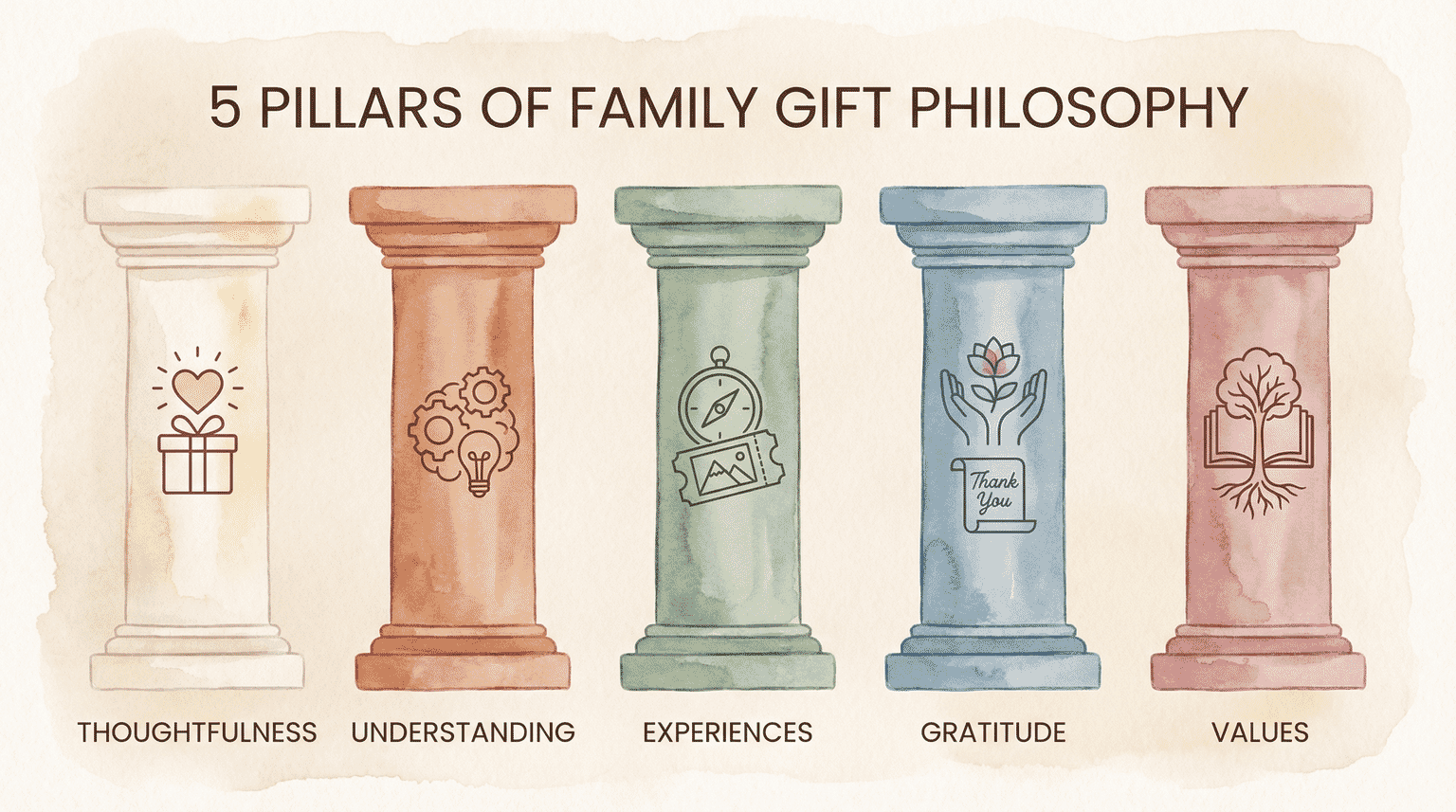
A family gift philosophy is a shared set of principles guiding how your family gives and receives gifts—emphasizing thoughtfulness over price, understanding over obligation, and values alignment over accumulation. It serves as a decision-making framework for gift selection, a teaching tool for character development, and a communication guide for extended family expectations.
Component 1: The Thoughtfulness Principle
A 2024 study from Johns Hopkins examining family gift practices identified what researchers call the “light gift, heavy sentiments” principle. The finding? Thoughtfulness matters more than price. Even expensive gifts can seem insincere if they lack familial warmth, while modest, thoughtful gifts can strengthen intimate family bonds.
I’ve watched this play out with my own kids. My 12-year-old still talks about the $8 journal her grandmother gave her three years ago—because Grandma remembered she’d mentioned wanting to write stories. Meanwhile, the expensive gadget from that same Christmas? Forgotten within weeks.
What thoughtfulness actually looks like:
- Remembering something mentioned months ago
- Noticing what brings the recipient joy (not just what they ask for)
- Choosing gifts that say “I see you” rather than “I spent money on you”
Red flags that indicate price-over-thought patterns:
- Racing to match a dollar amount
- Defaulting to gift cards because “I don’t know what they like”
- Measuring success by the recipient’s immediate reaction rather than lasting value

Consumer psychologist Kathleen Vohs puts it directly: “It’s as much about what the giver wants to get out of the gift-giving process—warm feelings or even some dose of pride—as it is about making the recipient happy.”
Her research suggests we need to examine our own motivations honestly. Are we giving to connect, or to impress?
Sample family philosophy language: “In our family, we believe the thought behind a gift matters more than its price tag. A $10 gift chosen with care means more than a $100 gift grabbed at the last minute.”
Component 2: The Understanding Principle
The Johns Hopkins research goes further: “The ideal gift shows an in-depth understanding of the recipient, strengthening and reshaping intimate family bonds.” This isn’t about buying what someone asks for—it’s about demonstrating that you know them.
My 15-year-old is notoriously hard to buy for. Last year, instead of another gift card, his younger sister saved up and bought him a vintage poster of his favorite obscure band. She’d overheard him mention them once, months earlier. His face when he opened it? That’s the Understanding Principle in action.
How to involve kids in selecting thoughtful gifts:
- Ask “What does Grandma really love?” instead of “What should we get Grandma?”
- Help them observe recipients over time, not just ask for wish lists
- Practice the question: “What would make this person feel truly seen?”
The difference between “what they’d like” and “what they need”:
Sometimes understanding means recognizing that your brother-in-law would like another video game but needs to know you noticed he’s been stressed at work. A gift that acknowledges his real life—not just his wish list—demonstrates deeper care.
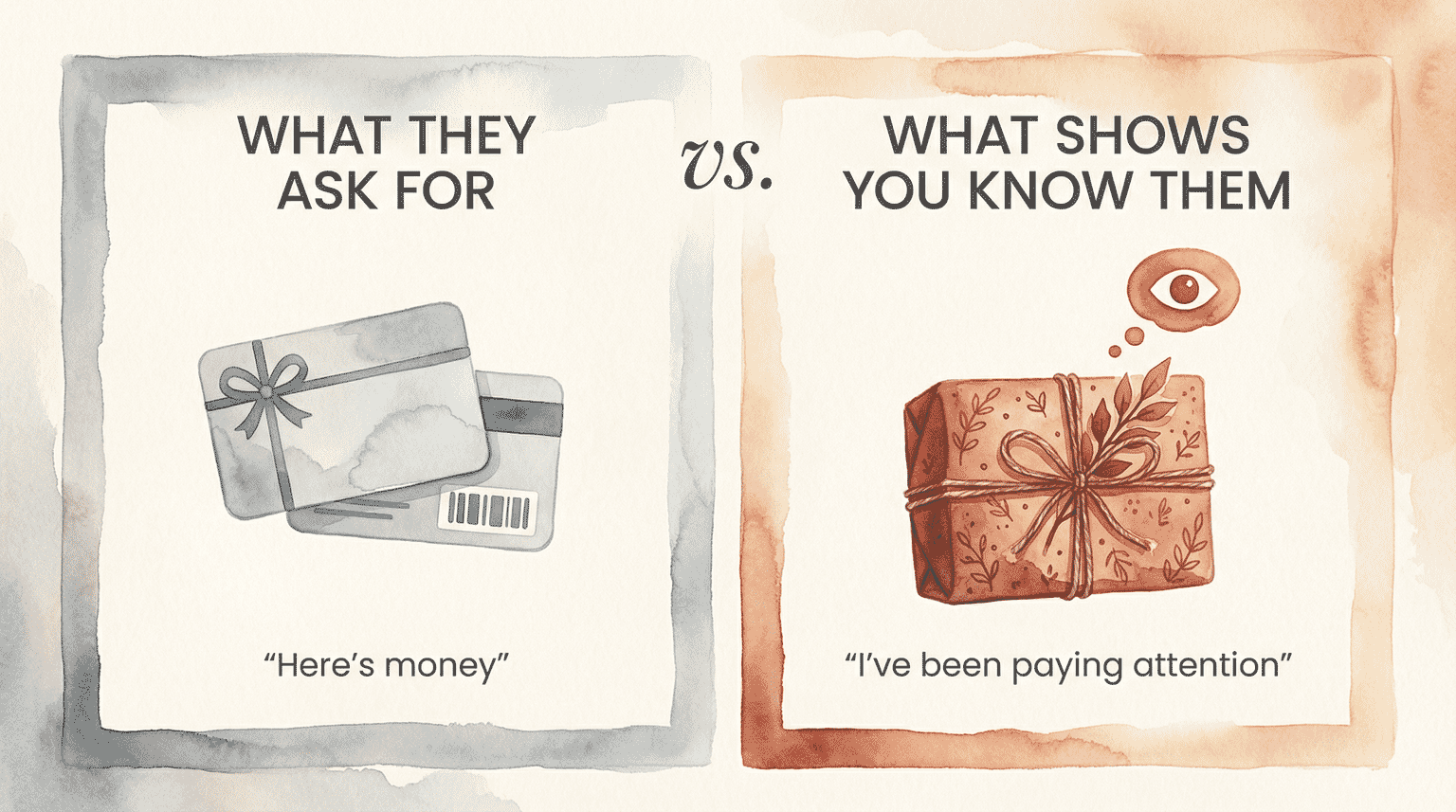
Sample family philosophy language: “We give gifts that show we truly know the person—their interests, their struggles, their joys. Our gifts say ‘I’ve been paying attention.'”
Component 3: Experience Over Accumulation

Here’s a finding that changed how our family approaches gift-giving: consumer psychologists Chan and Mogilner documented that experiential gifts foster stronger social relationships than material gifts. The same research review confirmed that recipients don’t appreciate gifts more simply because they cost more.
After one particularly overwhelming Christmas—if this sounds familiar, you may have holiday gift-giving anxiety—when my then-5-year-old melted down after opening present #12 and asked “Is that all?”—we shifted toward experiences. Concert tickets. Museum memberships. A “date day” with just Dad. If you’re working on breaking the consumer gift cycle, this component is your starting point.
Practical applications:
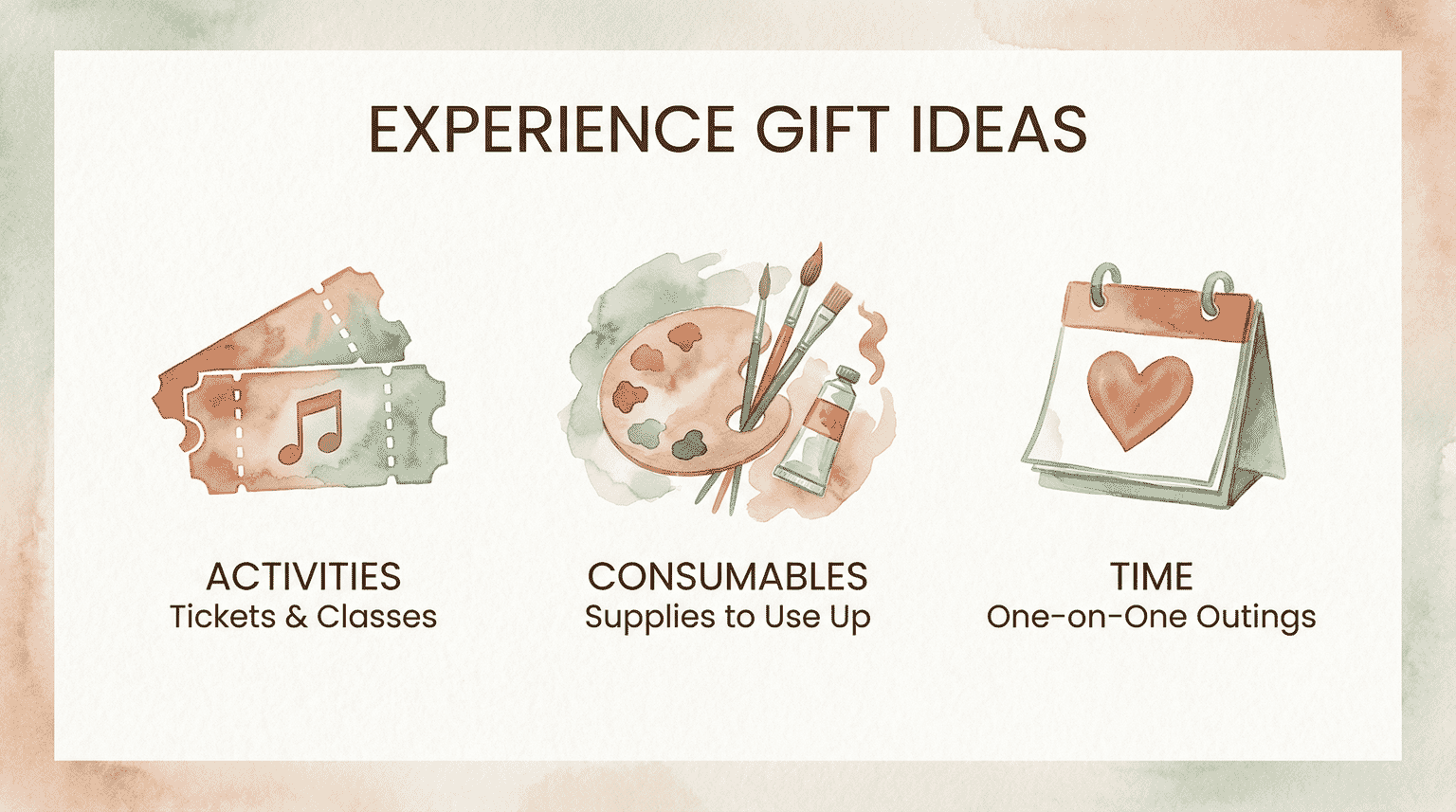
- Activity gifts: Cooking class together, escape room tickets, hiking trip
- Consumable gifts: Specialty foods, art supplies meant to be used up
- Time gifts: Coupons for one-on-one outings, “experience jars” with activity ideas
How to communicate this to gift-giving relatives:
Frame it positively: “We’re focusing on experiences and presence this year. Would you consider taking [child] on a special outing instead of a toy?” Most grandparents are thrilled to spend quality time rather than shop.
Sample family philosophy language: “We prioritize gifts that create memories and togetherness. Experiences and shared time matter more than adding to the toy pile.”
Component 4: Gratitude, Not Obligation
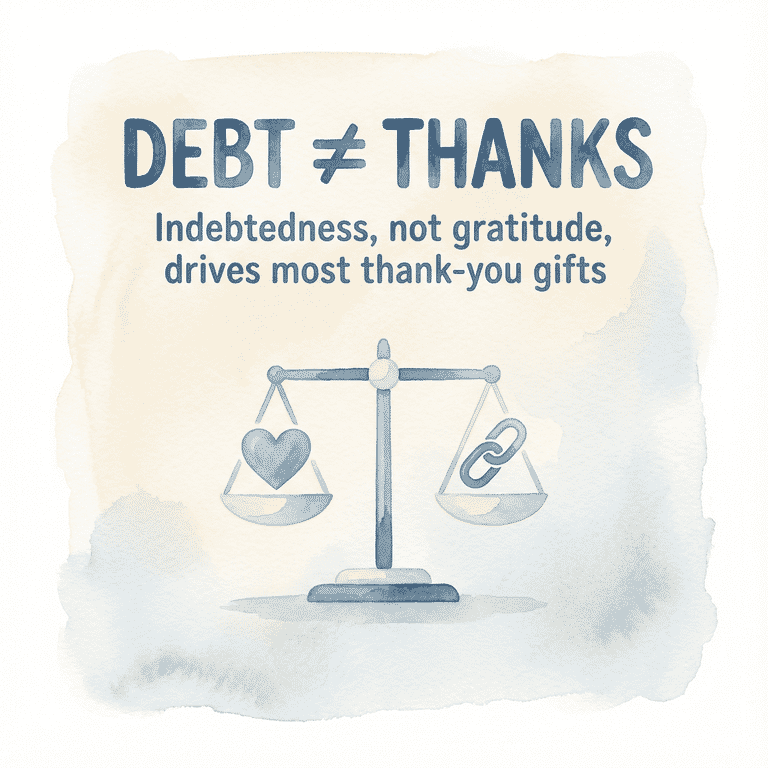
Research from a 2025 study in the Journal of Personality and Social Psychology revealed something that surprised me: indebtedness—not gratitude—was the only consistent predictor of thank-you gift-giving across three studies with over 1,000 participants. People give thank-you gifts because they feel they owe something, not because they feel genuinely thankful.
This matters for families. We want to raise kids who experience authentic appreciation, not children who perform gratitude because they feel obligated. The distinction is subtle but crucial.
Cross-cultural research consistently shows that gifts create emotional connection most effectively when given freely, without expectation of return. When we remove the transactional element, gratitude can emerge naturally.
My 8-year-old recently said, “Mom, I don’t want to write thank-you notes because then I have to think of what to say and it feels fake.” Fair point. Now we write notes only when he has something genuine to express.
Teaching genuine appreciation vs. performative thanks:
- Focus on how the gift makes them feel, not just saying “thank you”
- Encourage specific acknowledgment: “I love that you remembered I wanted this”
- Model genuine gratitude yourself—let kids see you moved by thoughtfulness
Building gratitude as character trait, not transaction:
I help my son find the words for real feelings rather than formulaic responses. The goal isn’t a perfectly written note—it’s a child who genuinely notices and appreciates when someone thinks of them.
Sample family philosophy language: “We express appreciation genuinely, not out of obligation. Thank-you notes aren’t performances—they’re authentic expressions of connection.”
Component 5: Values Alignment
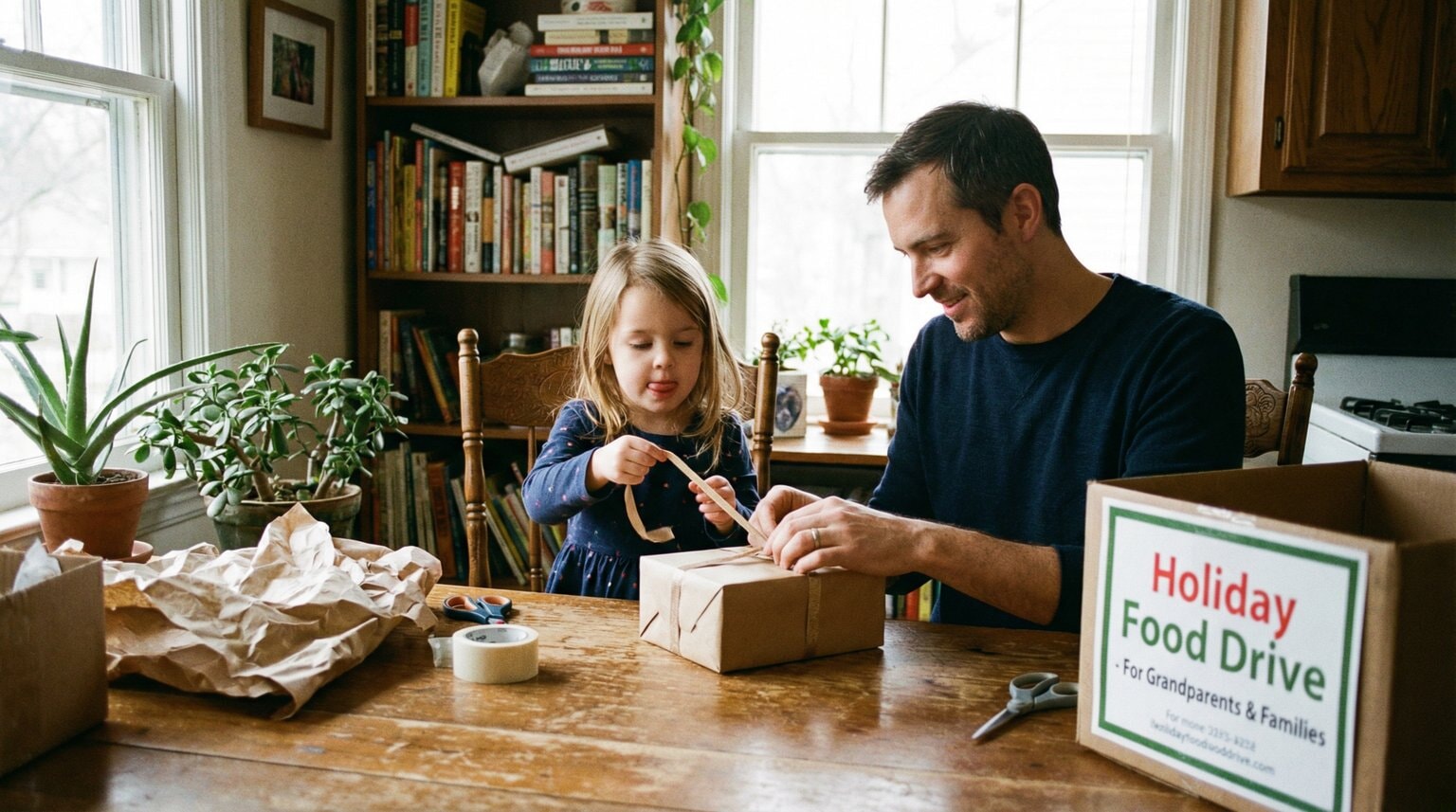
This component ties everything together. Your family gift values should reinforce what you stand for—generosity, patience, thoughtfulness, or whatever matters most in your home.
Research in Marketing Theory (2023) found that how parents talk about gifts directly shapes children’s developing self-concept through what researchers call “pre-exchange socialization”—constant reminders and speech acts that communicate expectations. The messages we send about gifts become part of who our children believe themselves to be.
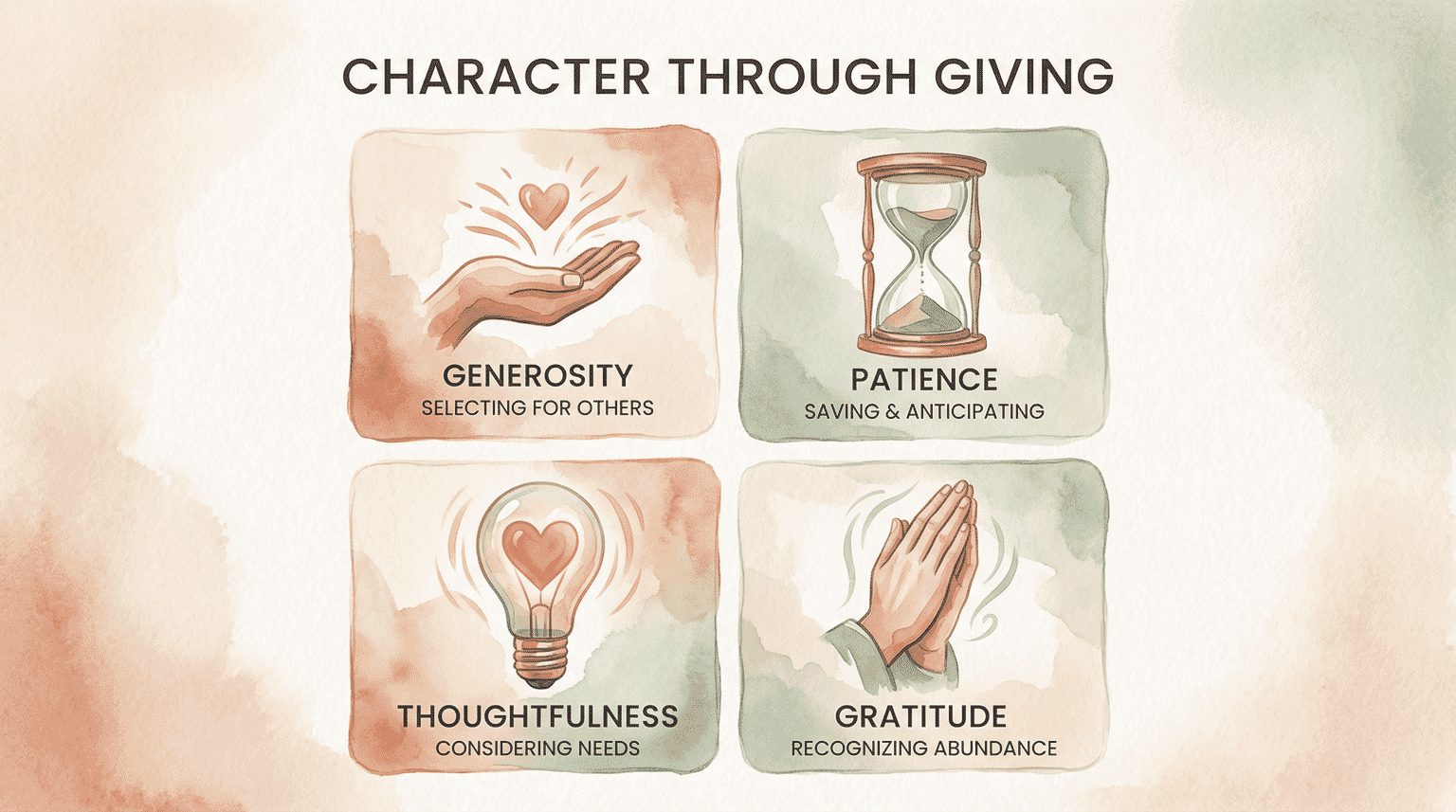
Character traits gifts can reinforce:
- Generosity: Involving kids in selecting gifts for others, including those in need
- Patience: Anticipation periods, saving for meaningful gifts
- Thoughtfulness: The process of considering what someone else would truly want
- Gratitude: Recognizing abundance, appreciating effort over expense
When gifts violate family values—what to do:
This happens. The great-aunt sends something that contradicts everything you’ve discussed. Use it as a teaching moment: “Aunt Mary was so kind to think of you. In our family, we handle gifts like this by…” Then privately discuss how the gift fits—or doesn’t—with your philosophy.
“What parents are responsible for is not the overall sum of the wellbeing of their children, but preparing their children to meet life’s challenges, uncertainties, disappointments and, yes, suffering.”
— Anastasia Berg, Professor and Author, UC Irvine
Sample family philosophy language: “Our gifts reflect who we are as a family. We choose presents that reinforce generosity, patience, and the importance of relationships over stuff.”
Writing Your Family Gift Philosophy Statement
Now comes the practical part. You don’t need a dissertation—even a single sentence helps.
Key components of an effective statement:
- Your stance on price versus thoughtfulness
- Your position on experiences versus material items
- How you want children to handle receiving
- What values you want gifts to reinforce
Template with fill-in sections:
“In our family, gifts are about [core value: connection/thoughtfulness/experiences]. We believe [position on price/thoughtfulness]. When we give, we focus on [what you prioritize]. When we receive, we [how you handle gratitude]. Our gift practices reflect our family values of [2-3 specific values].”
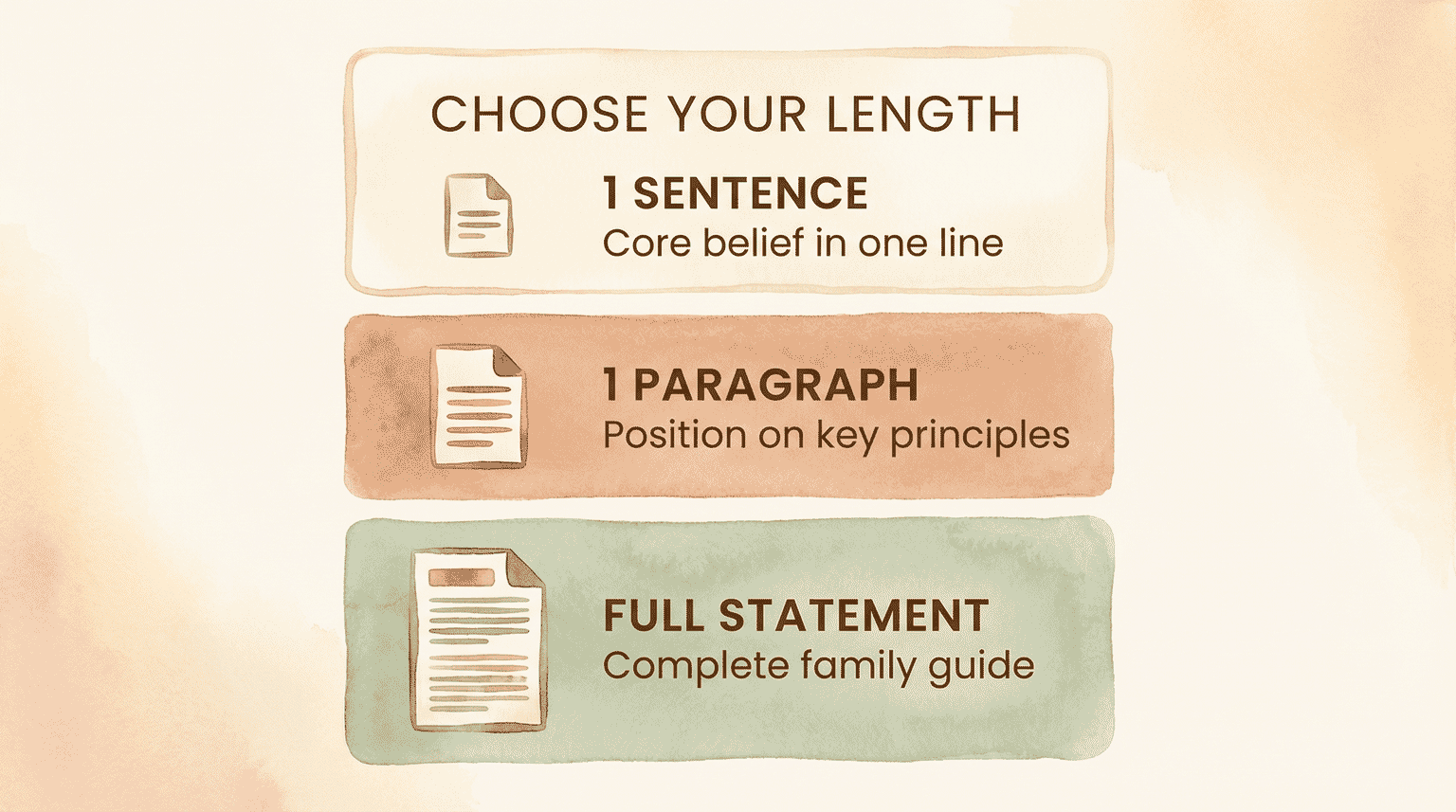
Examples at different lengths:
One sentence: “In our family, gifts show we care and understand each other—the thought matters more than the price.”
One paragraph: “We believe gifts should strengthen relationships, not strain budgets. We focus on thoughtfulness over expense, experiences over accumulation, and genuine gratitude over obligation. Our gift-giving reflects our values of generosity, patience, and presence.”
Full statement: Use the template above, fleshing out each section with specifics relevant to your family.
If you’re looking for a practical structure to implement your philosophy, the want-need-wear-read framework works beautifully alongside these principles—it operationalizes your values into specific gift categories.
Getting Everyone On Board
When parents have different gift backgrounds
My husband and I came from opposite gift-giving cultures. Here’s the alignment process that worked for us:
- Share your stories. What did gifts mean in your childhood? What feelings do you associate with them?
- Identify the positives. What do you want to carry forward from each background?
- Name the negatives. What didn’t work? What would you change?
- Find common ground. There’s almost always overlap in values, even if execution differed.
- Write something together. Even a rough draft creates shared language.
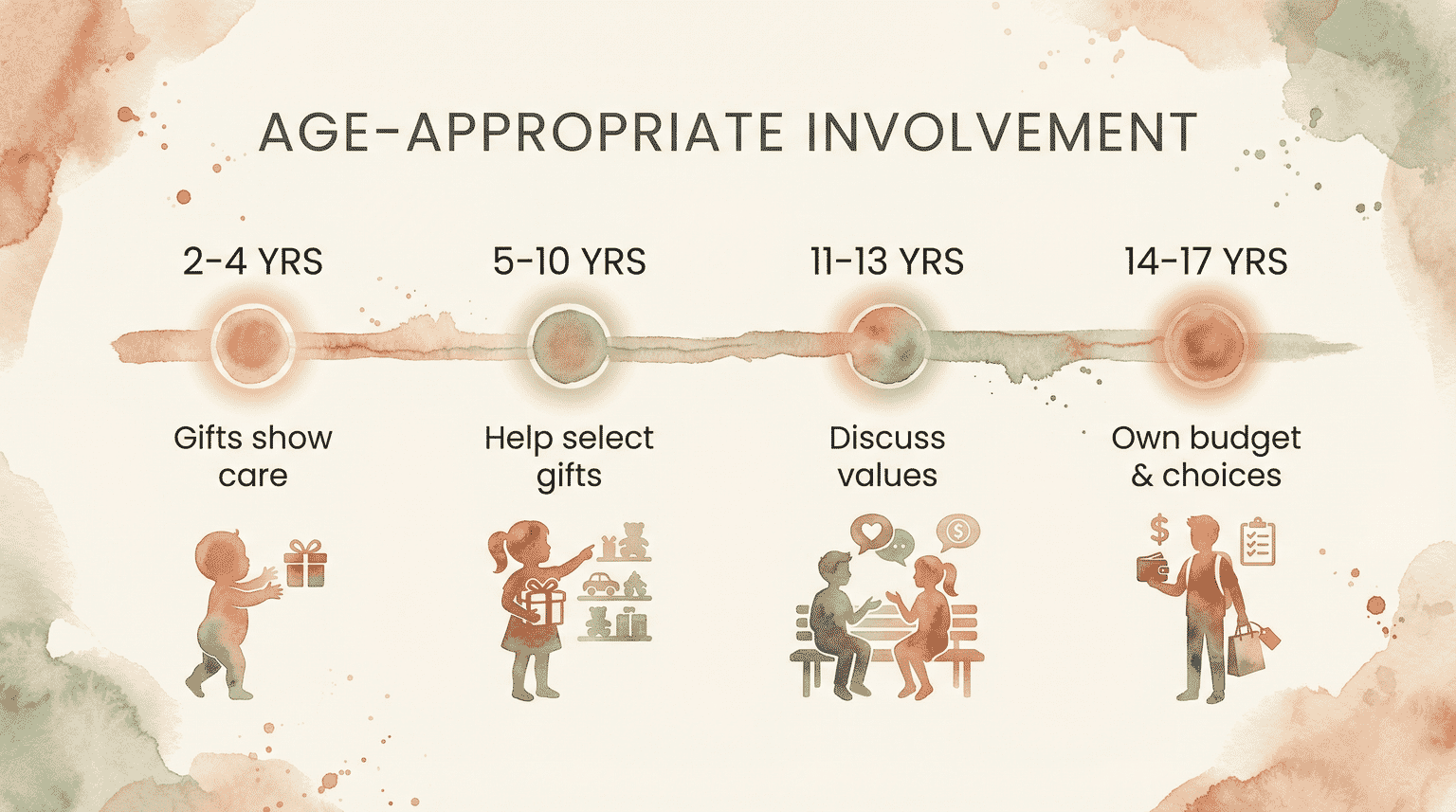
Age-appropriate involvement
Communicating to extended family
Share proactively, not reactively. Before the gift-giving season, send a warm note: “We’re focusing on experiences and thoughtfulness this year. Here are some ideas that would mean a lot to the kids…” Frame it as invitation, not restriction.
Making it a “living document”
We revisit our philosophy every September—before the holiday pressure begins. As children age, the conversation deepens. What worked when they were 4 doesn’t fit at 14. That’s not failure; that’s growth.
When Your Philosophy Gets Tested

Grandparents who over-gift despite requests
You can’t control others. When grandparents over-gift, use it as teaching opportunity: “Grandma and Grandpa show love through lots of presents. Different families do things differently. In our family, we appreciate the thought behind gifts most.” Then privately reinforce your values.
Children comparing gifts with peers
“Max got a PlayStation AND an iPhone!” I’ve heard versions of this from most of my eight. The response: “Every family has their own way of doing gifts. Ours focuses on [your principle]. What did you receive that made you feel most loved?”
For more on navigating these conversations, see our guide on handling Christmas gift comparison.
Gifts that arrive violating your values
Thank the giver genuinely for their thoughtfulness. Discuss privately with your children: “This isn’t a gift we would have chosen. Here’s why… How should we handle it?” Sometimes the gift gets donated. Sometimes it stays. The conversation matters more than the outcome.
Building family gift traditions that align with your philosophy creates natural reinforcement—when the traditions themselves embody your values, consistency becomes easier.
United Front Strategies
Presenting a consistent message to children
Kids detect parental disagreement instantly. Even if you have different instincts, agree on public message before gift-giving events. “Mom and Dad talked about this, and here’s what we decided together…”
Backing each other up with extended family
When Uncle Bob challenges your philosophy at Thanksgiving, your spouse’s response matters. Agree in advance: “We’ve thought about this a lot and this is what works for our family.” Unified. Non-defensive. Final.
Regular check-ins to assess how philosophy is working
After major gift-giving occasions, debrief together: What worked? What felt stressful? What would we adjust? These conversations take 15 minutes and prevent resentment from building.
Adjusting without abandoning principles
When your philosophy isn’t working, don’t throw it out—refine it. Maybe “experiences only” felt too restrictive. Adjust to “experiences prioritized.” The framework should serve your family, not constrain it.

Frequently Asked Questions
How do I create a family gift philosophy?
Start by identifying your family’s core values around generosity, thoughtfulness, and material possessions. Use the 5-Component Framework: establish your Thoughtfulness Principle, Understanding Principle, Experience Priority, Gratitude-Not-Obligation stance, and Values Alignment criteria. Write a brief statement capturing these principles, discuss with your partner and children, and revisit annually.
What should be in a gift-giving philosophy?
An effective family gift philosophy includes your position on gift cost versus thoughtfulness, expectations around understanding recipients’ actual needs, your stance on experiences versus material items, how you want children to express gratitude without feeling indebted, and which family values gifts should reinforce. Include both giving and receiving guidelines.
At what age should we involve children in our gift philosophy?
Children can begin understanding “gifts show we care” as early as age 3-4. By age 5-7, they can participate in thoughtful gift selection for others. Full philosophy discussions work well starting around age 8-10, when abstract values become meaningful.
What if grandparents won’t follow our gift philosophy?
Share your philosophy positively and suggest alternatives, but recognize you can’t control others. When grandparents over-gift, use it as a teaching opportunity with your children about different families having different approaches—while reinforcing your own values privately.
How often should we revisit our family gift philosophy?
Annually works well for most families—perhaps before the holiday season. As children age, their understanding deepens and the philosophy can evolve. Think of it as a living document that grows with your family.
I’m Curious
What’s your family gift philosophy—and did you create it intentionally or stumble into it? I’d love to hear how you and your partner aligned (or didn’t) on gift-giving approaches.
Your philosophy stories help other families figure out their own approach.
References
- Money and Filial Piety in Chinese Family Care – Johns Hopkins research on the “light gift, heavy sentiments” principle in family gift-giving
- The Psychology of a Thank-You Gift – Research distinguishing gratitude from indebtedness in gift reciprocation
- An Integrative Review of Gift-Giving Research – Comprehensive review of experiential versus material gift impacts on relationships
- The Darker Side of Gift-Giving – Research on pre-exchange socialization and how gift expectations shape children’s development

Share Your Thoughts