
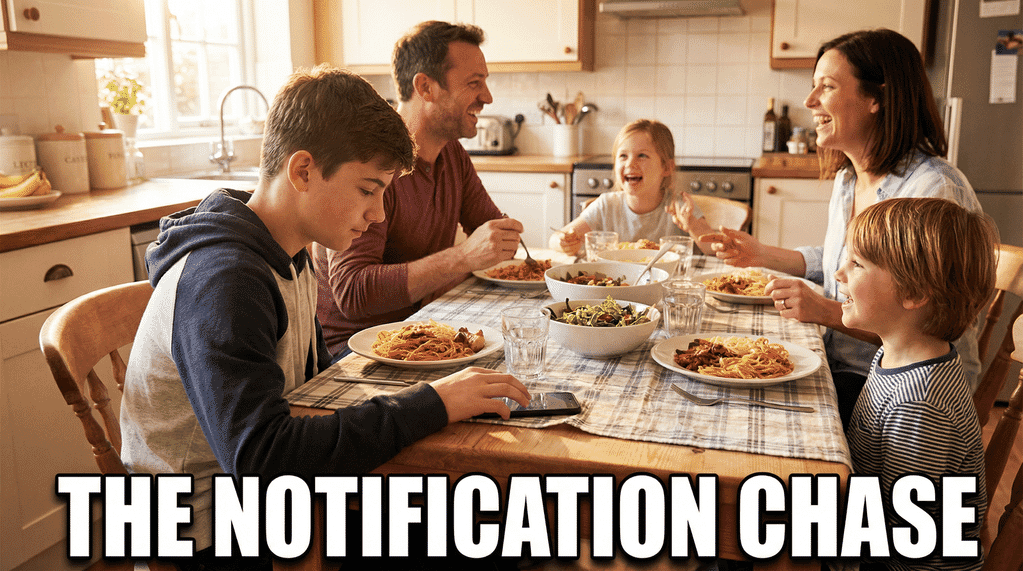
Your daughter checks her phone for the third time in ten minutes. Nothing new. She puts it down, picks it up again, refreshes. A notification pops—someone liked her post. Her whole face changes. Thirty seconds later, she’s scrolling again, hunting for that next hit.
I’ve watched this exact sequence play out with my teenagers, and my librarian brain couldn’t let it go without understanding why. What I found explains not just the behavior, but why our kids are so much more vulnerable to it than we are.

Key Takeaways
- Likes trigger the exact same dopamine response as real-life compliments—your child’s brain can’t tell the difference
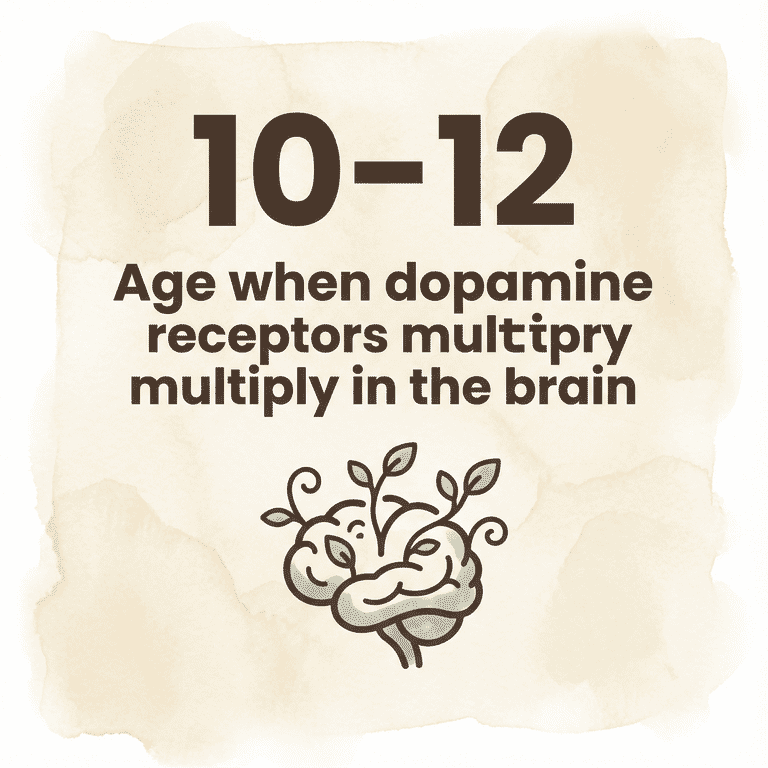
- Ages 10-12 are peak vulnerability when dopamine receptors multiply but self-control hasn’t developed
- The unpredictable “slot machine” reward pattern is what makes checking compulsive, not the content itself
- A 30-minute daily limit reduced depression symptoms by nearly 25% in recent research
- Watch for six warning signs that distinguish heavy use from problematic patterns
The Chemistry of a Like
Here’s what the research actually shows: when your child receives a like, comment, or notification, their brain’s reward center—a region called the ventral striatum—releases dopamine. This is the same “feel-good chemical” that fires when they eat something delicious, succeed at a challenge, or connect with a friend face-to-face.
The science behind gift-giving and dopamine explains why this matters beyond screens.
“We know that social media activity is closely tied to the ventral striatum. This region gets a dopamine and oxytocin rush whenever we experience social rewards.”
— Dr. Mitch Prinstein, Chief Science Officer, American Psychological Association
A 2024 NIH study puts it bluntly: social media platforms “exploit the brain’s reward system by releasing dopamine in response to notifications or comments.” This isn’t an accidental side effect. It’s how these platforms are designed to work.
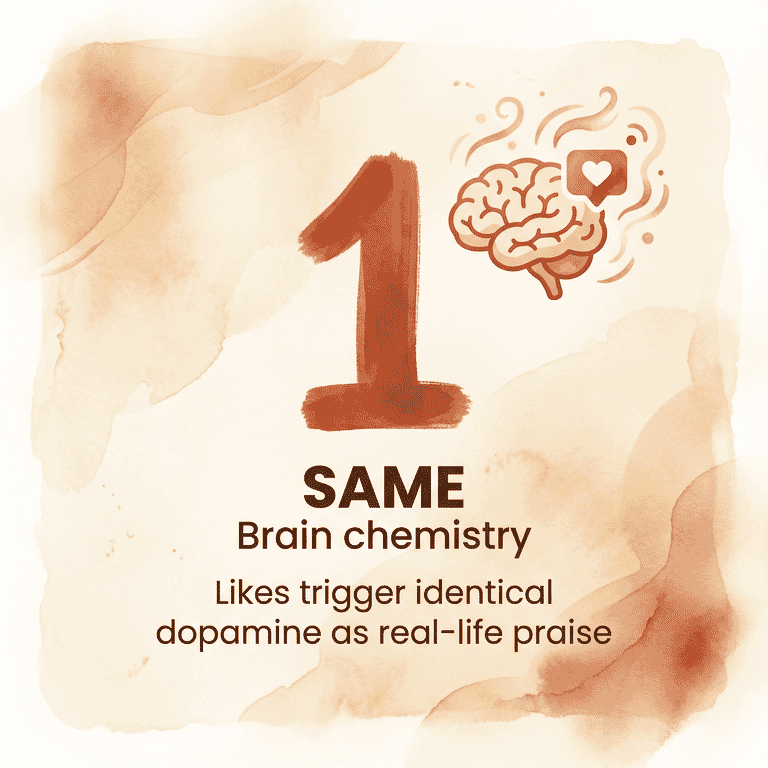
The brain doesn’t distinguish between a compliment at the dinner table and a like on Instagram. Both register as social approval, both trigger dopamine, both feel good.
That’s the first piece of the puzzle—and it explains why telling kids “it’s just social media” falls flat. To their neurochemistry, it’s not “just” anything.
The Slot Machine Effect
But here’s what makes this truly compulsive: the rewards are unpredictable.
“When the outcome is unpredictable, the behavior is more likely to repeat. Think of a slot machine: If game players knew they never were going to get money by playing the game, then they never would play.”
— Dr. Jacqueline Sperling, McLean Hospital
This is called a variable reward schedule, and it’s the most powerful driver of repeated behavior that psychology has identified. Sometimes your child posts and gets dozens of likes within minutes. Sometimes… crickets. That unpredictability is precisely what keeps them checking.
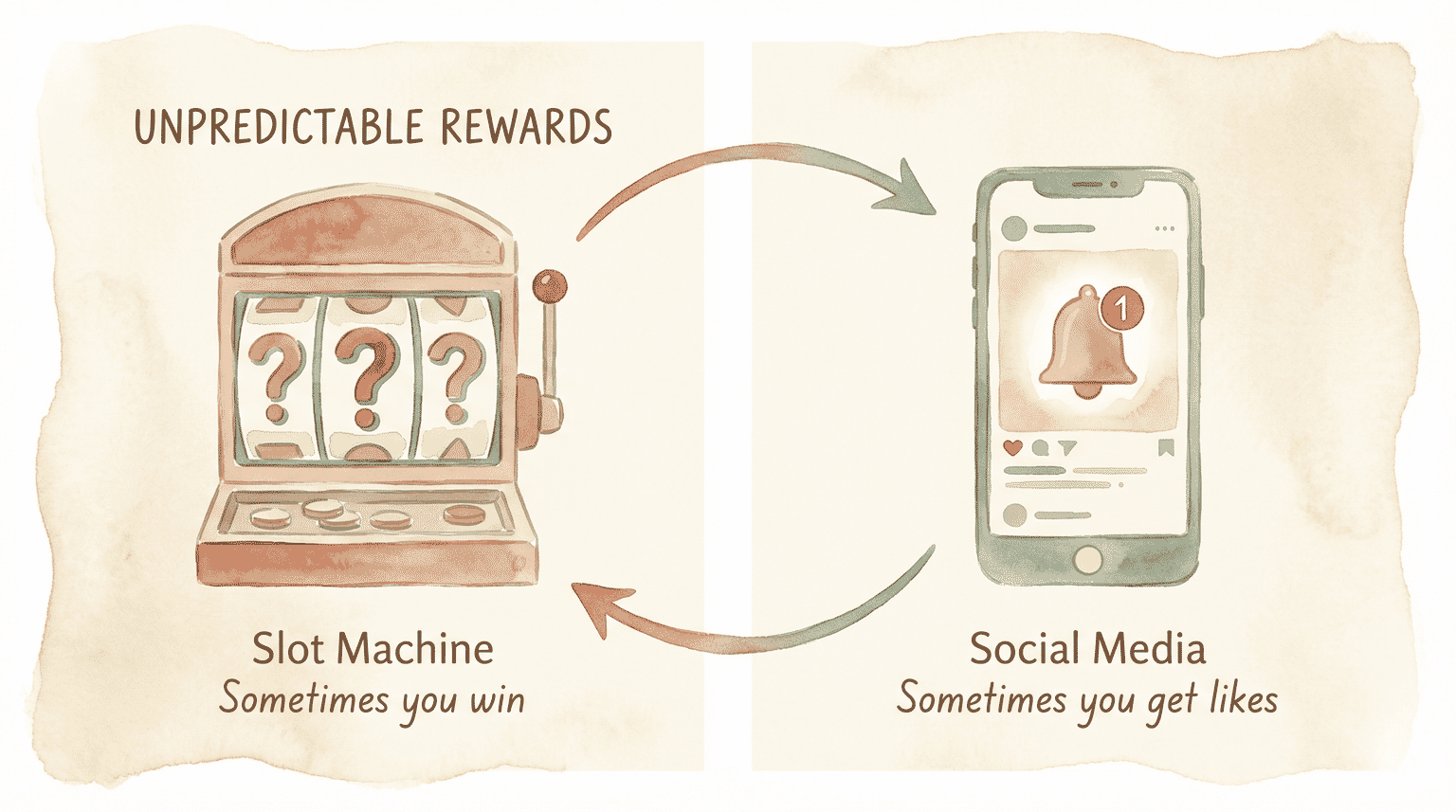
PMC researchers describe what they call the “desire loop”—an unrelenting cycle of desire → seeking and anticipating rewards → triggers that reinstate the desire behavior. Your child isn’t choosing to check their phone constantly. Their brain has been trained to seek that next unpredictable reward.
I’ve seen this with my 15-year-old. She’ll post a photo and then hover. Not quite putting the phone down, not quite doing anything else. Just… waiting. When I finally understood the slot machine parallel, her behavior stopped looking like distraction and started looking like what it actually is: a conditioned response to variable rewards.
What Happens After the High

Here’s the piece most articles miss—and it’s the key to understanding why “just put the phone down” doesn’t work.
After the dopamine surge comes the crash.
“We go into a dopamine deficit state… That’s essentially the comedown… that moment of wanting to stay online and click on one more video.”
— Dr. Anna Lembke, Professor of Psychiatry, Stanford University
Your child’s baseline dopamine level actually drops below normal after the high of receiving engagement. This creates genuine discomfort—a low-grade version of the restlessness and irritability you might associate with more serious withdrawal.
The only quick fix their brain knows? Return to the app.
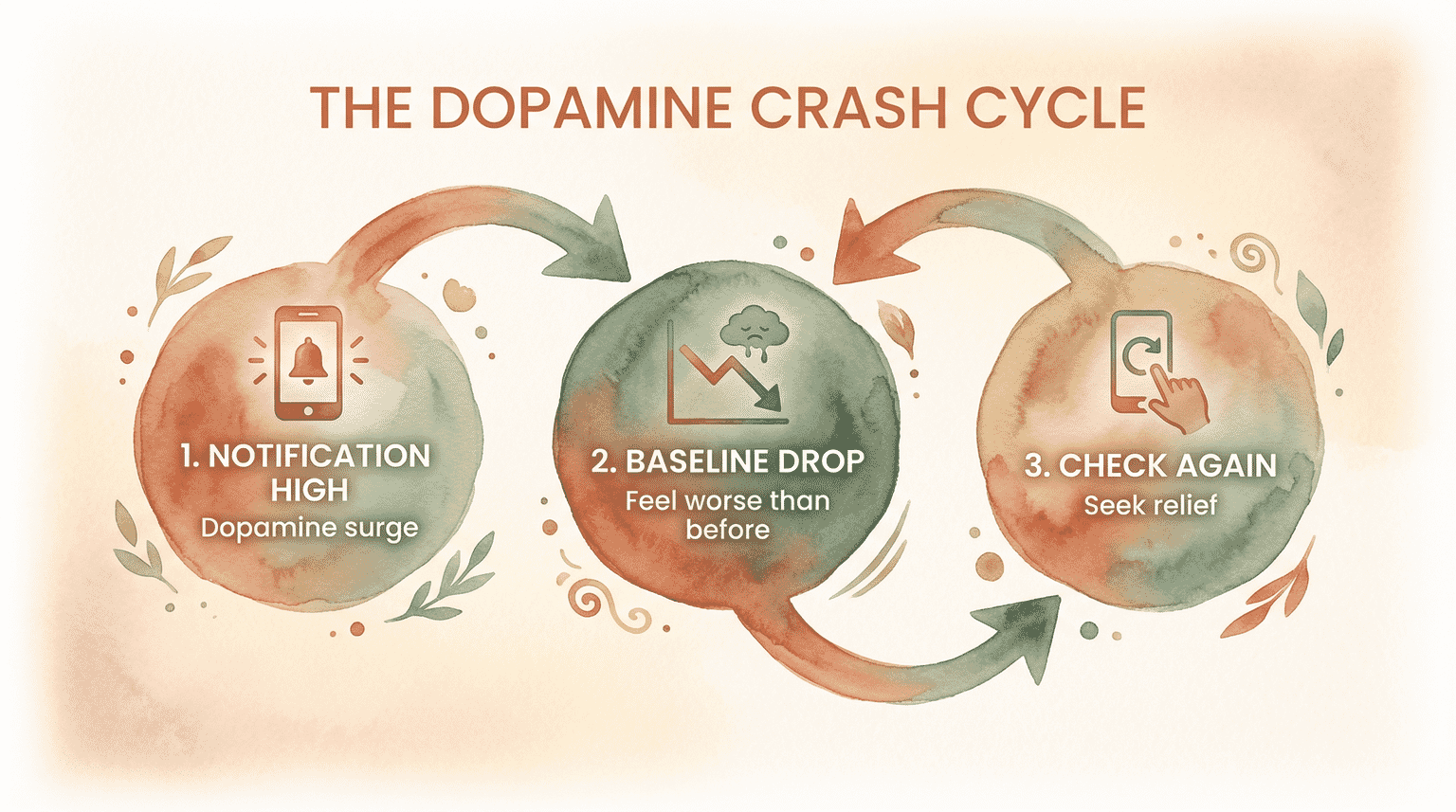
This explains the compulsive checking even when nothing new has happened. The checking itself becomes an attempt to escape the deficit state.
Over time, the Surgeon General’s Advisory warns, frequent and problematic use can create brain structure changes similar to those seen in substance use or gambling addictions.
Why Children’s Brains Are Especially Vulnerable
Adults experience this cycle too. But children—especially between ages 10 and 15—are dramatically more susceptible. The research explains why.
“Between the ages of 10 and 12, receptors for the ‘happy hormones’ oxytocin and dopamine multiply in a part of the brain called the ventral striatum,” reports the APA, “making preteens extra sensitive to attention and admiration.”
At exactly the age when dopamine receptors are multiplying—making social rewards feel incredible—the prefrontal cortex (the brain’s brake system) hasn’t finished developing.
It’s like giving someone a sports car with a souped-up engine but brakes that won’t be installed for another decade.
“During adolescent development, brain regions associated with the desire for attention, feedback, and reinforcement from peers become more sensitive. Meanwhile, the brain regions involved in self-control have not fully matured. That can be a recipe for disaster.”
— Dr. Mary Ann McCabe, George Washington University
Two key differences protect adults:
- Adults typically have a more fixed sense of self that relies less on moment-to-moment peer feedback
- Adults have a more mature prefrontal cortex that can better regulate emotional responses to social rewards
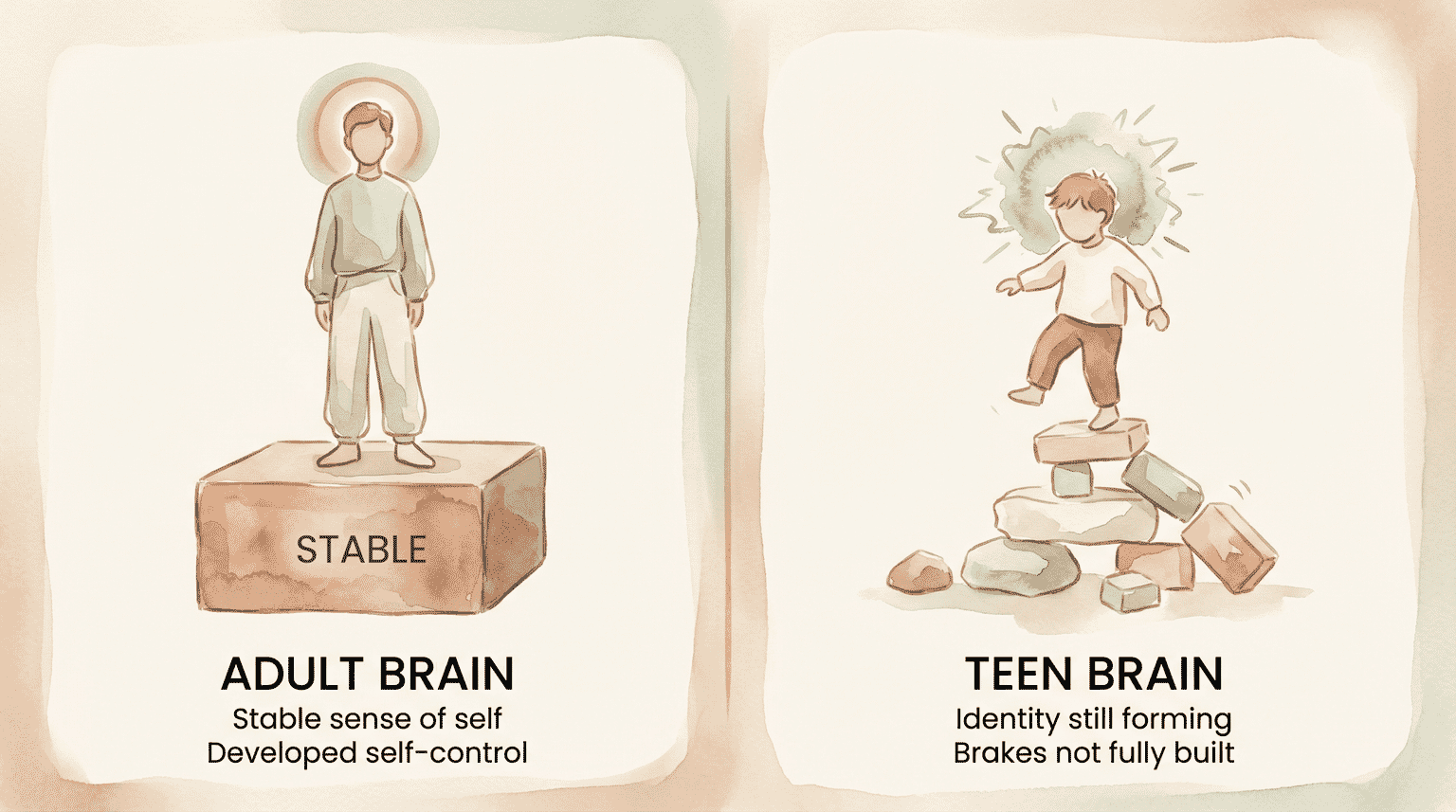
My 17-year-old handles a post with zero engagement very differently than my 12-year-old. Same household, same parenting—but different brain development. The research explains exactly what I observe.
How Different Platforms Exploit These Mechanisms

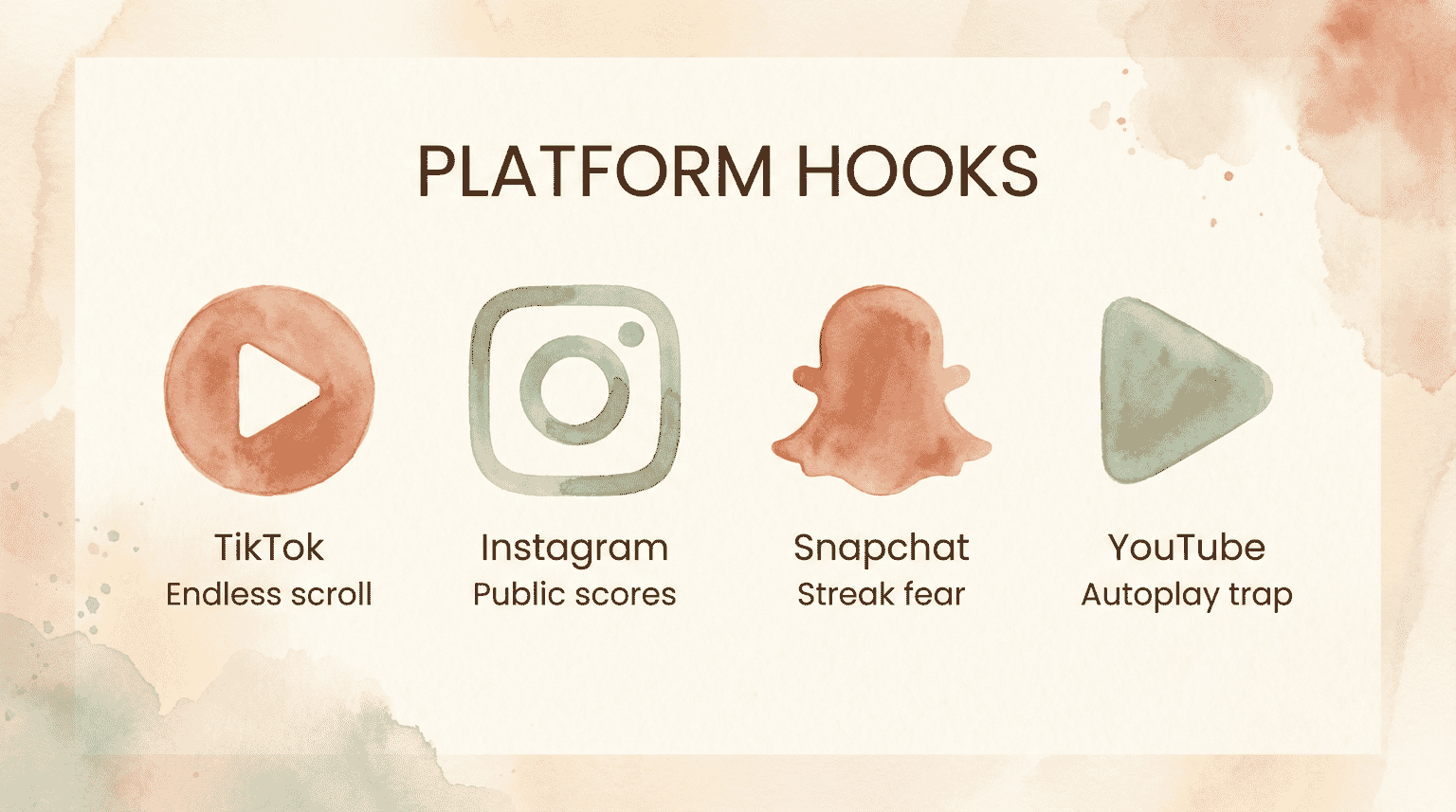
Not all social media is created equal when it comes to dopamine exploitation. Each platform has optimized for a slightly different hook.
TikTok combines infinite scroll with an algorithmically-optimized For You Page, creating a constant stream of variable rewards. Research published in PubMed found that TikTok specifically stimulates the dopaminergic reward system through likes, comments, and followers—forming the basis of addictive behaviors.
Instagram layers like counts with social comparison. The visible metrics create what researchers call “quantified popularity”—a scoreboard that makes every post a public judgment.
Snapchat exploits loss aversion through streaks. The fear of breaking a 200-day streak creates daily compulsive use that has nothing to do with enjoyment. A 2024 BioMed Central study found Snapchat high users showed a 43.3% probability of psychosocial health problems—second only to Facebook’s 51.9%.
YouTube uses autoplay and recommendation optimization to eliminate natural stopping points. Each video ends with an immediate next option, bypassing any moment of decision.
“Technology is expertly designed to pull us in. Features such as ‘like’ buttons, notifications, and videos that start playing automatically make it incredibly hard to step away.”
— Dr. Jacqueline Nesi, Brown University
Understanding how digital experiences become gift culture helps explain why screen time has become the default “treat”—and why breaking that pattern requires intentionality.
When Validation Becomes Identity
Here’s what keeps me up at night as a parent of eight: these dopamine cycles aren’t just shaping behavior. They’re shaping identity.
Between ages 10 and 19, children are actively forming their sense of self. The Surgeon General’s Advisory emphasizes that “in early adolescence, when identities and self-worth are forming, brain development is especially susceptible to social pressures, peer opinions, and comparison.”
When a child’s developing brain learns that self-worth comes from likes, they’re not just building a habit—they’re building an identity framework.
The constant social comparison creates what Yale Medicine researchers call the “highlight reel” problem: children compare their ordinary lives to everyone else’s curated best moments.
This connects to something deeper about why children want what others want—the visible desires and validations on social media shape what children believe they should want for themselves.
Adults, Dr. Prinstein explains, tend to have “a fixed sense of self that relies less on peer feedback.” But a 12-year-old is literally constructing that sense of self in real time—and doing so based on metrics designed to maximize engagement, not wellbeing.
Signs the Dopamine Cycle Has Taken Hold

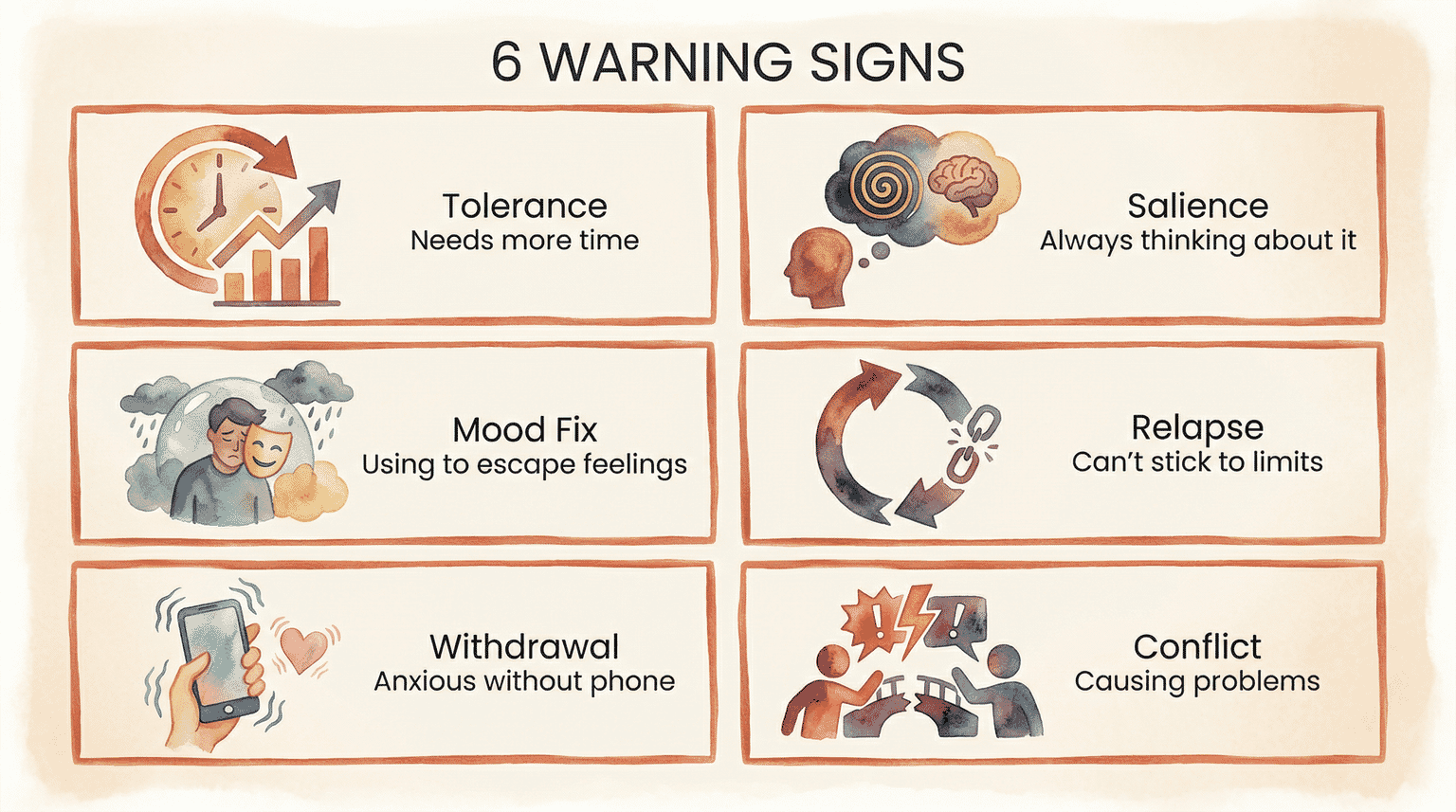
The BioMed Central study identifies six clinical signs that distinguish heavy use from problematic patterns:
- Tolerance: Needing more time for the same satisfaction (what used to feel good now requires longer sessions)
- Salience: Social media becomes a primary concern, dominating thoughts even when offline
- Mood modification: Using platforms specifically to escape negative feelings
- Relapse: Failed attempts to reduce or control use
- Withdrawal: Irritability, restlessness, or anxiety when unable to access platforms
- Conflict: Social media causing problems with relationships, school, sleep, or other activities
In my house, I watch for the behavioral signals: Does my child get genuinely anxious when the phone isn’t accessible? Do they seem unable to enjoy activities that used to hold their attention? Is there irritability that magically disappears when the phone returns?
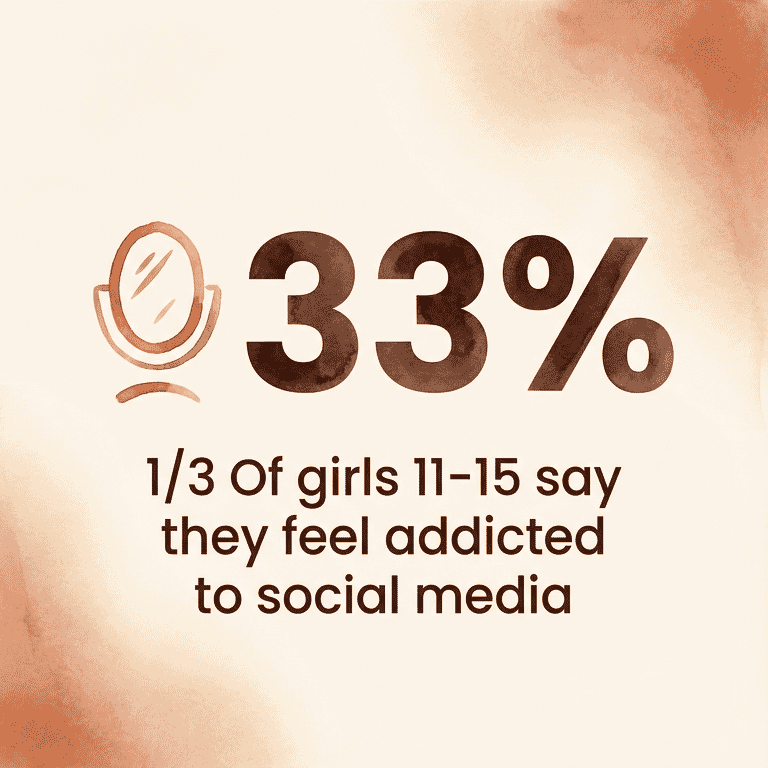
The Surgeon General reports that one-third of girls aged 11-15 say they feel “addicted” to a social media platform, and over half of teenagers report difficulty giving up social media. These aren’t exaggerations—they’re accurate descriptions of what dopamine dysregulation feels like.
Breaking the Cycle
Understanding the mechanism changes the approach.
Working with the dopamine system means:
Providing alternative reward sources. The brain craves dopamine—that’s non-negotiable. What you can change is where it comes from. Physical activity, creative accomplishment, genuine social connection, mastery of new skills—these all activate the reward system without the deficit crash. Understanding the science behind what makes gifts meaningful can help identify experiences and objects that create genuine satisfaction rather than compulsive seeking.
Respecting the reality of withdrawal. Cold-turkey approaches often backfire because the dopamine deficit creates genuine discomfort. Gradual reduction allows the brain’s baseline to reset.
Making rewards predictable. This directly counteracts the slot machine effect. Designated checking times (rather than constant availability) reduce the variable reward pattern that drives compulsive behavior.
Targeting the 10-30 minute threshold. University of Pennsylvania research found that limiting social media to 10 minutes per platform per day yielded significant reductions in loneliness and depression.
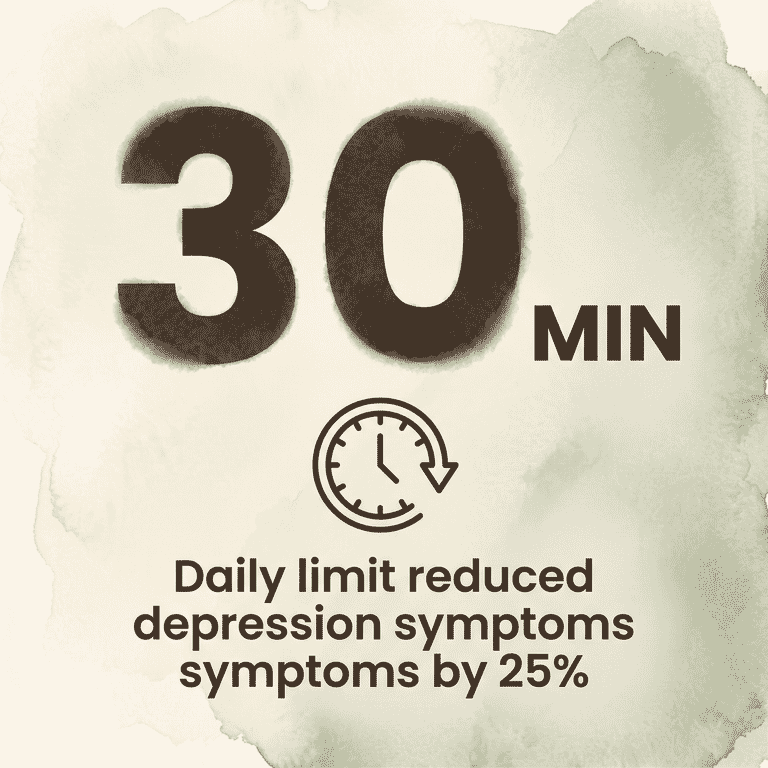
A November 2025 Harvard study provided even more specific numbers: a 30-minute daily limit reduced depression symptoms by 24.8%, anxiety by 16.1%, and insomnia by 14.5% among young adults.
The goal isn’t eliminating dopamine—it’s helping your child’s brain recalibrate to find rewards in places that don’t leave them feeling worse afterward.
Frequently Asked Questions
Is my child actually addicted, or just very interested in social media?
The distinction lies in control and consequences. Heavy use alone isn’t necessarily problematic—researchers emphasize that how and why children use platforms matters more than duration. If your child can put the phone down when needed, engages in other activities with genuine enjoyment, and doesn’t show withdrawal symptoms when offline, they’re likely on the healthier end. Watch for the six clinical signs: tolerance, salience, mood modification, relapse, withdrawal, and conflict.

At what age are kids most vulnerable to social media dopamine effects?
Research identifies specific windows: ages 11-13 for girls and ages 14-15 for boys show the strongest correlation between social media use and decreased life satisfaction. More broadly, the 10-12 age range is when dopamine receptors multiply, making preteens especially sensitive to social rewards—right when many children receive their first smartphones.
Can limiting social media really help?
Yes, and the research is surprisingly specific. University of Pennsylvania research found that 10 minutes per platform per day significantly reduced loneliness and depression. The Surgeon General cites studies showing 30 minutes daily led to meaningful mental health improvements. Even platform deactivation for four weeks improved subjective well-being by 25-40% of the effect of professional therapy.
What’s the difference between a dopamine hit and actual addiction?
Everyone gets dopamine hits—that’s normal brain function. Addiction involves dysregulation: the brain’s reward pathways change, baseline dopamine drops, tolerance develops, and the behavior becomes compulsive despite negative consequences. The Surgeon General’s Advisory notes that people with frequent and problematic use can experience brain structure changes similar to those with substance use or gambling addictions.
I’m Curious
Have you watched the notification-checking cycle in your kid? I’d love to hear what’s worked for breaking the dopamine loop—or whether you’ve decided some level of it is just part of growing up now.
Your dopamine loop stories help other parents feel less alone in this.
References
- U.S. Surgeon General’s Advisory on Social Media and Youth Mental Health – Comprehensive federal guidance on adolescent vulnerability and usage statistics
- Why Young Brains Are Especially Vulnerable to Social Media – APA – Developmental neuroscience research on ages 10-12
- The Impact of Social Media on Children’s Mental Health – PMC/NIH – Dopamine mechanism and mental health outcomes research
- Social Media Algorithms and Teen Addiction – PMC/NIH – The “desire loop” cycle and brain structure changes
- Scrolling Through Adolescence – BioMed Central – Six signs of addiction and platform-specific risk data
- Social Media Brings Benefits and Risks to Teens – APA Monitor – Gender-specific developmental windows
- How Social Media Affects Your Teen’s Mental Health – Yale Medicine – Brain changes and algorithmic concerns
- How Social Media Can Cause Anxiety in Kids – Riley Children’s Health – Clinical perspective on childhood vulnerability
- Social Media and Dopamine – McLean Hospital – Slot machine analogy and University of Pennsylvania intervention research
- Harvard Social Media Study (Nov 2025) – 30-minute limit reduces depression by 24.8%, anxiety by 16.1%

Share Your Thoughts