
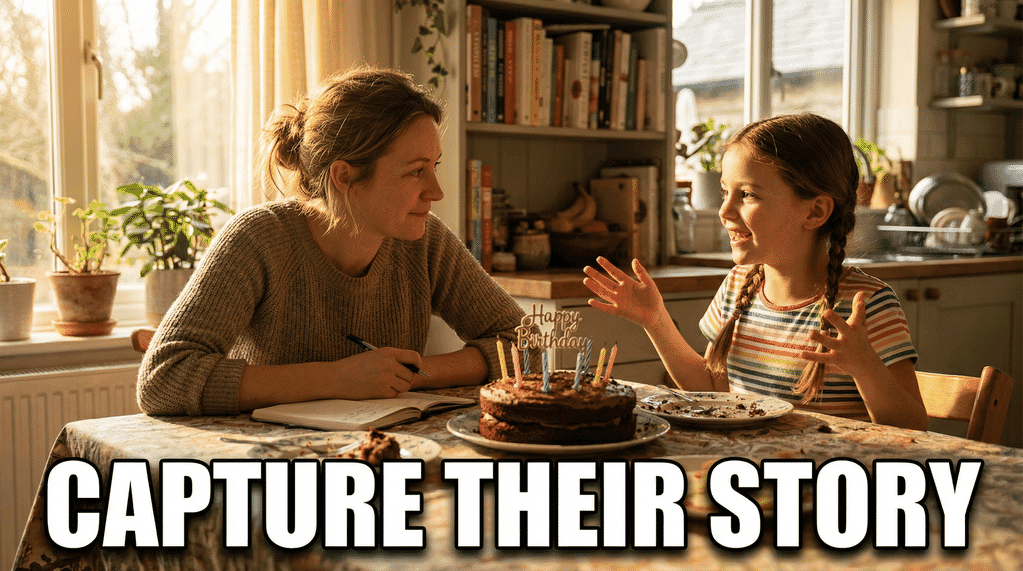
Filmmaker Jay Rosenblatt interviewed his daughter Ella on her birthday every year from age 2 to 18. Seventeen years of the same ritual: camera on, questions ready, a few minutes of conversation captured forever. The footage became an Oscar-nominated documentary—but more importantly, it became an irreplaceable record of one child’s entire journey from toddler to adult.
I’m not suggesting you make a documentary. But after watching my own eight kids grow at a pace that still catches me off guard, I’ve learned that memories blur faster than we expect. Birthday interviews capture something photographs can’t: how your child thinks, what matters to them, who they’re becoming.
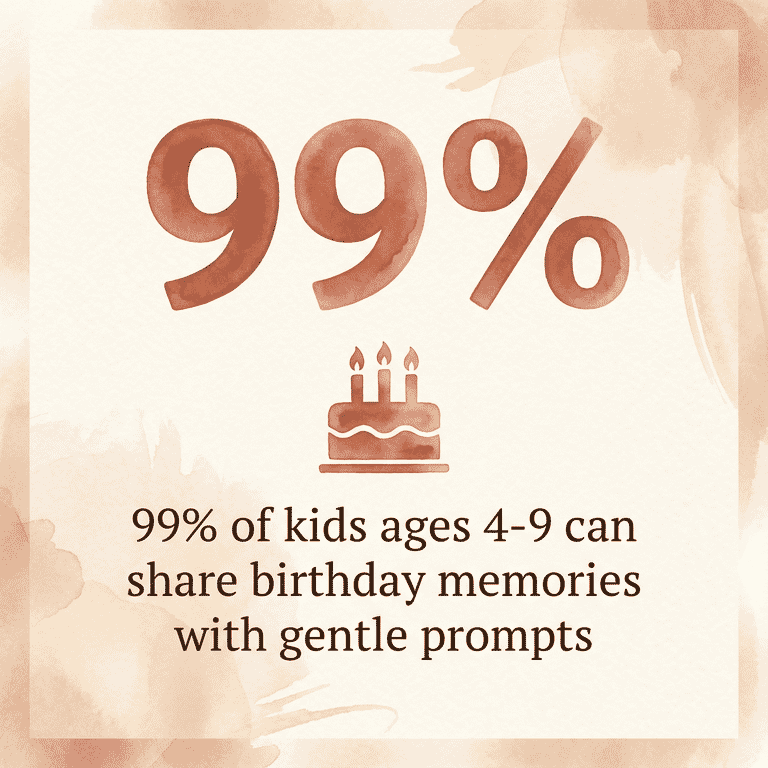
Here’s what convinced my librarian brain this was worth doing properly: USC researchers found that 99% of children ages 4-9 can successfully recall and share birthday-related memories when given gentle encouragement. The initial response rate was 91%—and with simple follow-up prompts, nearly every child opened up. Birthdays work as interview topics because they naturally combine special activities, sensory experiences, and emotional significance.
What follows is more than just a list. I’ve organized 55+ questions by purpose, noted which ones work best at different ages, and included research-backed tips for phrasing questions in ways that actually get answers. Because there’s nothing more frustrating than setting up a birthday interview tradition only to get one-word responses and shrugs.
Key Takeaways
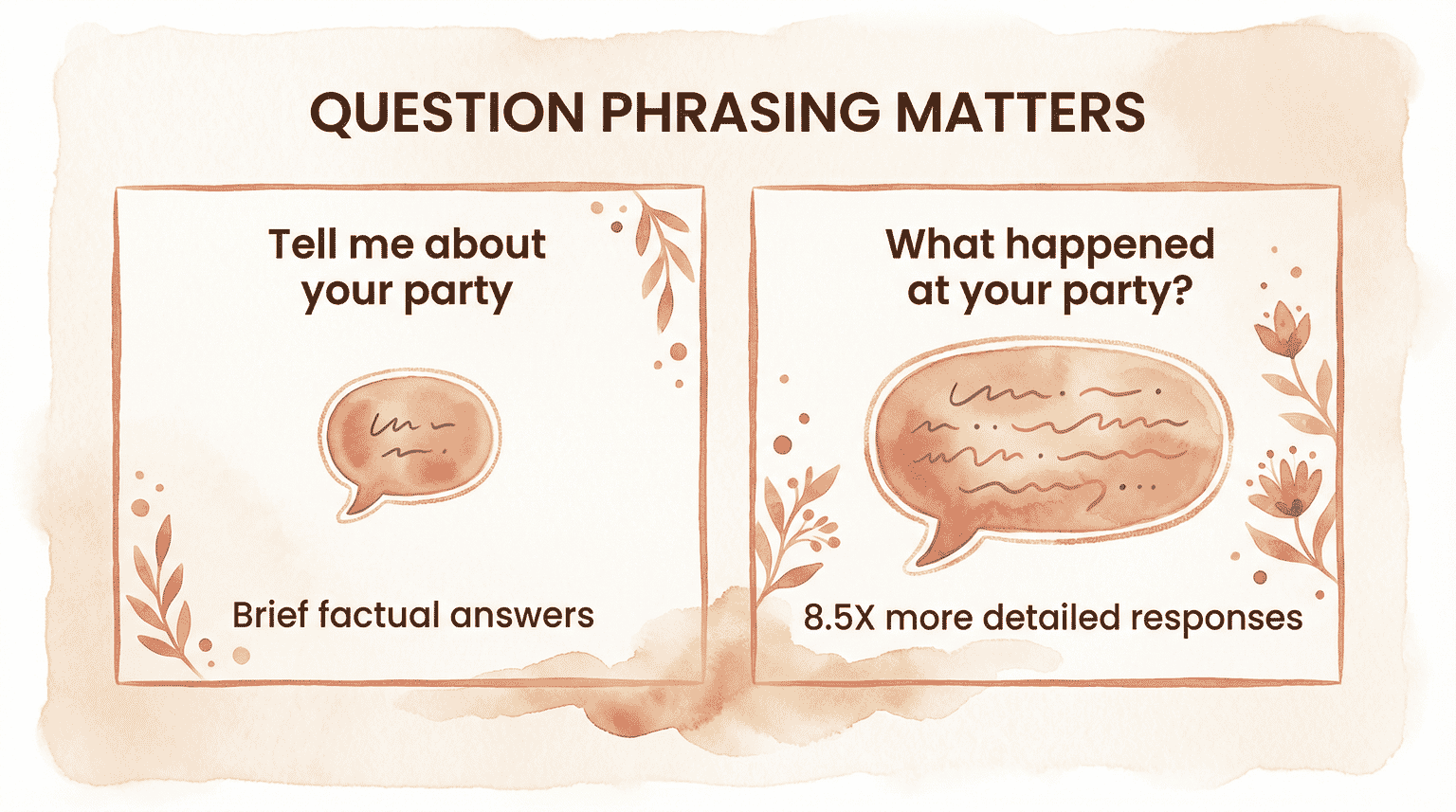
- Question phrasing matters enormously—children give 8.5x more detailed responses to “what happened” questions versus “tell me about” questions
- Keep 5-10 core questions identical every year to track how your child’s answers evolve over time
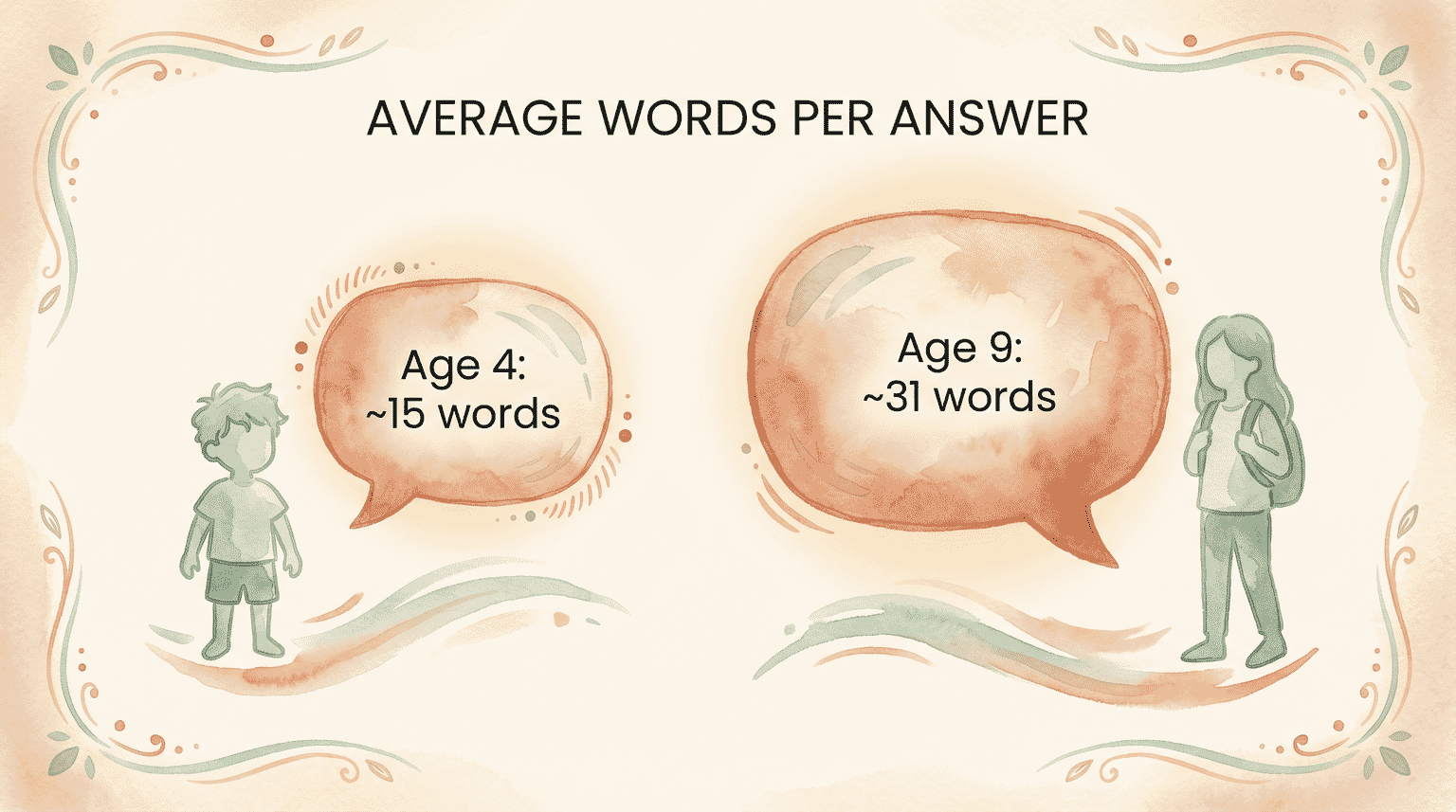
- Brief answers are normal—4-year-olds average 15 words per response while 9-year-olds average 31
- Deeper reflective questions work beautifully with tweens and teens who appreciate being asked their real opinions
- Gentle follow-up prompts like “tell me more” boost response rates from 91% to 99%
How to Ask Questions That Get Real Answers
Before diving into the questions themselves, let me share something that surprised me when I dug into the research.
A 2023 study on children’s interview responses found that children were 8.5 times more likely to give only brief, factual responses when asked “tell me about” questions versus “what happened” questions. The difference in phrasing seems small, but the impact on response quality is enormous.
Instead of: “Tell me about your birthday party.”
Try: “What happened at your birthday party?”
This simple switch signals to your child that you want a story, not just a date or a one-word answer. I’ve tested this with my own kids, and the difference is remarkable—especially with my 6 and 8-year-olds, who would otherwise default to “It was fun” and consider their work done.
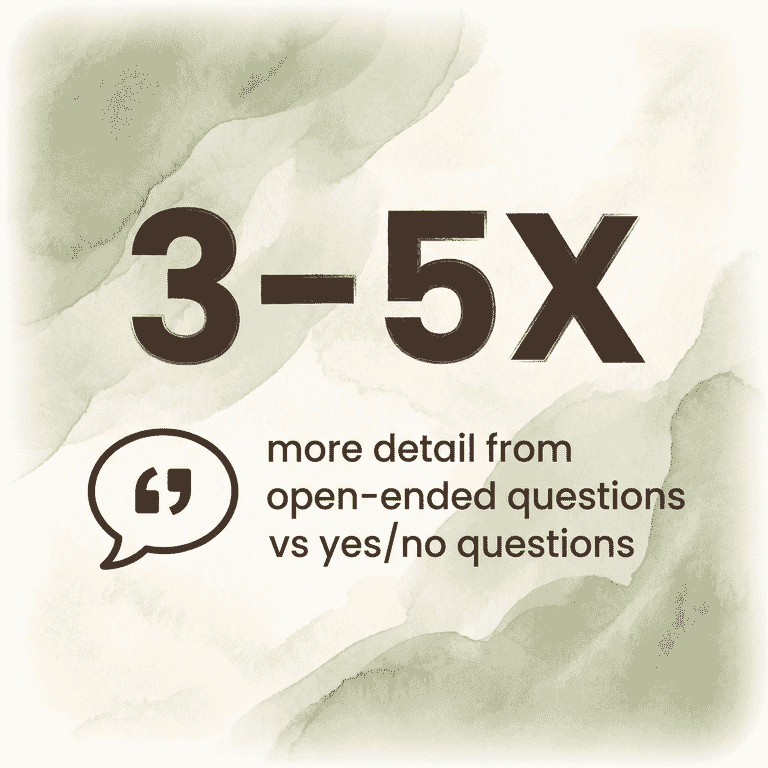
Open-Ended Questions Get 3-5x More Detail
Memory researchers have consistently documented that responses to open-ended questions are three to five times more detailed than responses to yes/no questions. Instead of “Did you like your birthday?” (which gets “yes”), try “What was the best part of your birthday?” (which gets a story).
The difference between a one-word answer and a real story often comes down to how you phrase the question. Yes/no questions invite quick responses and closed conversations.
Open-ended questions invite your child to think, remember, and share. They signal that you’re genuinely curious—not just checking boxes.
What to Do When You Get One-Word Answers
Brief answers are completely normal—especially for younger children. USC research found that 4-year-olds typically respond with about 15 words per answer, while 9-year-olds average 31 words. Don’t panic if your kindergartner isn’t giving elaborate responses.
The researchers also found that when children initially give minimal responses, gentle follow-up makes a huge difference. Response rates jumped from 91% to 99% with simple encouragement like:
- “Tell me more about that.”
- “What happened next?”
- “What made that your favorite?”
As the USC researchers put it, children’s brief responses are “predominantly attributable to a failure to provide additional support” rather than inability to remember. Your patience is the secret ingredient.
55+ Birthday Interview Questions by Category
Getting Started Questions (All Ages)
These warm-up questions help children ease into the interview. Even my teenagers don’t mind these—there’s something grounding about stating the basics.
- What is your name? (Yes, ask it anyway—it’s charming to watch this evolve)
- How old are you today?
- When is your birthday?
- What grade are you in? (Or: Are you in school yet?)
- Where do you live?
- What do you want people to call you? (Nicknames change!)
- What’s one birthday wish you made?
- How does it feel to be [age]?
Favorites & Preferences (All Ages, Adapt Phrasing for Younger Kids)
These questions create the clearest year-over-year comparisons. I keep some identical every year so we can track how favorites evolve.
Watching favorites shift over time tells its own story. The year “pizza” becomes “sushi.” The year their best friend changes. The year superheroes give way to sports stars.
These concrete questions work perfectly for toddlers and preschoolers. Expect one-word answers, and that’s exactly right. You’re capturing preferences, not philosophy.
- What is your favorite color?
- What is your favorite food?
- What is your favorite thing to eat for breakfast?
- What is your favorite treat or dessert?
- What is your favorite toy to play with?
- What is your favorite game?
- What is your favorite book? (Or: What book do you like me to read to you?)
- What is your favorite movie?
- What is your favorite TV show?
- What is your favorite song?
- What is your favorite animal?
- What is your favorite thing to do outside?
- What is your favorite place to visit?
- What is your favorite thing to wear?
- What is your favorite holiday besides your birthday?
For toddlers (ages 2-3): Stick to 5-8 of these concrete “favorite” questions. Expect one-word answers, and that’s perfect. You’re capturing their preferences, not their philosophy.
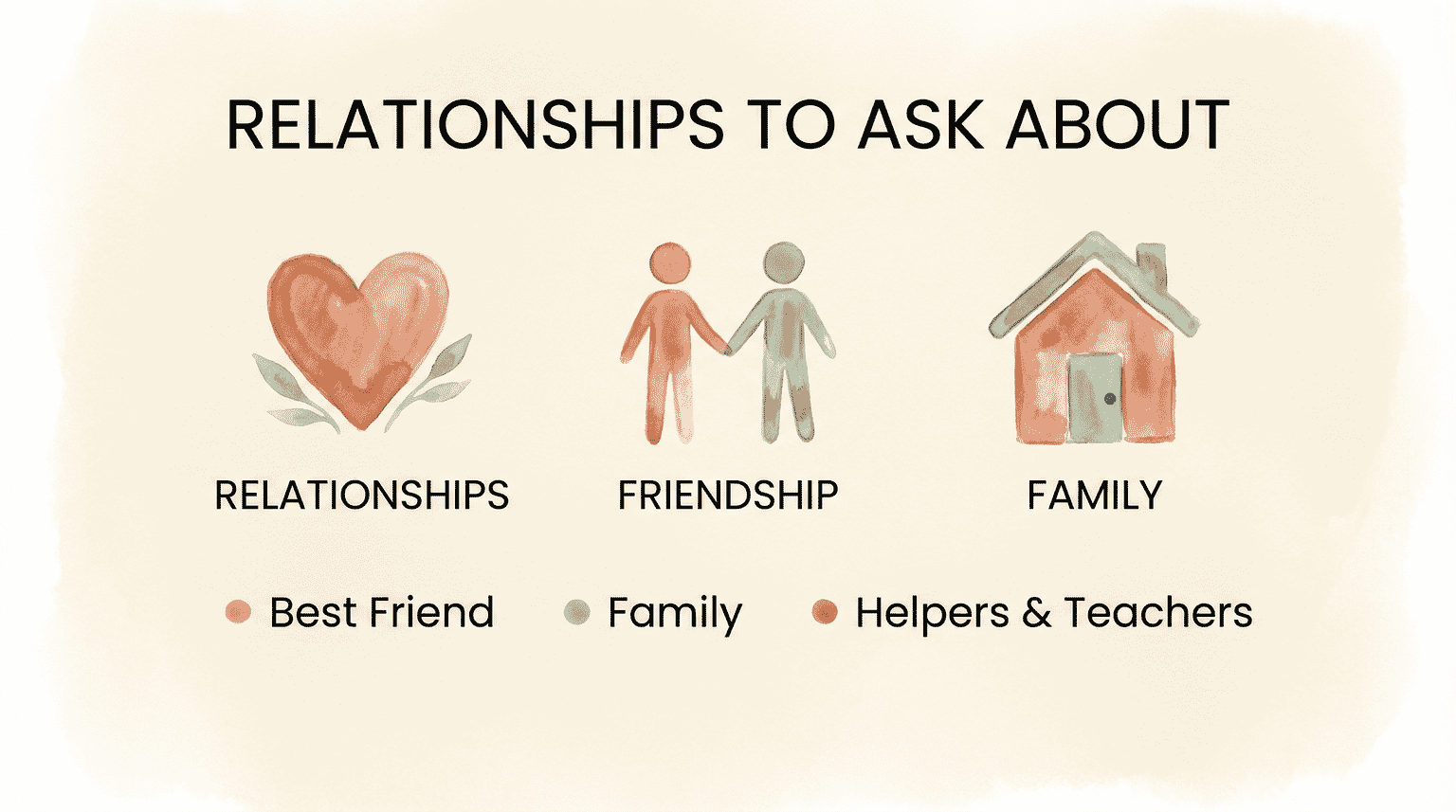
People & Relationships (Ages 4+)
These questions reveal who matters in your child’s world—and often surface names you haven’t heard before.
- Who is your best friend?
- What do you like to do with your best friend?
- Who makes you laugh the most?
- Who is your favorite person to play with?
- What do you like to do with Mom/Dad/[caregiver]?
- What do you love about your family?
- Who is someone who helps you?
- What is your favorite thing to do with your siblings? (If applicable)
- Who is your favorite teacher? What makes them great?
Memories & Experiences (Best for Ages 5+)
Now we’re moving into narrative territory. These questions ask children to reflect on actual events, which requires more cognitive development.
- What was your happiest memory from this year?
- What was the funniest thing that happened to you?
- What was something hard that you did?
- What are you most proud of?
- What was the best day you had this year?
- What was your favorite thing you learned?
- What was the best trip or adventure you went on?
- What’s something new you tried?
- What was the best gift you received?
- What was your favorite part of your birthday celebration?
For younger children (ages 4-5), rephrase as “What happened when…” rather than “What was your favorite…” to elicit more narrative detail.
Dreams & Aspirations (All Ages, Different Versions)
These future-focused questions capture your child’s imagination at each stage.
Concrete versions (ages 3-6):
- What do you want to be when you grow up?
- What do you want to learn how to do?
- Where would you like to go someday?
Abstract versions (ages 7+):
- What do you hope will happen this year?
- What’s something you want to get better at?
- What kind of person do you want to become?
- What’s a goal you have for yourself?
- If you could learn anything in the world, what would it be?
Imagination & Fun (All Ages)
Every interview needs some playfulness. These questions often yield the most entertaining answers—and the ones you’ll laugh about years later.
- If you could have any superpower, what would it be?
- If you could be any animal for a day, which would you choose?
- If you could eat one food forever, what would it be?
- If you could go anywhere in the world tomorrow, where would you go?
- What would you do with a million dollars?
- If you could make one rule everyone had to follow, what would it be?
- What makes you really, really happy?
- What’s the silliest thing you can think of?
Reflective Questions (Ages 9+ and Teens)
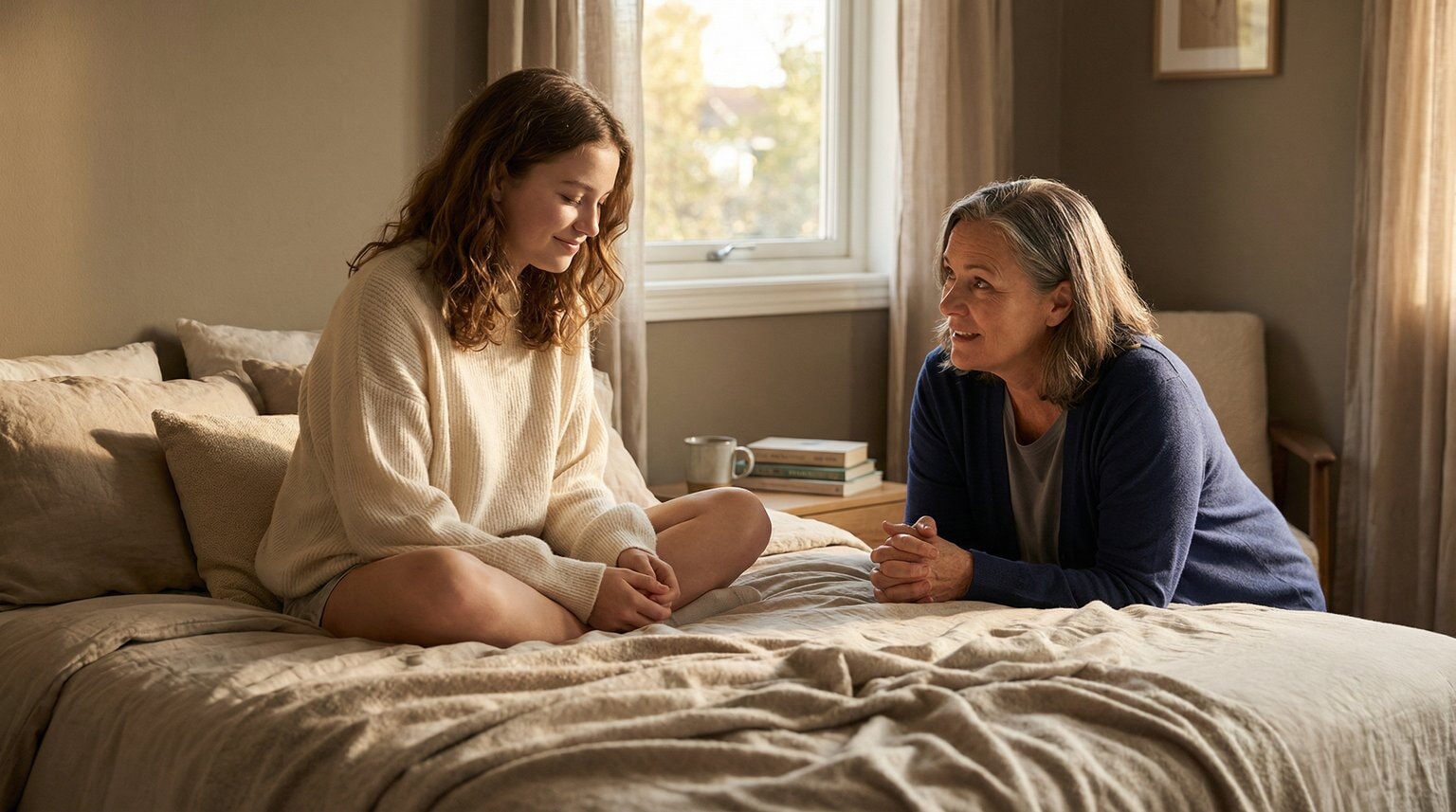
Jay Rosenblatt asked his daughter philosophical questions like “What is power?” and “Are you happy?” These deeper questions work beautifully with older children and create the most meaningful footage to watch years later.
- Are you happy? What makes you feel that way?
- What do you worry about?
- What are you most afraid of?
- How do you feel about our relationship?
- What do you think makes a good friend?
- What have you changed your mind about this year?
- What do you wish adults understood about kids?
- What’s something you believe that other people might not?
- If you could give your younger self advice, what would you say?
- What does it mean to be [age]?
In Rosenblatt’s documentary, when asked “Are you happy?” at age 14, his daughter responded, “Not really, but I’m working on it.” These honest moments become precious documentation of your child’s inner world.
Recording and Preserving Your Interviews
Video vs. Written: Both Work
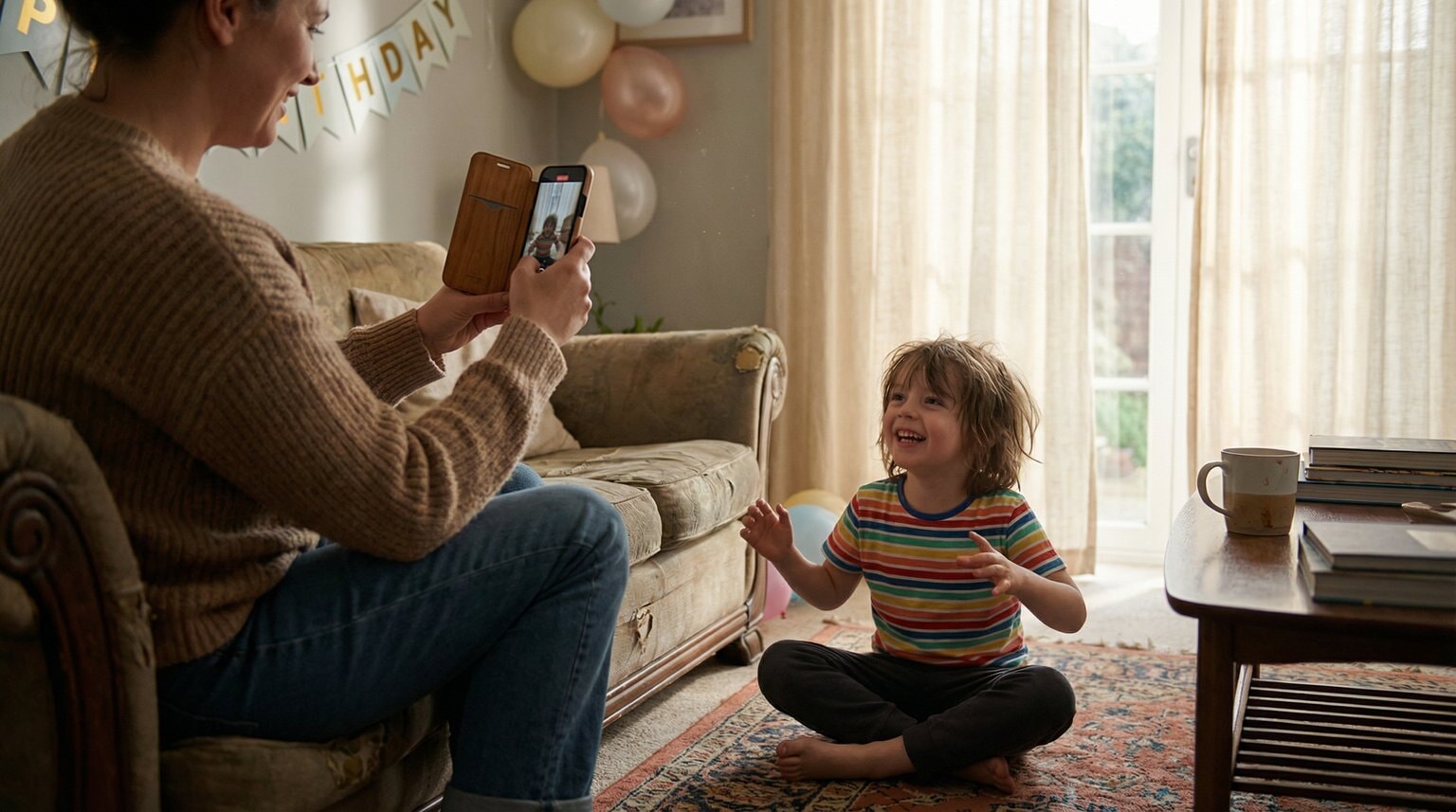
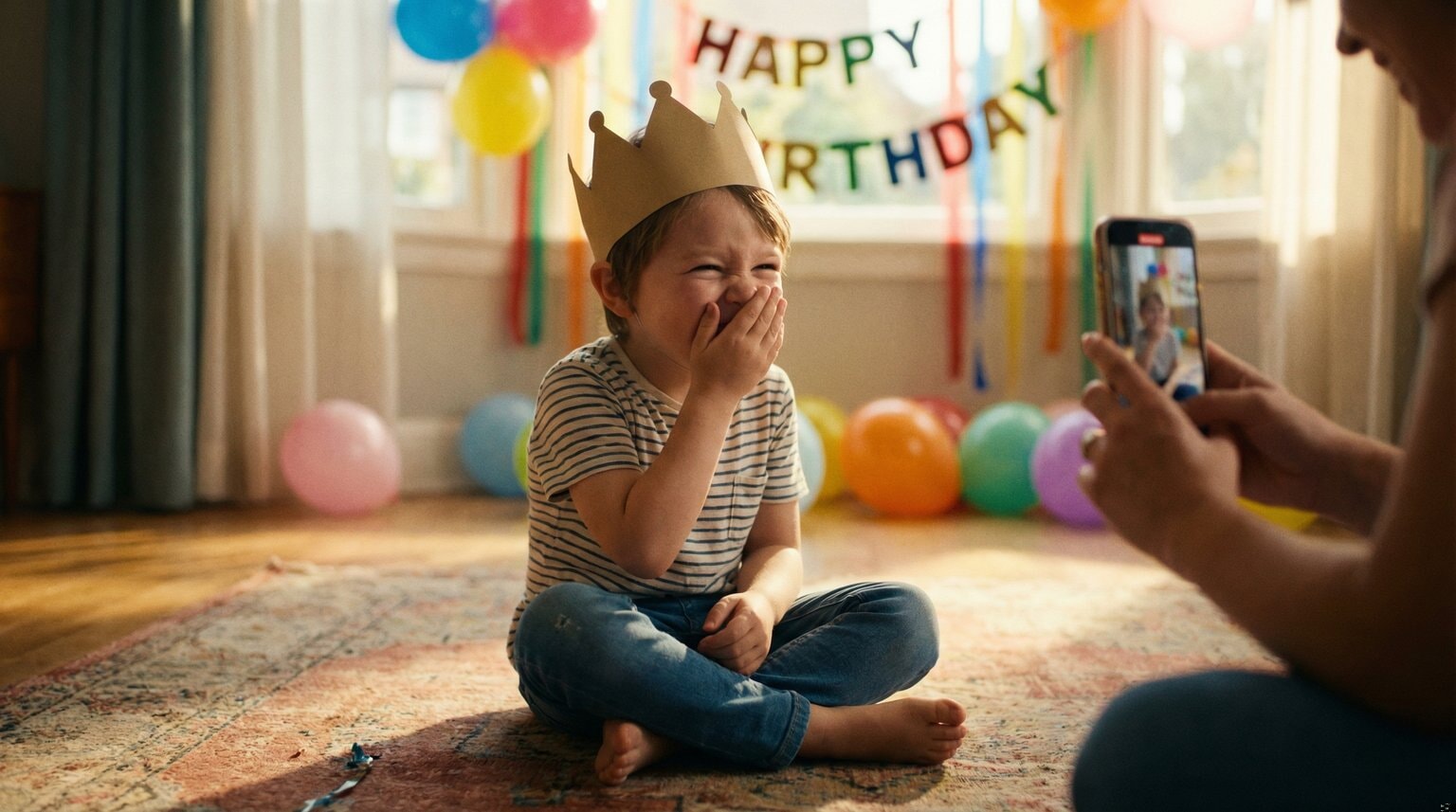
Video captures voice, expressions, and mannerisms that written records can’t—but some children freeze up on camera. My 10-year-old hates being filmed but will chat freely while I write down her answers. Choose what works for your child.
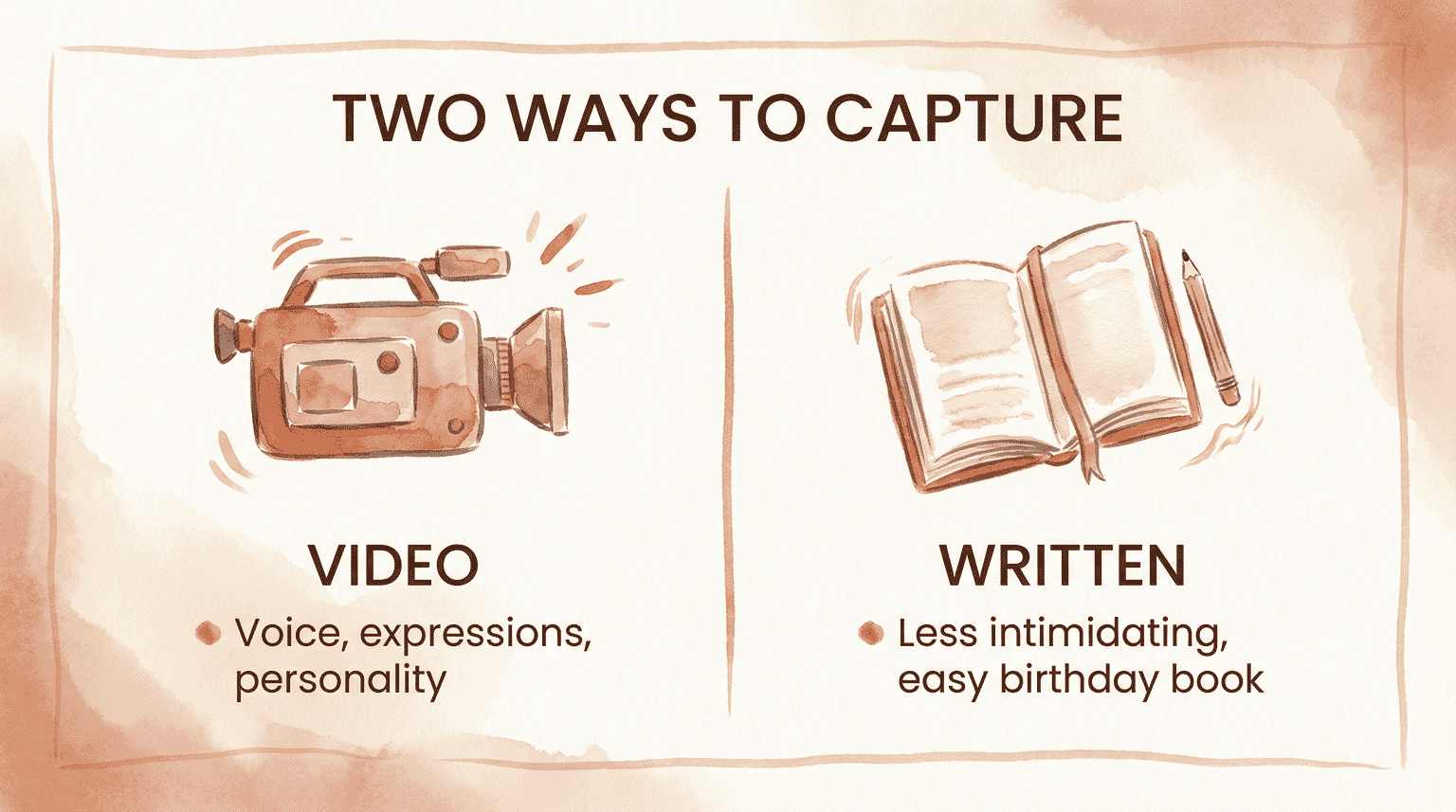
Video advantages: Captures personality, voice changes, physical growth, expressions
Written advantages: Less intimidating, easier to do casually, creates a birthday interview book
Either way, you’re creating a meaningful family tradition that compounds in value over time.
Creating Birthday Interview Books
Many families keep a dedicated journal or binder with written interviews. You can also print video transcripts and add photos from that year.
After 17 years, Rosenblatt described reviewing his footage as deeply moving—he “choked up” watching his daughter’s growth documented over time. He found moments he’d forgotten, including his daughter saying she loved him, something he’d never consciously registered at the time: “It felt like a gift that she gave me.”
Simple Storage Solutions
For video: Create a dedicated folder (cloud or hard drive) organized by year. Back up annually.
For written: A simple notebook works. Date each entry clearly.
The most important thing isn’t the format—it’s consistency.
Making It Work Year After Year
Pick Your Moment
Most families find success with morning interviews before the birthday festivities begin, or the evening before as a birthday-eve tradition. Avoid post-party interviews when children are overstimulated or exhausted. Choose a time when your child is rested, fed, and not distracted by new presents.
Consider building the interview into your birthday countdown routine—making it part of the celebration rather than an interruption.
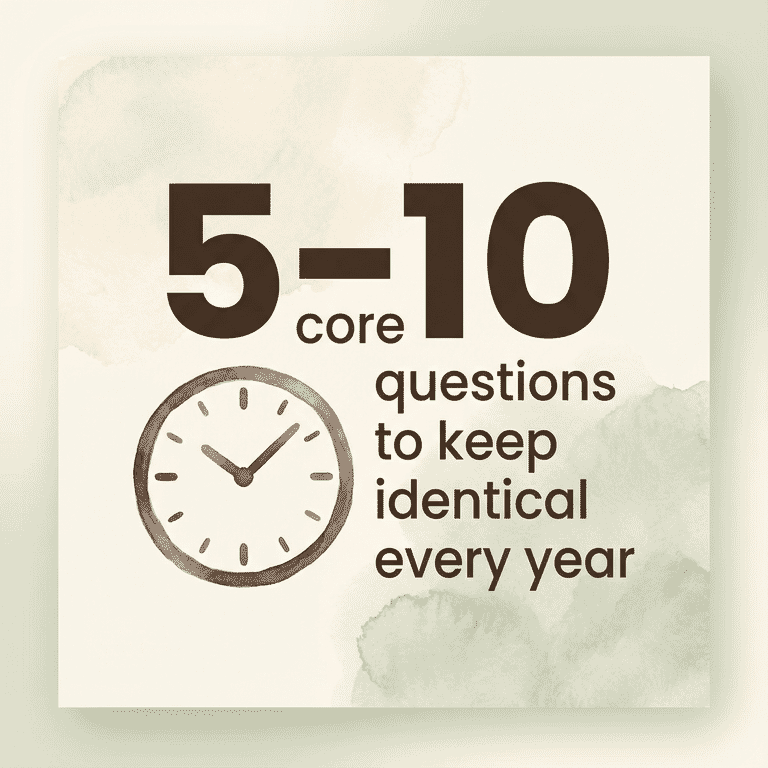
The magic of birthday interviews emerges over years, not in any single session. Consistency is what transforms a nice activity into irreplaceable documentation.
Keep 5-10 core questions identical each year, then add age-appropriate questions as your child grows. This creates trackable data alongside evolving conversations.
Keep Some Questions Consistent
When you ask “What do you want to be when you grow up?” annually from ages 4 to 18, you create a documentary of evolving dreams. The astronaut becomes a veterinarian becomes a marine biologist becomes an engineer. Each shift tells a story.
Adapt as They Grow
Preschoolers need concrete questions about favorites. Elementary kids can handle memory and reflection questions. Tweens and teens engage with philosophical questions—and often appreciate being asked their actual opinions about life.
My 15-year-old initially groaned about continuing our birthday interview tradition. But when I asked “What do you wish adults understood about teenagers?”—and genuinely listened—the interview became a conversation she actually wanted to have.
What You’ll Discover Later
Parents who maintain this tradition consistently describe unexpected discoveries when reviewing years of interviews. You’ll see patterns you didn’t notice in real time. You’ll hear your child’s voice at ages that feel impossibly distant. You’ll find moments that make you laugh, cry, and marvel at who this person is becoming.
That’s the point.
Quick Reference: Sample Interview Flow
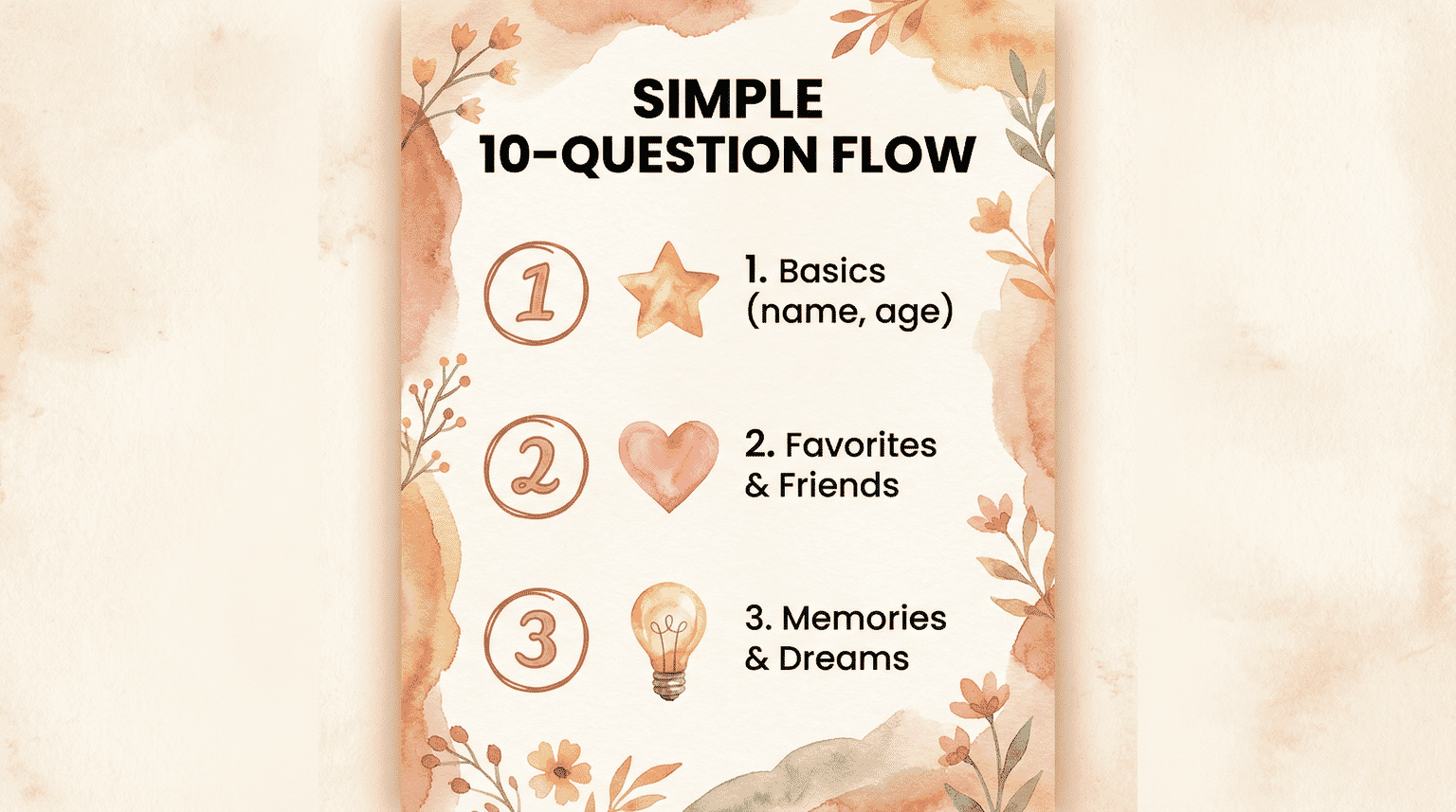
Here’s a 10-question starter interview you can use today:
- What is your name and how old are you today?
- What is your favorite thing to do?
- Who is your best friend?
- What makes you happiest?
- What do you want to be when you grow up?
- What was your favorite memory from this year?
- What’s something you’re really good at?
- If you could have any superpower, what would it be?
- What do you love about our family?
- What do you hope happens this year?
Pair this interview with a special birthday plate tradition and you’ve created birthday rituals your children will remember—and perhaps continue with their own kids someday.
Frequently Asked Questions
What age should you start birthday interviews?
Most children can participate starting at age 3-4. USC research found that 83% of 4-year-olds responded to birthday-related questions initially, and 93% succeeded with gentle encouragement. Start simple with favorite colors and foods, then add reflective questions as your child grows.
How many questions should a birthday interview have?
For younger children (ages 3-5), aim for 8-12 questions to match shorter attention spans. Children ages 6-9 can handle 12-18 questions. Tweens and teens may enjoy 15-20 questions, especially if they include deeper reflective questions. Quality matters more than quantity.
What if my child only gives one-word answers?
Completely normal, especially for younger children. Four-year-olds typically respond with about 15 words, while 9-year-olds average 31. Try gentle follow-up prompts like “Tell me more about that” or “What made that your favorite?” Research shows response rates jump from 91% to 99% with patient encouragement.
Can I do a birthday interview if my child is shy or dislikes being recorded?
Absolutely. Written interviews work just as well—simply write down answers while chatting casually. Some children open up more without a camera. You can also make it less formal by asking questions during a special birthday breakfast or while doing a favorite activity together.
Share Your Story
Do you do birthday interviews? I’d love to hear which questions have gotten the best answers—and which ones fell completely flat. After years of these, I’m still learning what actually sparks good conversation at different ages.
Your favorite question discoveries always help me refine my own family’s interviews.
References
- The Utility of the Birthday Prompt in Narrative Practice – USC Child Interviewing Lab research on children’s birthday memory recall
- Pseudotemporal Invitations: Children’s Interpretation of Questions – Research on question phrasing and response quality
- NPR: He Interviewed His Daughter for 17 Years – Jay Rosenblatt’s documentary journey
- Children’s Adaptive Question-Asking Behavior – Central European University developmental research

Share Your Thoughts