
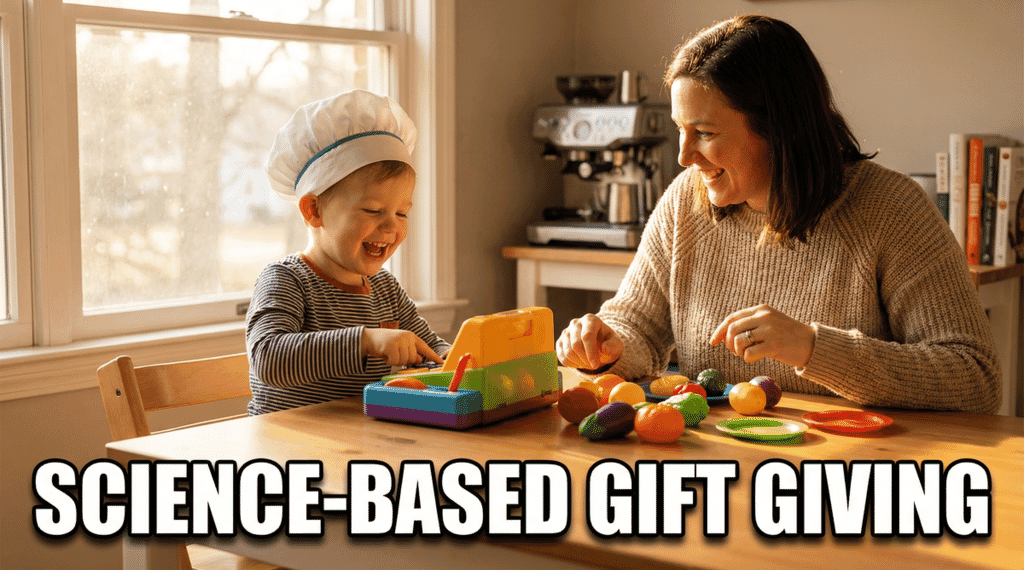
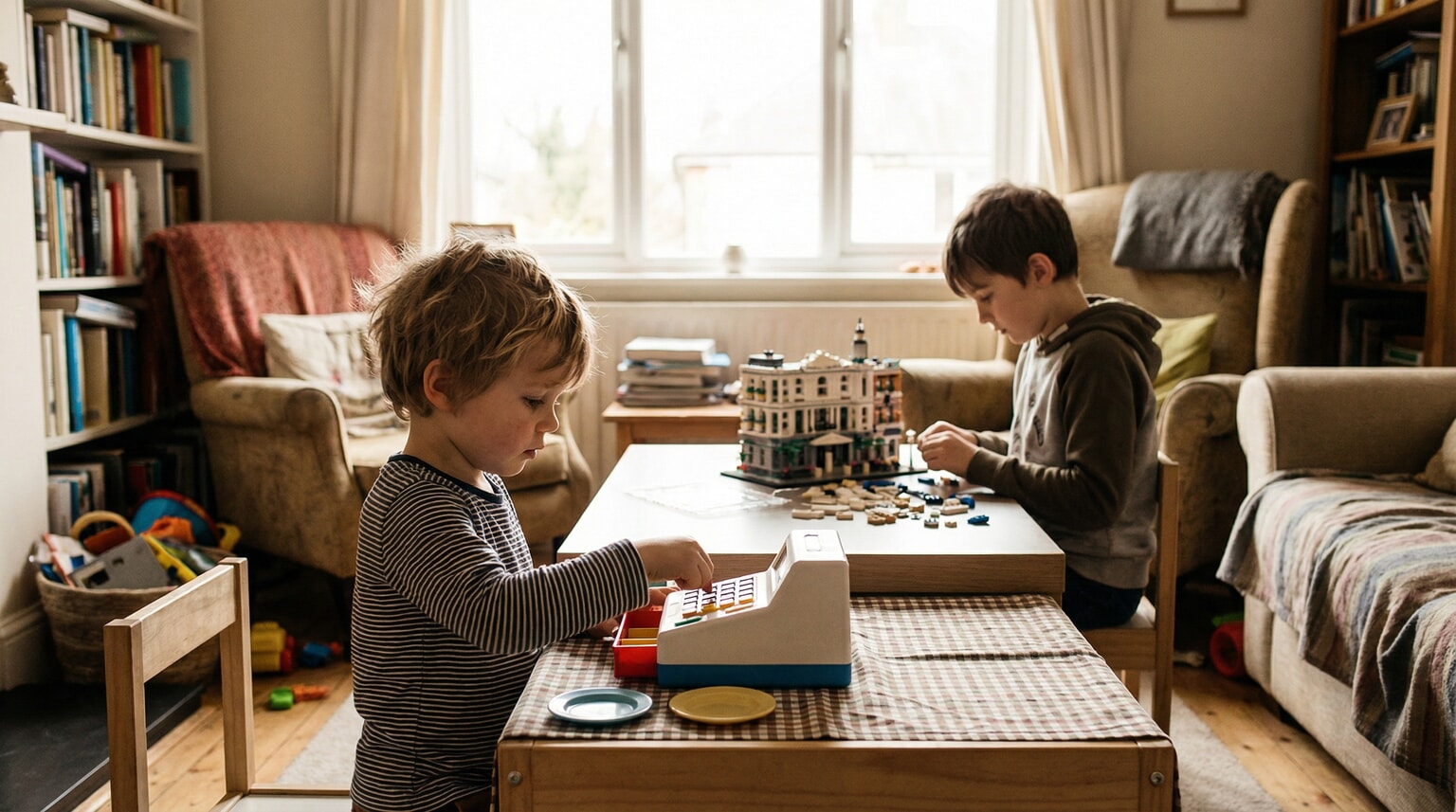
My 4-year-old is currently obsessed with playing “restaurant” with a battered toy cash register, while my 12-year-old spends hours building elaborate LEGO architecture sets. Same household, same parents—completely different developmental worlds. After 8 kids spanning ages 2 to 17 and over 1,200 gifts observed in action, I’ve learned that understanding why certain toys click at certain ages matters far more than trusting the number on the box.
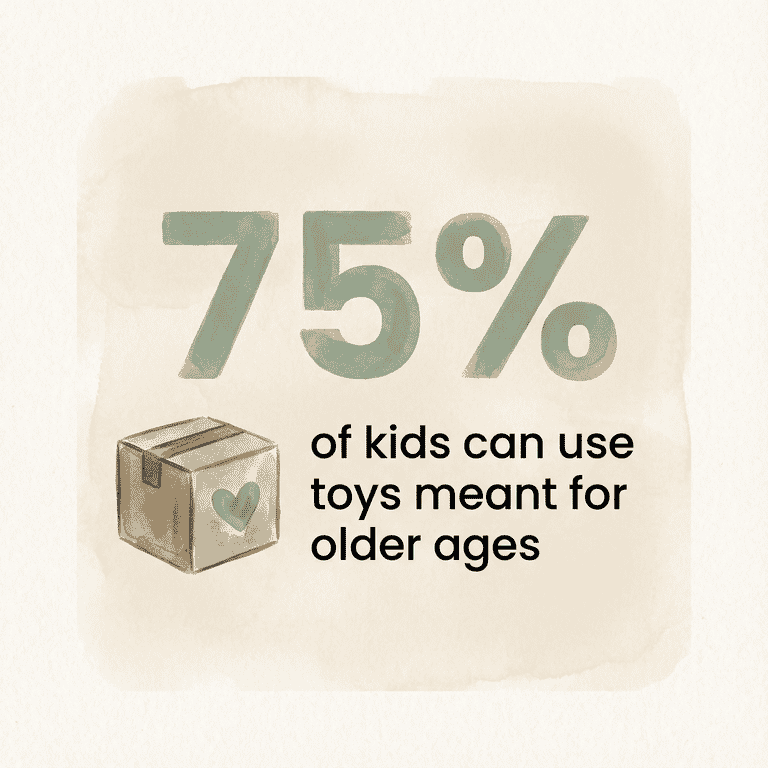
Here’s the thing my librarian brain couldn’t let go: a 2022 study found that 19% of manufacturer age labels don’t actually reflect developmental appropriateness. Even more surprising? In 75% of cases, children could successfully use toys designed for the next age group up. Those labels are legal safety guidelines, not developmental prescriptions.
So what should guide your gift choices instead? Understanding the developmental milestones happening right now—and matching gifts to those emerging abilities. When you understand the science behind how gifts affect child development, you stop buying for an age and start buying for a stage.
Key Takeaways
- Age labels are unreliable—19% don’t match developmental needs, and 75% of kids can use toys meant for older ages
- Preschoolers prefer realistic, detailed toys over fantasy options by a 56% to 12% margin
- The best toys make the child do the work—not the toy itself
- Pretend play peaks at age 4, then gradually shifts toward mastery and rule-following
- Open-ended toys like blocks, vehicles, and musical instruments work across the widest age ranges
| Age | Developmental Focus | Gift Features to Seek |
|---|---|---|
| 0-6 mo | Sensory exploration, visual tracking | High contrast, varied textures, cause-effect |
| 6-12 mo | Object permanence, motor exploration | Hide-reveal features, graspable |
| 1-2 yr | Walking, cause-effect, early pretend | Push/pull, stacking, simple figures |
| 2-3 yr | Language, symbolic play | Realistic details, open-ended props |
| 3-5 yr | Social play, self-regulation | Turn-taking games, role-play sets |
| 5-7 yr | Rules, pre-academics | Strategy basics, building systems |
| 7-11 yr | Mastery, concrete logic | Complex building, collections, skill-building |
| 12+ yr | Abstract thinking | Advanced strategy, interest-deep pursuits |
The research consistently points to one truth: developmental stage matters more than chronological age.
“As children go through different developmental stages, the right toy for them should target motor, play and cognitive skills.”
— Magdalena Oledzka, Pediatric Physical Therapist, Hospital for Special Surgery
Let me walk you through what that actually means at each age.
Birth to 12 Months: Sensorimotor Foundations
This first year sees more developmental change than any other—which is why I refuse to treat it as a single bracket. Your 2-month-old and your 10-month-old are essentially different species.
0-3 Months: High Contrast and Simple Sounds
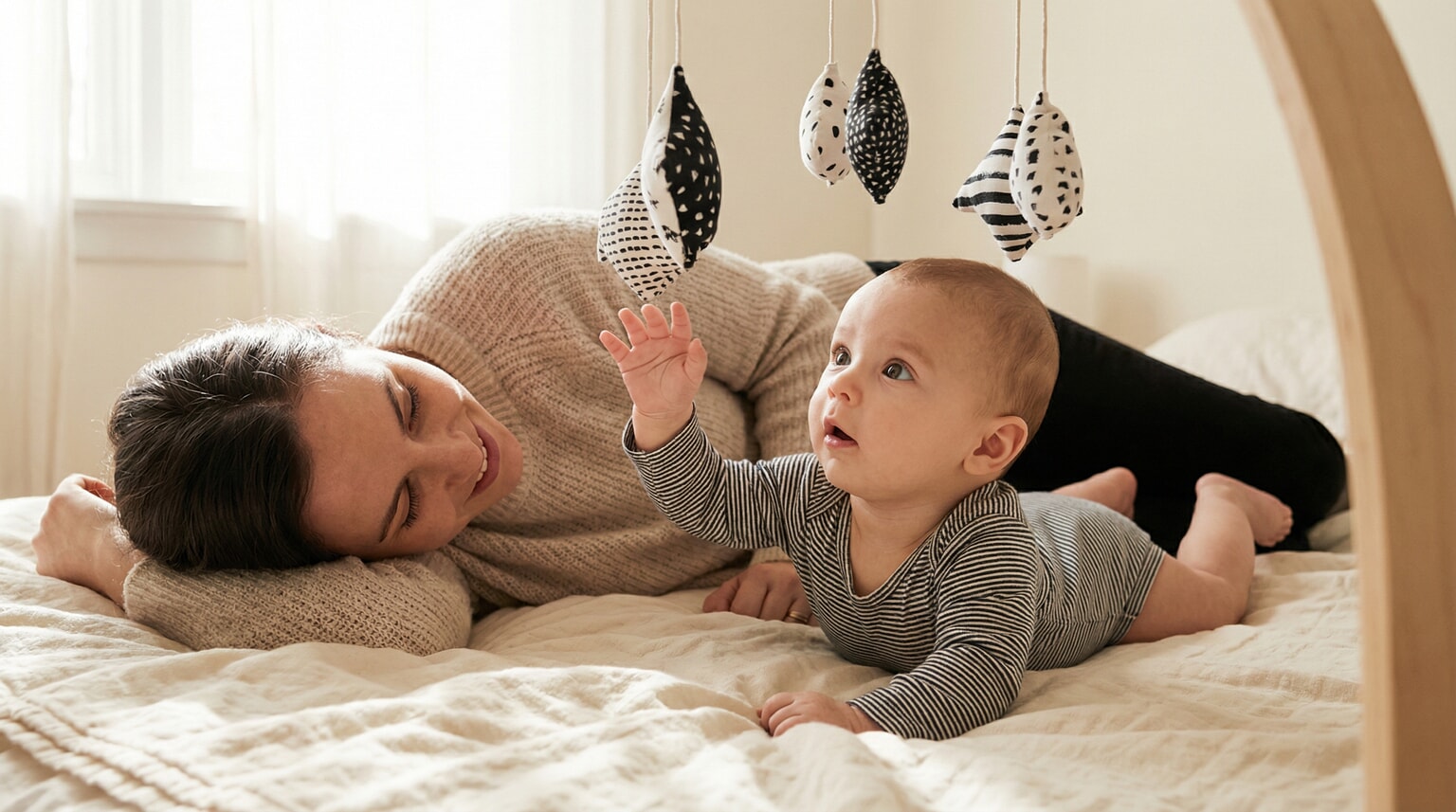
Newborns can’t see colors clearly yet. Those beautiful pastel nursery toys? Largely invisible to them. Research from the Hospital for Special Surgery confirms that black-and-white designs with bold contrasting patterns capture infant attention most effectively.
“That’s how babies explore. They explore through sight, sound, texture, and taste.”
— Dr. Cindy Gellner, Pediatrician, University of Utah Health
What to look for: High-contrast mobiles, simple rattles, unbreakable mirrors, crinkle books, and textured fabric toys that can safely go in mouths.
3-6 Months: Reaching and Grasping
Tummy time tolerance improves, reaching becomes purposeful, and everything goes straight to the mouth. This is the age of swatting at dangling toys and discovering that hands exist.
What to look for: Play gyms with hanging toys, colorful teething rings, activity quilts, small grippable balls, and toys with varied textures.
6-9 Months: Sitting and Exploring
Independent sitting changes everything. Suddenly, both hands are free for exploration. Object permanence begins emerging—they’ll now look for a toy you’ve hidden.
What to look for: Cause-and-effect toys (push button, something happens), stacking rings, pop-apart beads, board books, and simple musical instruments.
9-12 Months: Cruising Toward Walking
Crawling, pulling up, maybe cruising along furniture. This is also when a 2021 NIH-supported study found that families with more books showed significant cognitive advantages for their infants—the effect size of 0.51 for books was substantial. Books aren’t just toys; they’re developmental tools from month one.
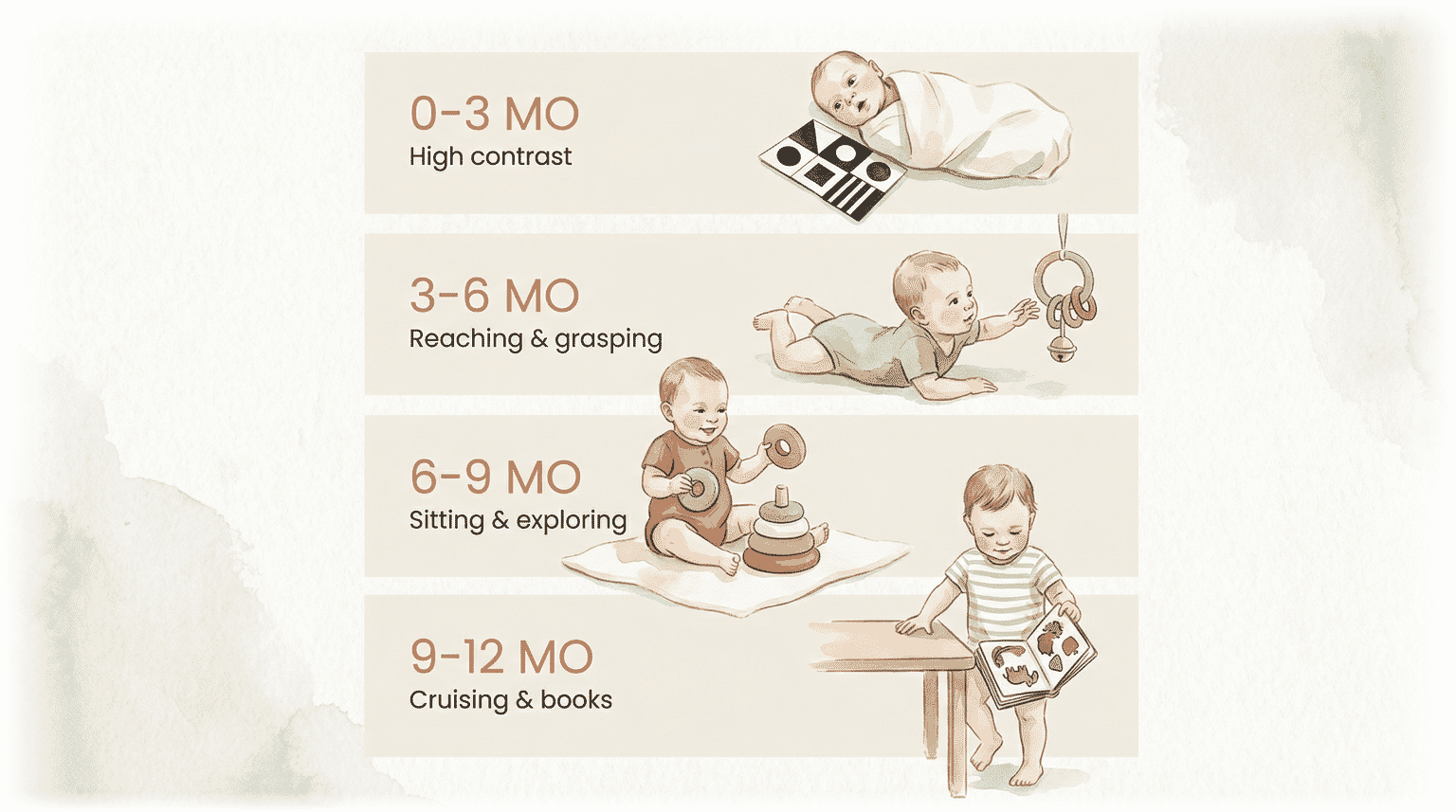
What to look for: Push-and-go toys, standing activity tables, shape sorters, board books (so many board books), and push toys that support early walking.
12-24 Months: First Steps and First Words
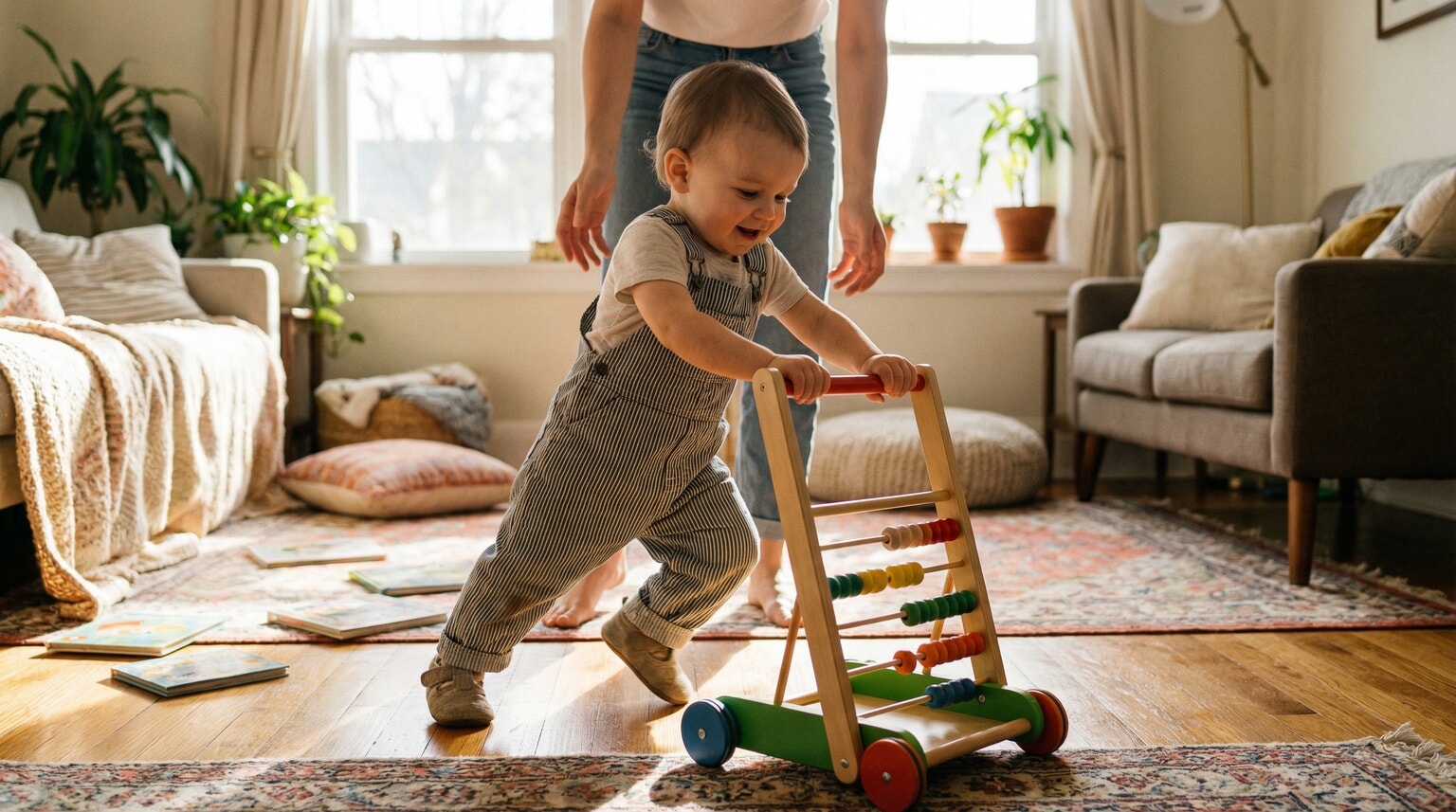
The walking, talking explosion begins. Your toddler is suddenly doing things—and fascinated by every cause-and-effect relationship they can find.
“Your toddler is fascinated by cause-and-effect and will enjoy any toy that responds to their actions and makes use of their newly acquired motor skills.”
— Dr. Robin Goodman, Clinical Psychologist
Research on open-ended toys shows that around 18 months, children begin active experiments—varying their actions to see what happens differently. This is when why simple items like boxes often outperform expensive toys becomes abundantly clear.
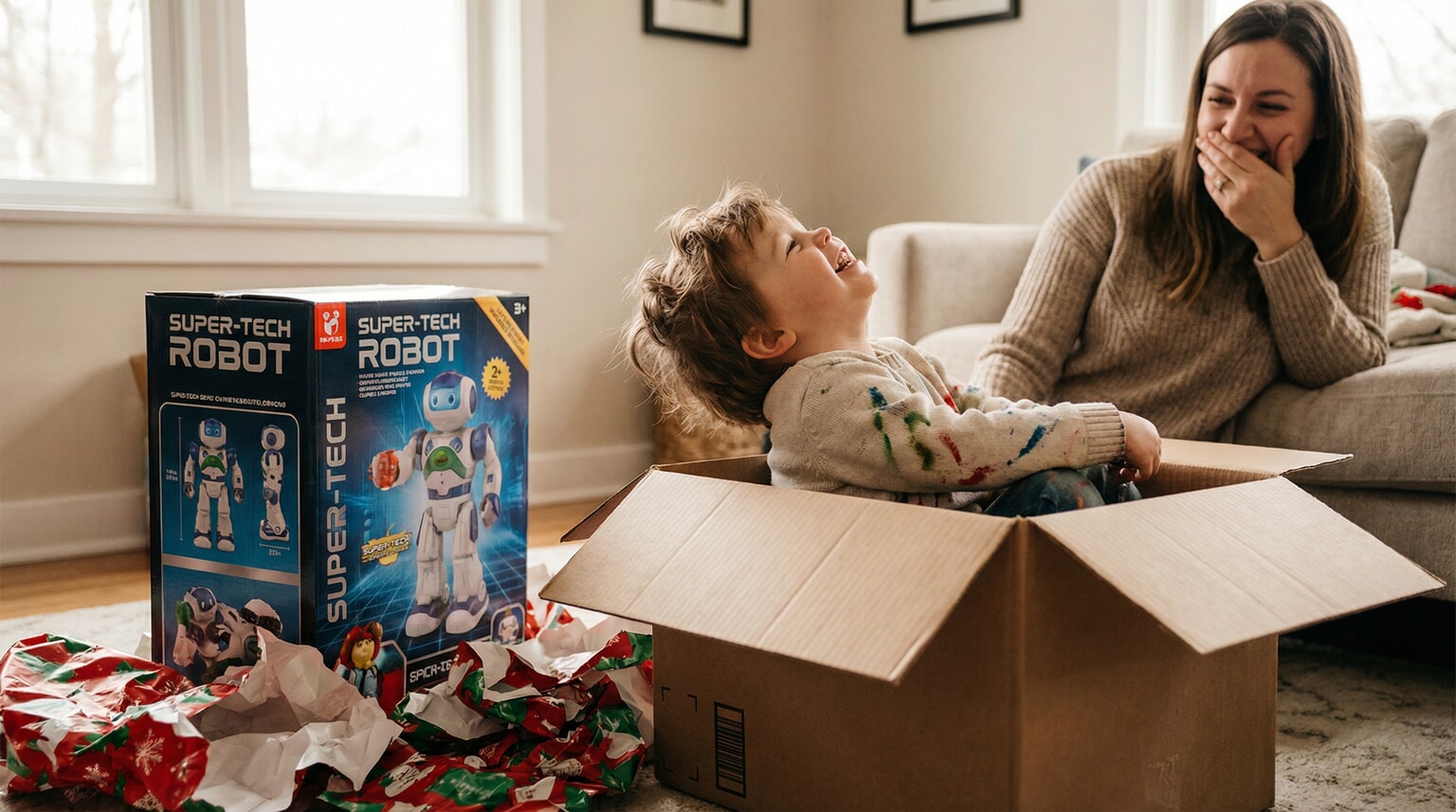
That cardboard box isn’t boring to them; it’s infinitely interesting because they control what it becomes. Research confirms what every parent suspects: the most engaging toys are often the simplest ones.
The 2022 PMC study found that 75% of children could successfully use toys designed for the next age group up—suggesting we consistently underestimate what toddlers can handle.
What to look for: Hammering toys, pop-up toys, push/pull toys, stacking cups and rings, simple musical instruments, toy phones, and basic pretend play items like toy kitchens.
What’s actually happening: The transition from pure sensory exploration to early symbolic thinking. By 18 months, your child can use a banana as a phone—they understand objects can represent other things.
2-3 Years: Symbolic Play Emerges
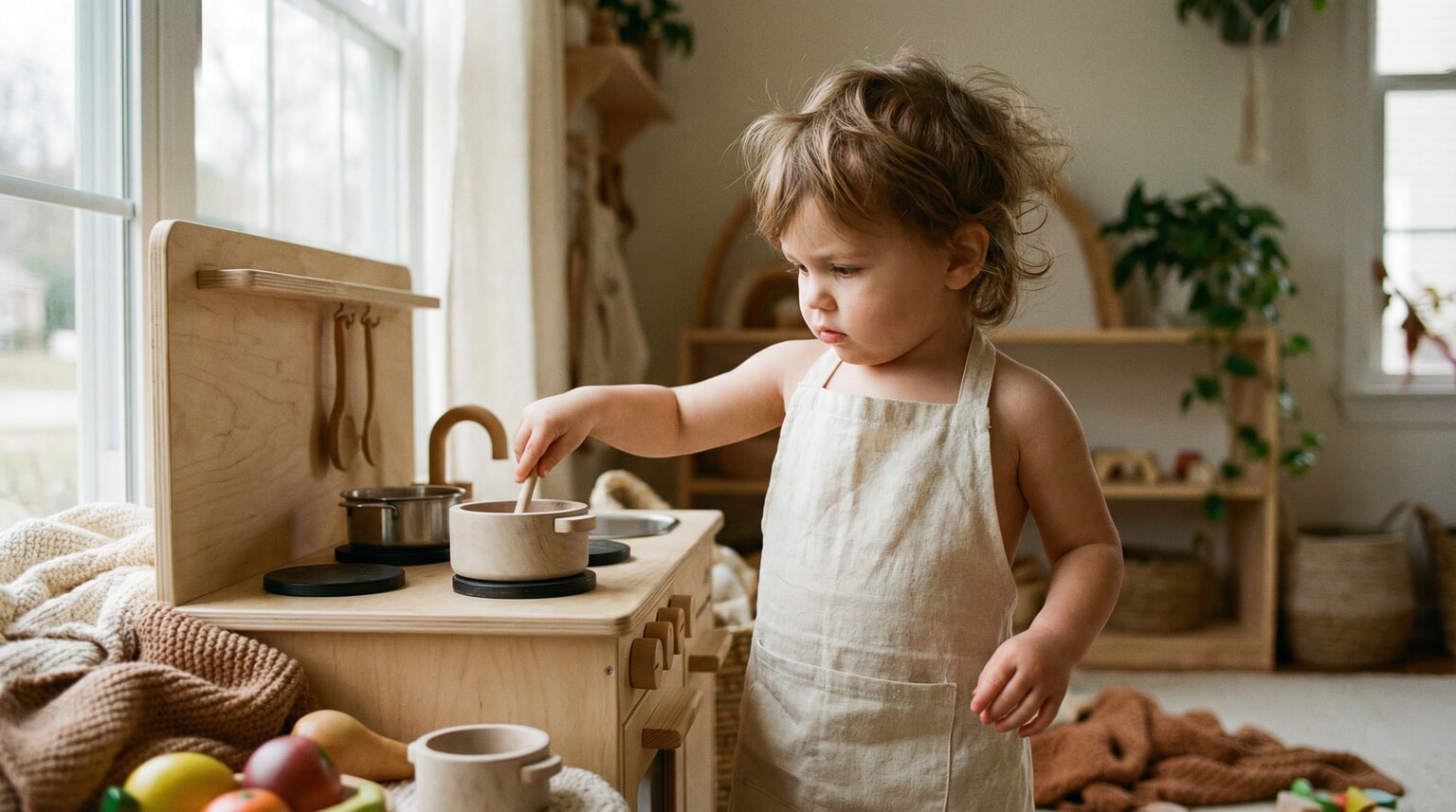
Here’s where things get interesting. Research from Acta Psychologica shows that substitution play—using objects as symbols—reaches meaningful benchmarks around 36 months. Your child isn’t just stacking blocks anymore; those blocks are a castle, a birthday cake, a mountain.
But here’s what surprised me: a 2023 study from Psychology in Russia found that 55.8% of 3-4-year-olds preferred realistic toys over fantasy-based options. When researchers offered dragons (which “only exist in fairy tales”), only 12.4% of children chose them. Even more striking, 63.6% preferred highly detailed toys over simpler versions.
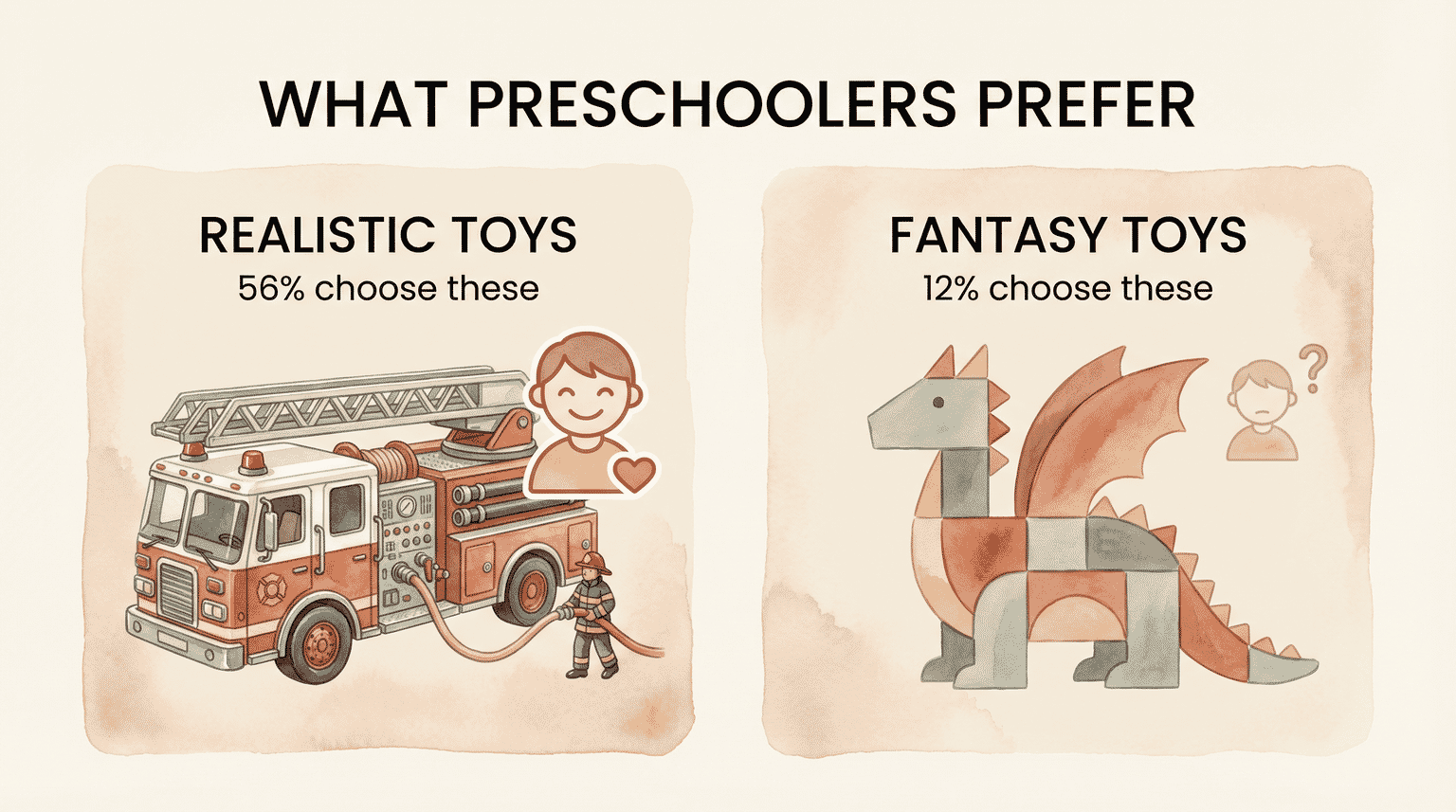
Why? Children at this age use play to recreate and understand their real experiences. Realistic, detailed toys provide “hints” that guide appropriate play activities. That detailed toy kitchen outperforms the abstract one because it connects to their actual observations of your kitchen.
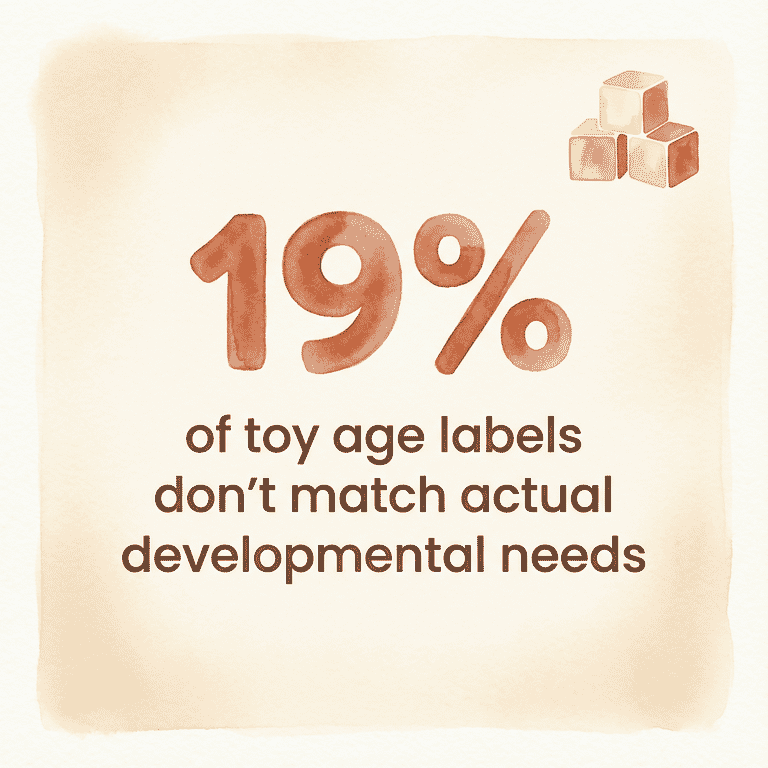
This is why trusting manufacturer age labels can lead you astray. The 2022 PMC research found that 19% of those labels don’t reflect developmental appropriateness at all.
Instead of checking the box, watch what your child is actually doing. Are they recreating scenes from daily life? They’re ready for realistic props. Are they narrating elaborate stories? They need open-ended materials.
What to look for: Realistic play figures, detailed vehicles, toy kitchens with recognizable features, dolls with changeable clothes, and open-ended building materials.
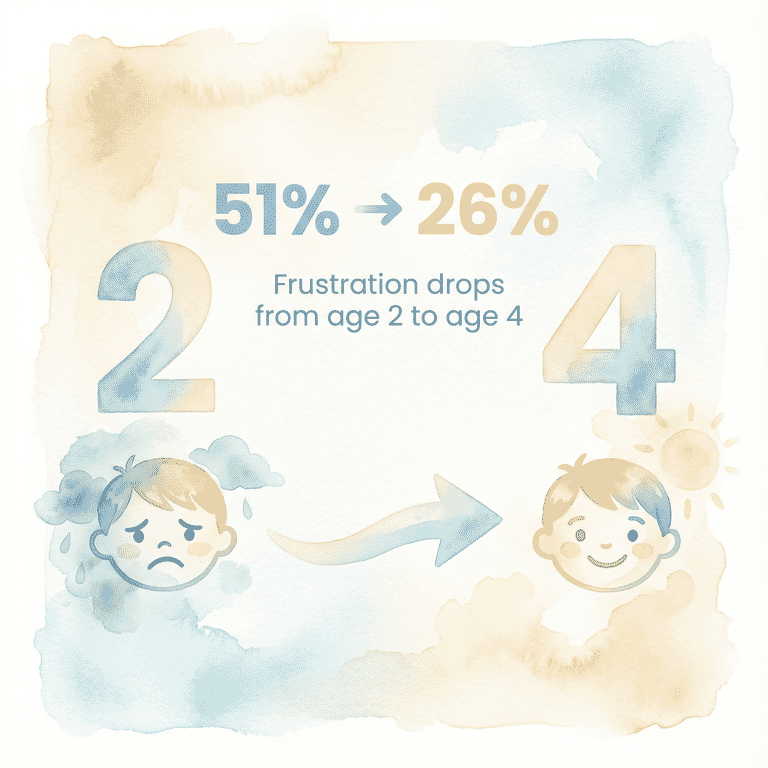
What’s actually happening developmentally: Self-regulation is still emerging. A 2023 PMC study found that at 24 months, children spend 51% of task time expressing frustration, with only 20% using distraction strategies. By 48 months, that flips—26% frustration, 36% distraction. This is why games with rules feel impossible right now. They’re not being difficult; their brains literally can’t regulate the waiting yet.
3-5 Years: Preoperational Peak
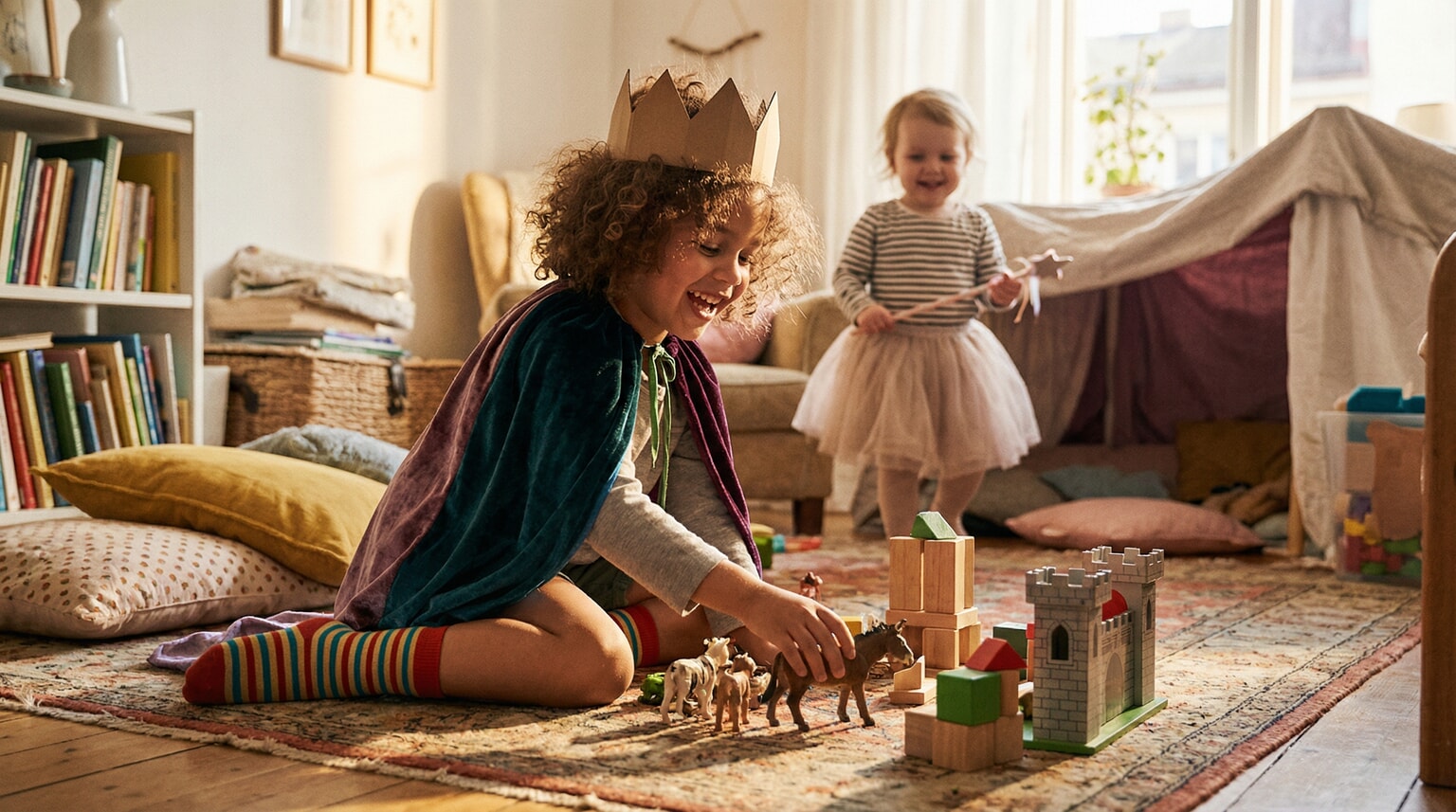
Pretend play peaks at age 4, according to the Acta Psychologica research. This is the golden age of imagination—my 4-year-old currently runs a veterinary clinic, a restaurant, and an airport (sometimes simultaneously) from our living room.
University of Utah Health describes preschoolers as “little sponges absorbing as much knowledge as they can.” The vocabulary explosion happening now means toys with language components suddenly click.
“The primary purpose of a toy is play. If the primary purpose is to teach something, it may not be a very good toy.”
— Dr. Barry Kudrowitz, Director of Product Design, University of Minnesota
Children learn from play itself. Toys that prioritize drilling content over genuine playability often miss the mark.
Executive attention—the ability to deliberately focus—emerges during the third year of life. By age 3-4, simple turn-taking games become possible. Not complex strategy, but “you go, then I go.”
The frustration research shows just how dramatically self-regulation improves during this window. What felt impossible at 2 becomes manageable by 4.
What to look for: Best pretend play toys for this stage include dress-up clothes, play sets with multiple figures, simple board games emphasizing cooperation over competition, art supplies, and building sets with more pieces.
5-7 Years: The Transition Zone
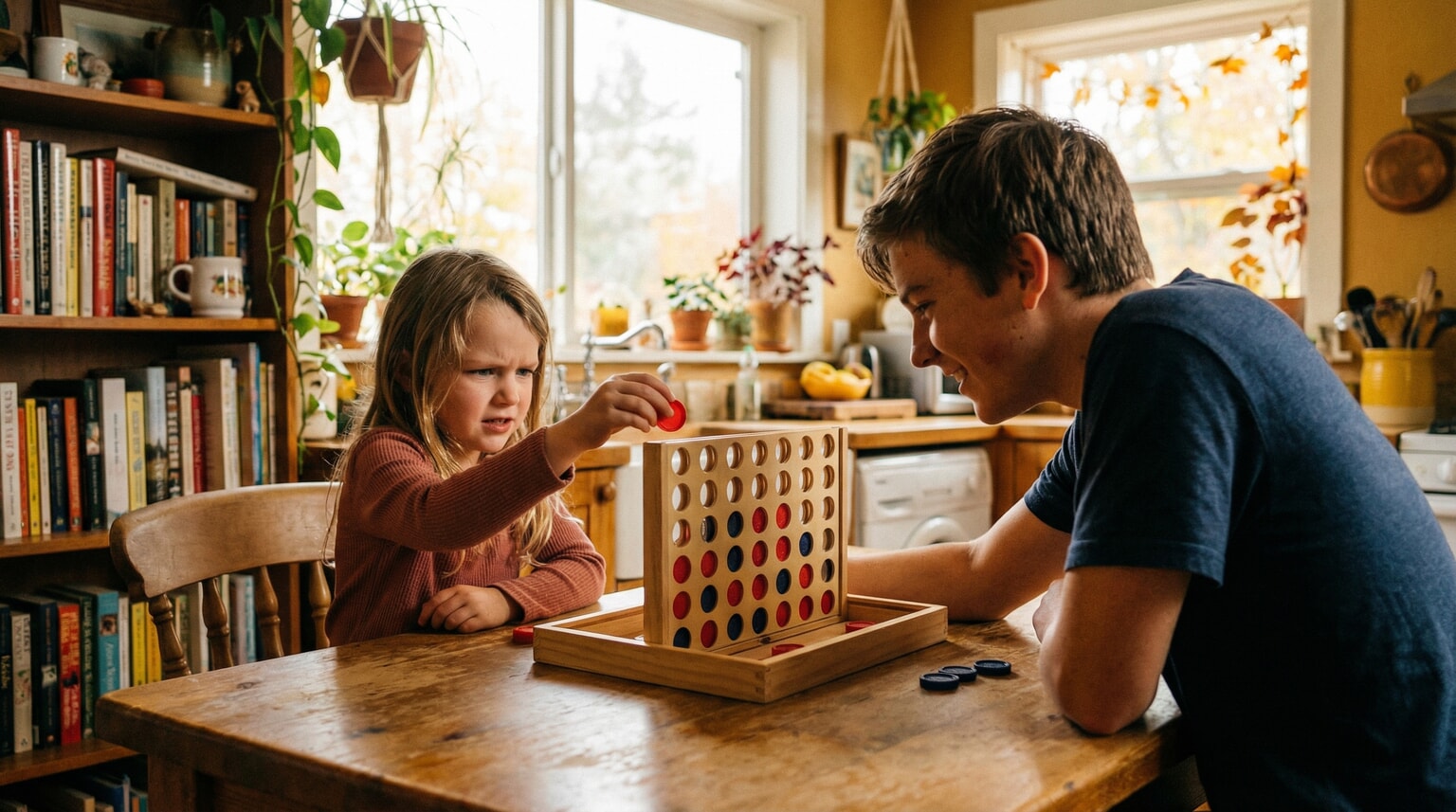
This is the age range researchers call the transition from preoperational to concrete operational thinking—which is academic-speak for “they’re starting to think logically about real things.”
Pretend play begins declining after age 7 (though my 8-year-old still has elaborate stuffed animal dramas). Meanwhile, rule-following matures significantly. The PMC research on children’s toy utilization found that by ages 6-8, children showed real advantages with age-appropriate games, puzzles, and sports equipment—these now match their emerging logical abilities.
What to look for: Simple strategy games (checkers, Connect 4), building systems with instructions to follow, beginner science kits, sports equipment, and crafts requiring multi-step processes.
What’s actually happening: They can now hold rules in their head AND follow them. They understand taking turns isn’t just waiting—it’s part of how games work. Losing still stings, but it’s survivable.
7-11 Years: Concrete Operational Gifts
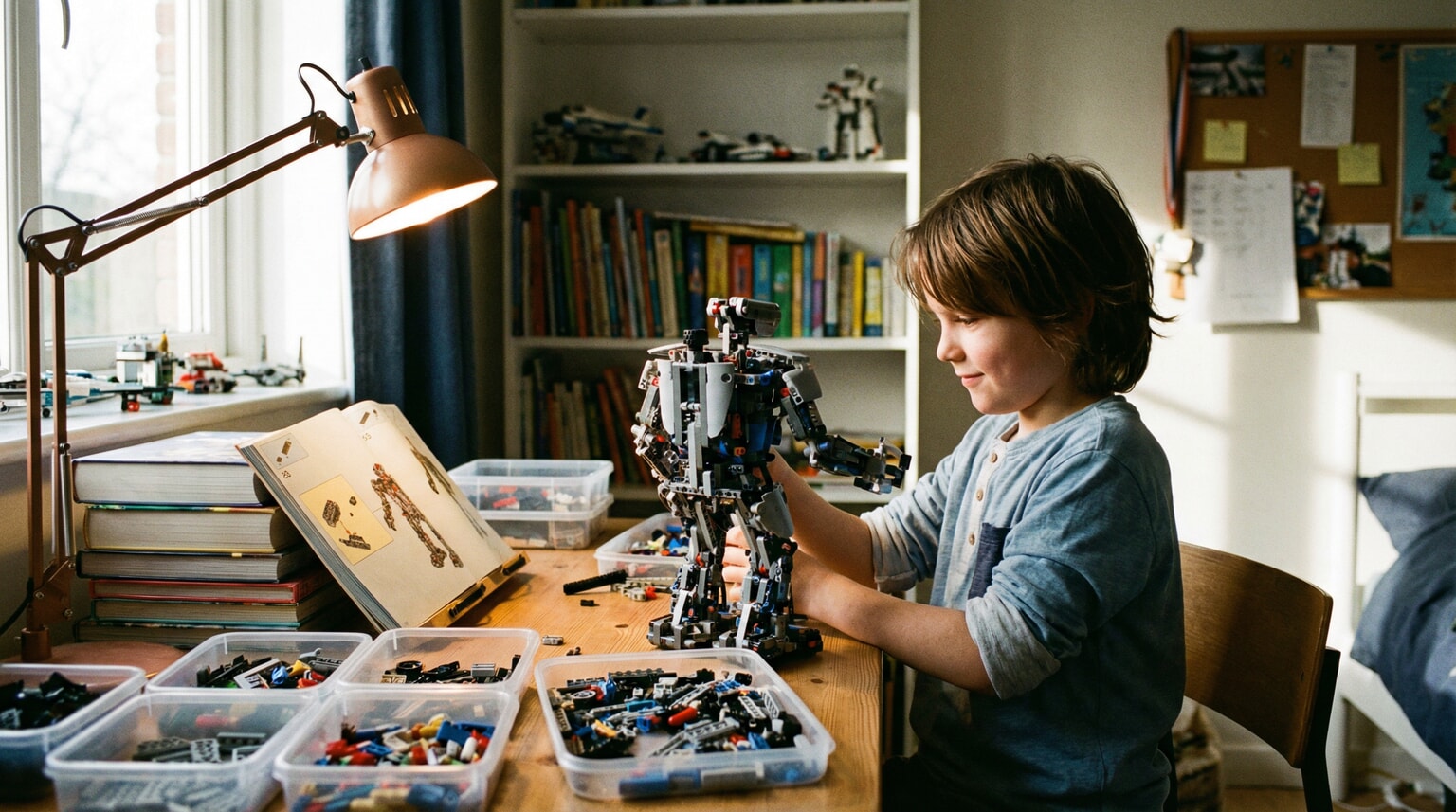
“A really good toy is one that doesn’t do everything itself, but has the child do it.”
— Dr. Doris Bergen, Distinguished Professor Emerita, Author of The Handbook of Developmentally Appropriate Toys
This is the mastery age. My 10-year-old spent three months building a complex LEGO Technic set and still talks about it. The satisfaction came from her accomplishment, not the toy’s bells and whistles.
Parents magazine research describes ages 8+ as “about doing things that give kids sense of mastery.” The APA’s podcast on toy research found something fascinating: adults who won MacArthur “genius” awards almost all reported enjoying “Small World Play” as older children—building structures and little towns, then playing within those created worlds.
What to look for: Complex building systems (standard LEGO works well now—DUPLO was for symbolic play ages), model kits, collections to organize, strategy games like chess, science experiment kits, and sports equipment for skill development.
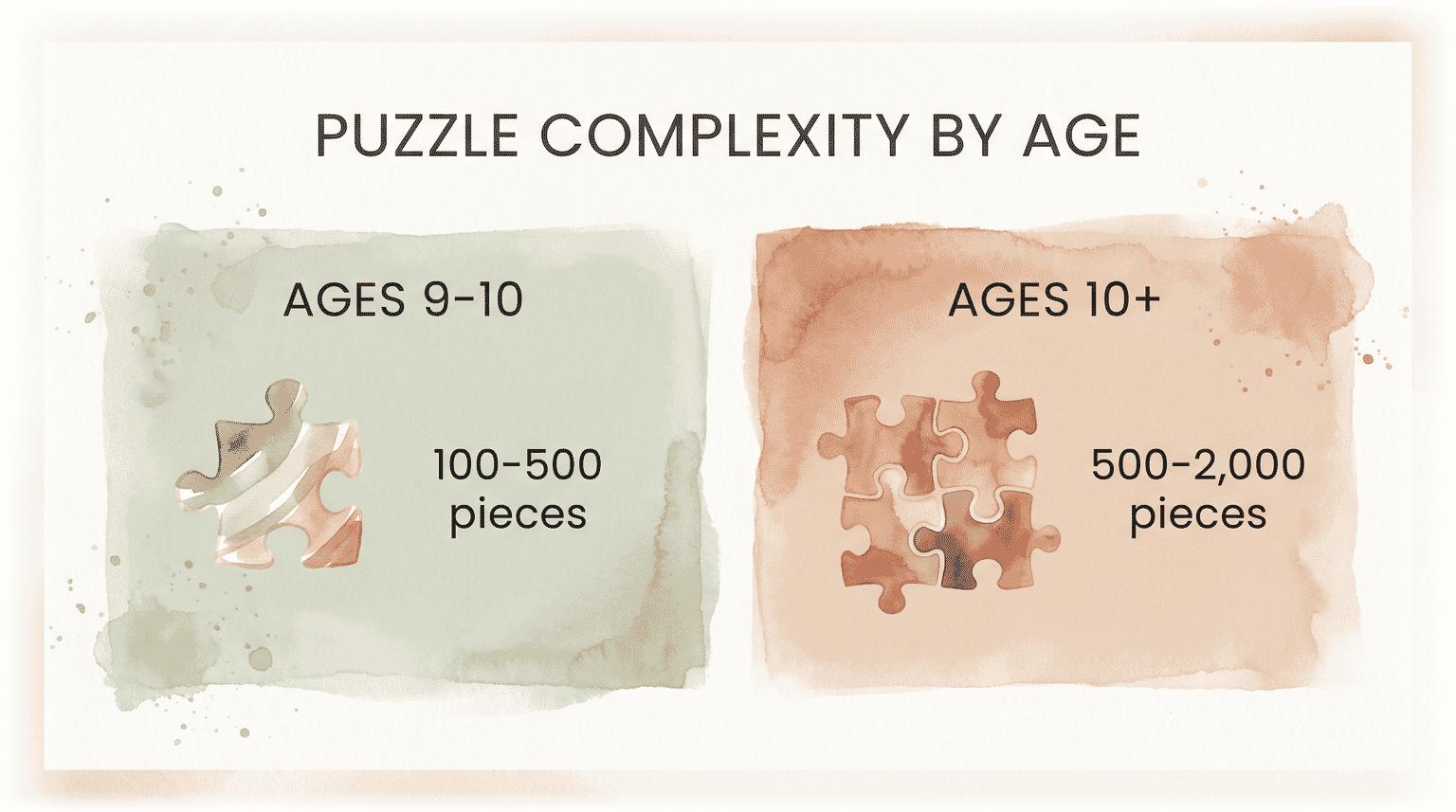
Seattle Children’s Hospital provides specific guidance: puzzle complexity can range from 100-500 pieces for ages 9-10, expanding to 500-2,000 pieces from age 10. They note children this age “can stick to rules and be OK with losing”—a genuine developmental achievement.
12+ Years: Abstract Thinking Emerges
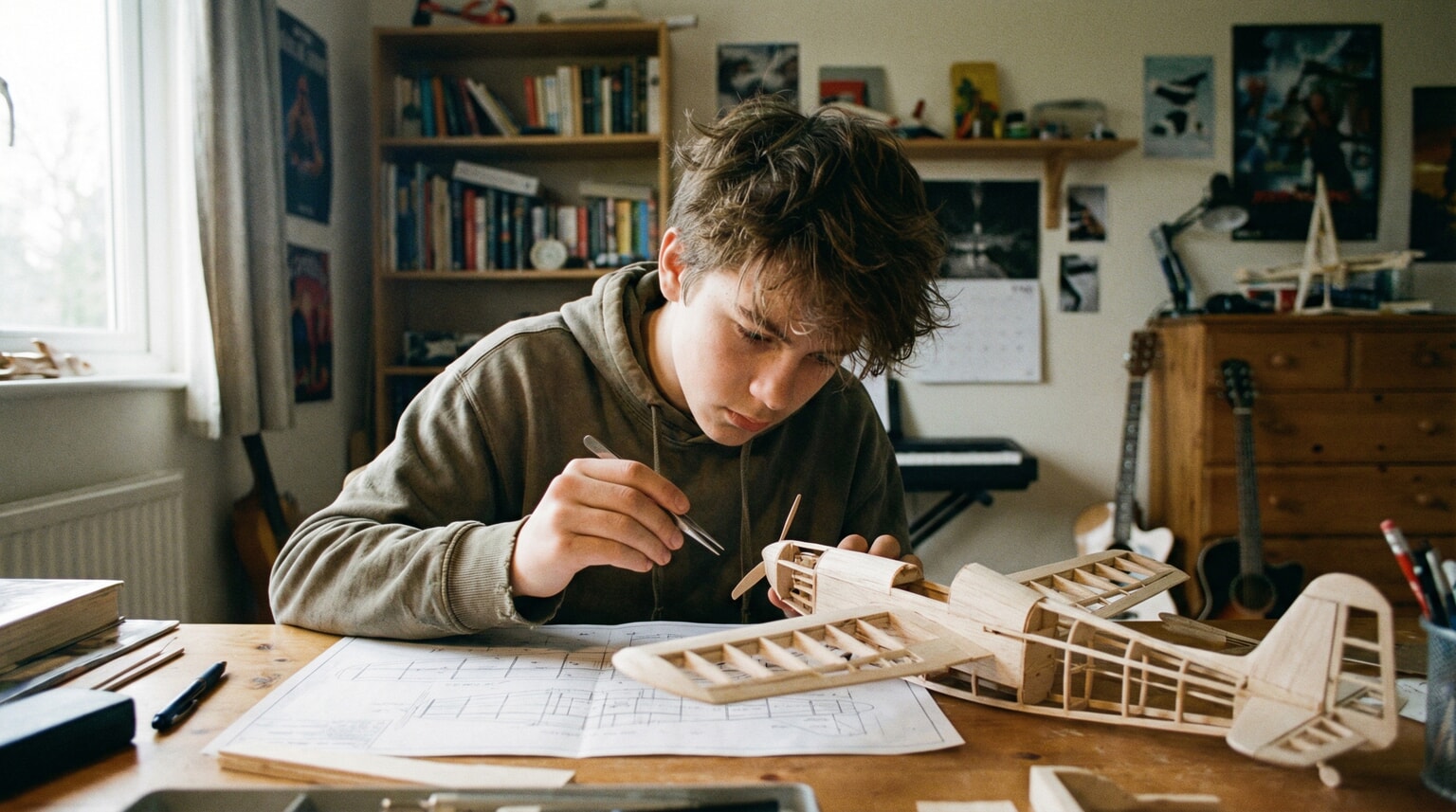
Formal operational thinking—the ability to reason about hypothetical situations—comes online in adolescence. My teenagers can now consider “what if” scenarios that would have confused them at 10.
The challenge? “Age compression”—a phenomenon the APA research documents where children abandon toys earlier than previous generations. My 12-year-old insists she’s “too old” for things she loved at 11. Navigating peer perceptions becomes part of gift-giving at this stage.
What to look for: Advanced strategy games, interest-specific depth (not breadth), creative tools for hobbies they’ve chosen themselves, experiences rather than objects, and sophisticated building/making kits.
Piaget’s framework reminds us that teens can handle abstract planning and hypothetical problem-solving. Video games requiring multi-step strategy based on hypothetical scenarios actually match their cognitive development—though content matters, obviously.
The Quality Gift Checklist
After tracking which gifts get played with for years versus which gather dust within weeks, here’s my evaluation framework:
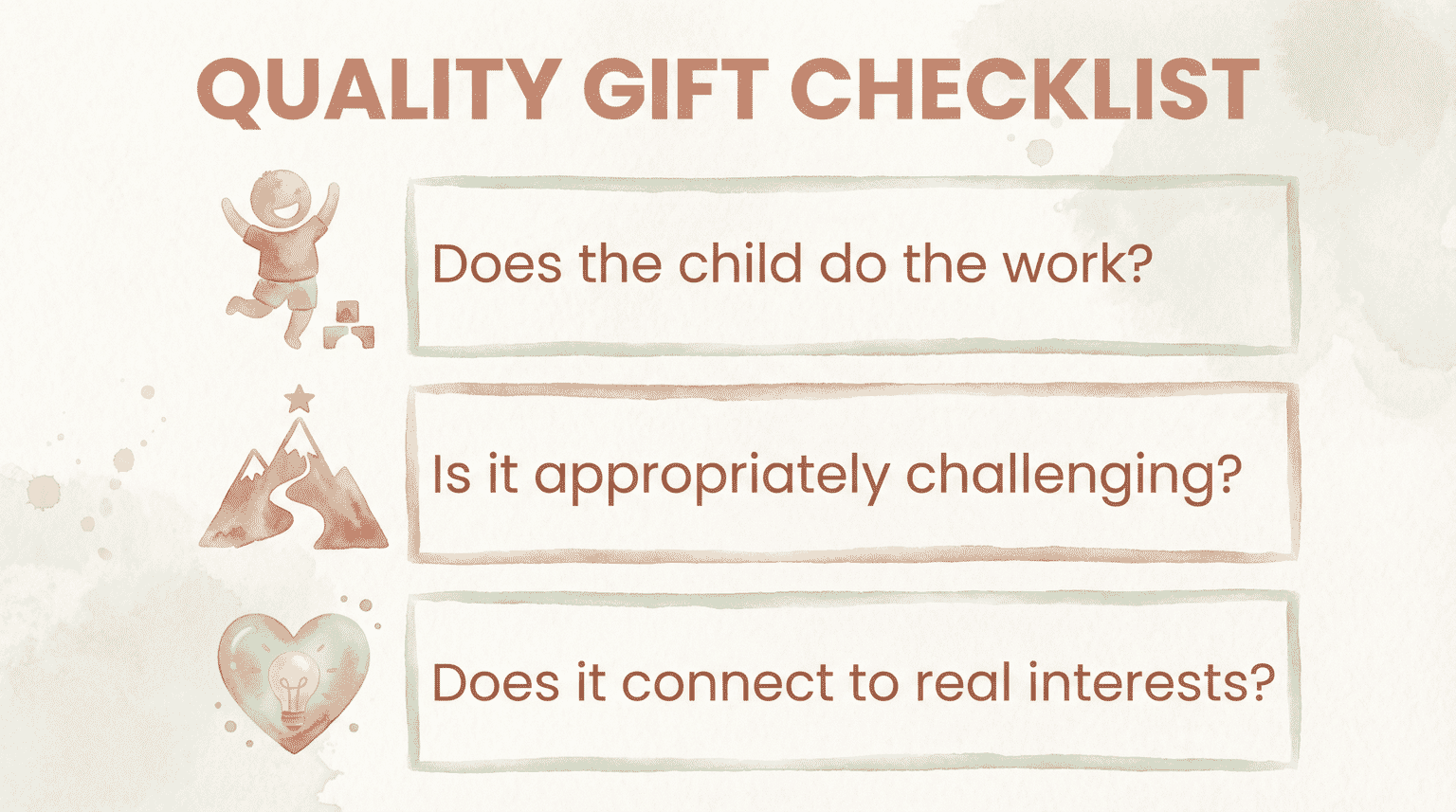
Does the child do the work? Dr. Bergen’s principle holds: toys that do everything themselves get boring fast. Dr. Kudrowitz adds that a good toy “could be used in a variety of different contexts and doesn’t die.” This is why fewer toys often lead to better play.
Is it appropriately challenging? The research on toy utilization found the most versatile categories across ages were small vehicles, imaginative play toys, and musical instruments. These scale with the child’s abilities rather than becoming obsolete.
Does it connect to real interests? That 55.8% preference for realistic toys among preschoolers reflects a broader truth: children engage more with things that connect to their actual experiences and genuine curiosity.
What to avoid:
- Single-function toys that can only be used one way
- “Educational” toys that prioritize drilling over play
- Toys significantly below current abilities (boring) or far above (frustrating)
- Items requiring so much adult involvement that the child isn’t really playing
Frequently Asked Questions
How do I choose age-appropriate gifts?
Start with the child’s current developmental abilities rather than the manufacturer’s age label—research shows 19% of labels don’t reflect developmental appropriateness. Focus on motor, cognitive, language, and social-emotional domains, and recognize that 75% of children can use toys designed for the next age group up.
What toys are good for child development?
Open-ended toys that require the child to do the work. Dr. Doris Bergen explains, “A really good toy is one that doesn’t do everything itself, but has the child do it.” The most versatile developmental toys—small vehicles, imaginative play props, and musical instruments—engage multiple skill areas and work across wide age ranges.
What toys should a 2-year-old play with?
Two-year-olds are developing symbolic play—the ability to use objects as representations. Research shows 55.8% of preschoolers prefer realistic toys over fantasy options, and 63.6% choose detailed toys over simpler versions. Provide realistic figures, detailed vehicles, and open-ended materials like blocks that connect to familiar experiences.
Are educational toys worth it?
Only if they’re genuinely playable. Dr. Barry Kudrowitz notes, “The primary purpose of a toy is play. If the primary purpose is to teach something, it may not be a very good toy.” Children learn best through engaged, self-directed play—not through content drilling disguised as toys.
When should kids start playing with LEGO?
Standard LEGO sets become appropriate around age 6-7 when concrete operational thinking emerges. Children can then follow multi-step instructions and understand spatial relationships systematically. Larger DUPLO blocks work well during the symbolic play years (2-5), with complexity increasing as thinking matures.
Join the Conversation
What gift totally bombed because it was wrong for the stage—or surprised you by clicking perfectly? I gave my 3-year-old a “big kid” LEGO set once (ambitious, I know). Learned that lesson fast. But some of my best gift wins came from ignoring the age on the box entirely.
I read every story—your stage wins and fails help other parents.
References
- PMC Study on Children’s Toy Utilization – Research on age-appropriateness and toy category flexibility
- Psychology in Russia: Toy Preferences Study – Research on preschoolers’ preferences for realistic and detailed toys
- Acta Psychologica: Object Play Development – Patterns in symbolic play emergence
- PMC Self-Regulation Study – Developmental timing of emotional regulation
- Room to Grow Intervention Study – Impact of books and toys on infant development
- Hospital for Special Surgery – Clinical guidance on developmental stages
- University of Utah Health – Pediatric recommendations by age
- Seattle Children’s Hospital – Guidance for 9-12 year olds
- APA Podcast: Psychology Takes Toys Seriously – Expert perspectives on toy quality
- Parents Magazine Guide – Age-specific recommendations
- Open-Ended Toys Research – Cognitive development and play materials

Share Your Thoughts